Here was the structure for an average episode of Rod Serling’s The Twilight Zone: a teaser, a first act introducing the viewers to the world’s rules (basically grounded in reality, but with at least one little aspect that toys with what we’ve come to understand about our world), a second act that ups the tension, and a reveal, usually in the form of a twist ending. It may sound like a complex framework, but the show always made it work very well, and it allowed for its 25-minute episodes to breeze by more often than not. But of the five seasons, only four of them really adhered to that structure.
Videos by ComicBook.com
The outlier was Season 4, which had 18 episodes all of them about 51 minutes in length. Now, it’s not to say they abandoned that structure entirely, it’s just that each part of said structure had enough padding on it to protect a matador. Did it work out? Well, it says a lot that none of its 18 episodes are even in the top 30 on IMDb.
Why Did CBS Make This Change, Why Did It Fail, & Did Season 4 Add Anything Important to the Series?
Let’s start with what The Twilight Zone Season 4 added to the show’s run. Mostly, its biggest contribution was being a cautionary tale as to why one should not mess with a successful formula. But this was also the season where the iconic intro was perfected. This was where we got the door (“You unlock this door with the key of imagination”), the smashed window that perfectly lines up with Serling’s delivery of the line “A dimension of sound,” the creepy opening eyeball, the hovering equation for Einstein’s theory of relativity, all of that started here. The intros prior to that just featured a big hypno spinner. Neat and fitting, but there’s little doubt Season 4’s is the intro fans think of for the series as a whole.
Even though its third season was fantastic, The Twilight Zone had been cancelled after that chunk of episodes had wrapped up. There were multiple reasons for this, including declining ratings, high production costs, and a seemingly untenable level of burnout on Serling’s end. Very understandable across the board. So, CBS replaced it with the first hour-long sitcom, Fair Exchange.
But then Fair Exchange did even worse than The Twilight Zone (though it did have its fans), so it was swiftly canned, and Zone was brought back in. Initially, the idea was to bring in Alfred Hitchcock Presents, which had also been expanded to an hour-long show and retitled The Alfred Hitchcock Hour, but it ended up being Serling’s show instead. However, as a mid-season replacement, there was an issue. There was now an hour slot to fill, not a half hour slot. So, even though he was growing burnt out creatively, Serling agreed to keep his baby alive.

However, while Hitchcock chose to make his show an hour long down the line, Serling was never fond of doing that with The Twilight Zone. In his words: “Outs is the perfect half-hour show…If we went to an hour, we’d have to fleshen our stories, soap opera style. Viewers could watch fifteen minutes without knowing whether they were in a Twilight Zone or Desilu Playhouse.”
There’s no episode of Season 4 that really plays smoothly. The closest it comes is in “On Thursday We Leave for Home,” which shows a space colony leader manipulating his followers into believing Earth is a dreadful place now that there’s a chance for rescue. The padding works there because we really get to understand the man who clings desperately to the only real power he’s ever had.
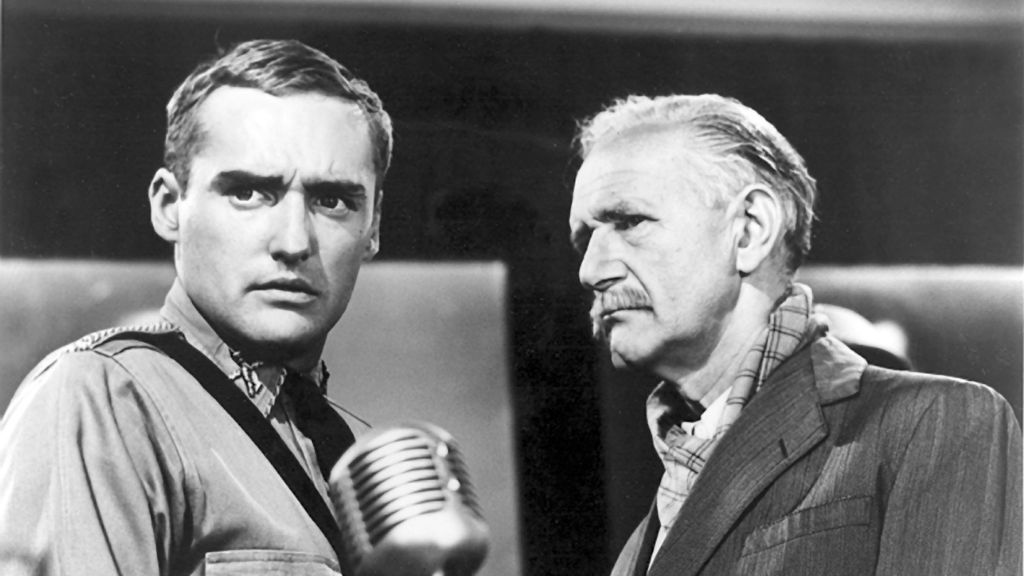
But the fact remains that there are no truly great episodes in this season. Instead, we get a lot of melodramatic, slow stuff like “The Bard,” “The Incredible World of Horace Ford,” “Jess-Belle,” and “Mute.” However, “He’s Alive,” which has the late, great Dennis Hopper as a young U.S. Nazi leader, is worth a watch.
The show would rebound in a major way in its fifth and final season, which returned to the half-hour format. It too was far from a perfect season, but it had “Nightmare at 20,000 Feet,” the horrifying “Living Doll,” “An Occurrence at Owl Creek Bridge,” “The Masks,” and “The Encounter.” Those are all-timers. But all good things must come to an end at some point, and with five seasons under its belt the time was finally up for Serling’s masterpiece. Though he wasn’t done because, five years after Zone wrapped up, we got the similarly impressive Night Gallery.
Most Viewed
-
Image courtesy of Tor Books/Macmillan -

Official art by Bastien Lecouffe-Deharme