The relationship between Rumi and Juni holds the key to redemption in KPop Demon Hunters, but it’s actually full of powerful symbolism. In one scene partway through the movie, Rumi and Juni meet on the ancient Naksan wall. Part of the Seoul city wall, it’s been developed into a major tourist attraction, and the area is noted for its romantic atmosphere; the Naksan wall has appeared in quite a few Korean romances, explaining why an ajumma mistakes Rumi and Juni for a couple on a romantic stroll.
Videos by ComicBook.com
But KPop Demon Hunters is deeper than that. Everything about this movie – from the Hunters’ weapons to the beautiful norigae the girls wear – is steeped in Korean mythology and lore. In fact, the meeting between Rumi and Juni represents their entire relationship, and the threat it poses. That’s because the Naksan wall has a long history behind it.
The Naksan Wall Protects the City from External Threats
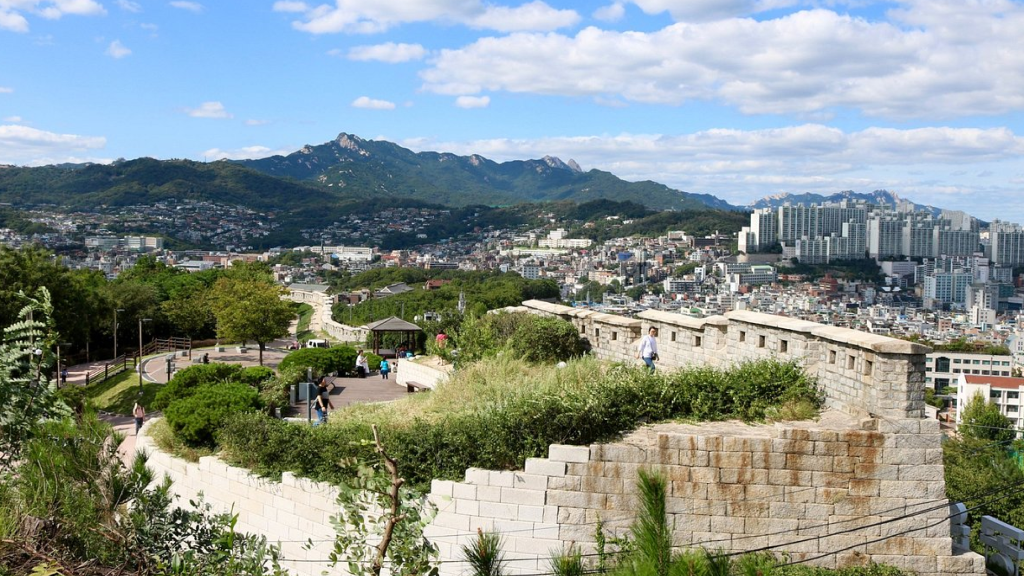
Seoul’s city wall is called Hanyangdoseong, and it was built during the early years of the Joseon Dynasty by King Taejo. He relocated the capital to Seoul (then called Hanyang), and ordered the construction of a fortified wall built along four mountain ridges. At its most basic, like any city wall, the Hanyangdoseong was built to protect the city from external threats. These walls were attacked many times over the centuries, whether in revolts or by invaders, and they were sometimes breached; they were always repaired, though, allowing Seoul to stand against invaders once again.
In KPop Demon Hunters, the Hanyangdoseong is standing as an image of the Honmoon itself – the mystical barrier that protects the land of the living from the demon world. Like Hanyangdoseong, the Honmoon has occasionally been breached, and it’s clear quite a few demons have managed to slip through; but the Hunters are the soldiers stationed on the wall, responsible for defending the land of life. It’s telling that Ruri is meeting Juni at the Naksan wall, close to a major watchtower where soldiers would keep lookout for invaders.
The Seoul City Wall Represented the Barrier Between Life and Death

But the symbolism goes even deeper than that. Significantly, the laws of Seoul required all burials to be carried out beyond the city walls, regardless of whether you were a king or a commoner. In practical terms, population density would have made it impossible to set aside burial grounds, and potentially unhygienic if water sources were contaminated. This also carried deep spiritual meaning, though, in that it meant the city walls represented the boundary between life and death. The parallels between the city walls and the Honmoon are even stronger than they seem at first glance.
Here’s the catch, though; KPop Demon Hunters draws on even older traditions of Korean shamans, whose responsibility was to maintain the boundary between the living and the dead. Shamans did this through several rituals, many of which involved music and dance, and the Hunters known as HUNTR/X are essentially the most recent incarnation of these ancient shamans. Rumi is performing her duties as a shaman when she meets Juni on the walls, but notice that she fails to take action; she is compromised, hesitant, and thus allows death’s incursion into the living to continue.
KPop Demon Hunters Hides a Fascinating Secret

Juni believed he was beyond redemption because of his choices. The song “Your Idol” reveals the secret of the Demon King Gwi-Ma‘s power in a single line; “I’m the only one who’ll love your sins.” The implication is that Gwi-Ma appeals to those who believe themselves lost in sin and sorrow, with no chance of redemption, and Gwi-Ma is forced to remind Juni of what he has truly done in the past – reminding him that, in a sense, he “deserves” to be in the place of death, existing as a demon.
But Juni is wrong, and Gwi-Ma is lying. In the end, Juni steps in to save Rumi from Gwi-Ma’s power; in doing so, he proves once and for all that he is defined not by what he has done in the past, but by what he has done now. What’s more, he is redeemed; we see him transform into a soul, the power of his redemption helping charge the Honmoon itself. The invader sent into the city to break down the wall actually helps to repair it, and in doing so, he proves there is still a chance of healing and wholeness for even the most fallen being.
What do you think? Leave a comment below and join the conversation now in the ComicBook Forum!
Most Viewed
-
Courtesy of David Production