Directed by and starring Mark Fischbach in his feature directorial debut, Iron Lung shattered industry expectations by earning over $21 million during its global opening weekend. Based on the 2022 video game by David Szymanski, the narrative places audiences in a suffocatingly small submarine navigating a moon of blood known as AT-5. In this nightmare scenario, a convict named Simon (Fischbach) is tasked with scavenging resources from the crimson depths long after a cataclysmic event called “The Quiet Rapture” erased every star and habitable planet from the universe. Iron Lung’s reliance on practical effects, including over 80,000 gallons of fake blood, creates a visceral sense of constant dread within the cramped, windowless hull of the vessel, offering audiences a unique take on cosmic horror that turned the movie into a commercial hit.
Videos by ComicBook.com
Cosmic horror is defined by the terror of the unknowable and the realization that humanity is insignificant in the face of indifferent forces or existential voids. These stories typically bypass standard slasher tropes to explore the psychological erosion that occurs when a character is confronted with forces that exist beyond human comprehension. In the case of Simon’s descent into the crimson depths, the horror stems from the silence of a dead universe and the suggestion that something massive and ancient still lurks in the dark. Now that Iron Lung has brought cosmic horror into the mainstream spotlight, it’s the perfect time to watch other films that have explored these horrifying boundaries of reality and the fragility of the human mind.
4) The Endless

The Endless is a sophisticated exploration of cult dynamics and Lovecraftian mythology that utilizes a low-budget aesthetic to build its immense sense of scale. The story follows two brothers, Justin (Justin Benson) and Aaron (Aaron Moorhead), who return to the communal group they fled years earlier after receiving a mysterious videotape in the mail. As they reintegrate into the camp, they discover that the group is not a standard doomsday cult, but rather a collection of people worshiping an unseen entity. This cosmic force remains entirely beyond human understanding, interacting with the characters through photographs and physical manifestations that suggest it views their lives as mere entertainment. The Endless avoids traditional jump scares, opting instead for a slow-burning realization that the universe contains predators that ignore the linear flow of time.

3) The Empty Man

Released in 2020, The Empty Man evolved from a misunderstood studio project into a definitive classic of the cosmic horror genre. The plot begins with a lengthy prologue set in 1995 Bhutan, where a group of hikers discovers a monstrous skeleton in a cave, before one of them enters into a bizarre stupor. The narrative then shifts to 2018, following a former police officer named James (James Badge Dale) as he investigates the disappearance of a neighbor’s daughter. His search leads him to the Pontifex Institute, a secretive organization that preaches a philosophy of nihilism and the “great binding nothingness” of the universe. Director David Prior utilizes the movie’s sprawling runtime and an oppressive atmosphere to examine how trauma and grief can hollow out an individual’s identity, leaving them susceptible to becoming a vessel for forces from the abyss. As the two storylines connect, The Empty Man argues that belief itself can function as a biological virus, capable of conjuring thoughts into physical reality through collective focus.
2) Annihilation
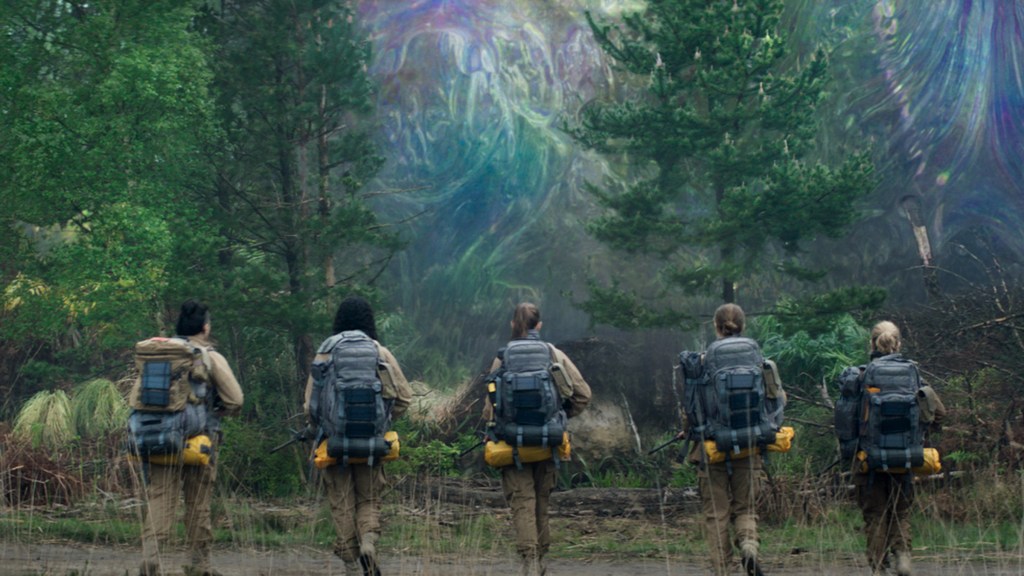
Alex Garland’s Annihilation serves as a vibrant and terrifying meditation on self-destruction and biological transformation. The film follows a biologist named Lena (Natalie Portman) who joins a specialized team of scientists entering “The Shimmer,” a quarantined zone created by a meteorite impact, where the laws of nature have been rewritten. Inside this zone, an alien presence functions like a cosmic prism, refracting the DNA of every living organism and forcing them to merge into horrifying new forms. Unlike many horror films that depict an invading force as a hostile military entity, Annihilation presents its antagonist as an indifferent biological phenomenon that seeks to change everything it touches without malice. The final confrontation emphasizes the total incomprehensibility of the extraterrestrial presence, leaving the audience to question the humanity of the survivors.
1) Event Horizon

Event Horizon remains the gold standard for space-based cosmic horror, blending high-concept physics with a visceral depiction of supernatural chaos. Set in 2047, the narrative follows a rescue crew led by Captain Miller (Laurence Fishburne) as they board the Event Horizon, a vessel that spontaneously reappears after disappearing seven years earlier. The ship’s creator, Dr. William Weir (Sam Neill), reveals that the vessel utilized an experimental gravity drive to fold space-time, intended to bridge the distance between stars. However, the drive opened a gateway to a different dimension, and the ship returned as a malevolent entity that feeds on the guilt and trauma of those who board it. Event Horizon excels as cosmic horror by treating space not just as a cold vacuum, but as a doorway to a realm of suffering that human evolution never prepared the mind to witness.
Which cosmic horror film would you recommend to fans of Iron Lung? Leave a comment below and join the conversation now in the ComicBook Forum!
Most Viewed
-

Image courtesy of Tor Books/Macmillan -

Official art by Bastien Lecouffe-Deharme