In Star Trek, the best stories are still the ones that go where no others have gone. Within the vast universe Gene Roddenberry birthed back in 1964, these narratives push the themes and ideals of Trek to their furthest corners. They contain new worlds, new friends, and new enemies, all of which fundamentally alter the characters who face them and define the franchise as a whole.
Videos by ComicBook.com
Across hundreds of episodes, Star Trek has told us many such tales. But which stories truly stand above the rest? The list that follows was formed to include the very best of what Star Trek has to offer. Whether it was Captain Kirk, Picard, or Sisko at the helm, these episodes are the reason Trek has endured from one generation to the next.
10) “Darmok” The Next Generation

In The Next Generation Season 5, the Enterprise meets the Tamarians, who communicate through metaphor. But when Captain Dathon transports he and Picard to a planet, they have to cooperate against a dangerous creature. Picard struggles to understand Dathon’s references, such as “Darmok and Jalad at Tanagra.” Through working together, he learns Tamarian communication, but not before Dathon is mortally wounded and sacrifices himself to prevent war between the Federation and Tamarians.
Written by Joe Menosky, this ep is the best example of Trek tackling one of its favorite topics: communication barriers. The Tamarians desire to establish relations, but their language makes it nearly impossible. “Darmok” does a great job of showing the effort and patience needed from both Picard and Dathon to understand one another. Not to mention, Paul Winfield delivers an amazing performance as Dathon.
9) “Balance of Terror” The Original Series
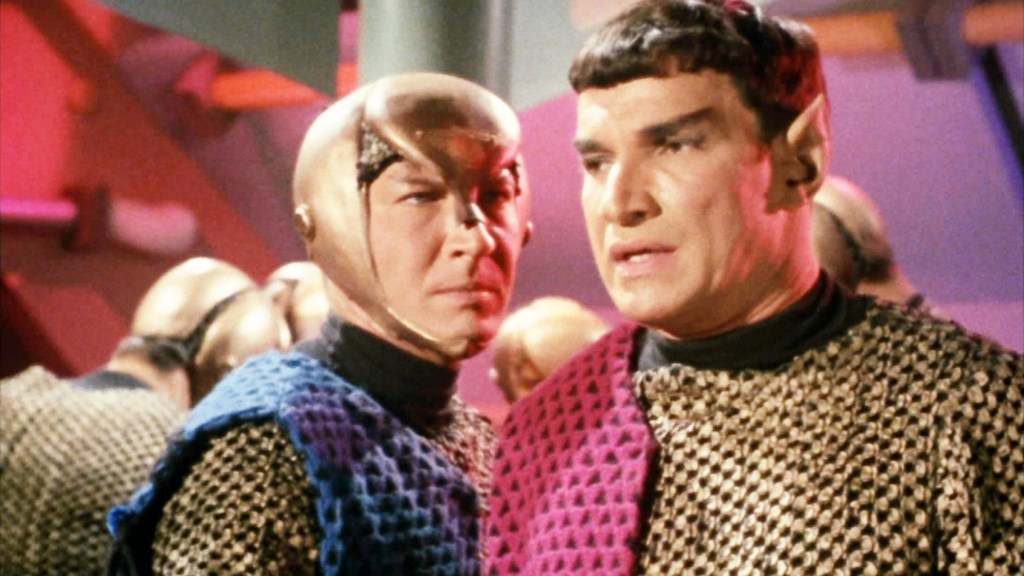
This fan-favorite Original Series episode features the Enterprise responding to attacks on Federation outposts along the Romulan Neutral Zone. When they discover a Bird-of-Prey with a cloaking device is responsible, the episode becomes a chess match between Kirk and the Romulan Commander. When the crew discovers Romulans look like Vulcans, tension rises around Spock. Meanwhile, Kirk has to stop the Romulan ship from revealing the Zone’s weakness to the Romulan Empire.
This first-season episode, penned by Paul Schneider, is widely known as the series’ best suspense episode. It introduces us to the Romulans and the idea of a cloaking device, both Trek staples. The Romulan Commander (Mark Lenard, who later played Spock’s father, Sarek) is also Trek’s first honorable enemy, and mutual respect bubbles between him and Kirk. The episode’s cat-and-mouse structure influenced all subsequent submarine-style episodes. But maybe most important is how “Balance of Terror” directly explored the theme of prejudice through the crew’s treatment of Spock.
8) “Measure of a Man” The Next Generation
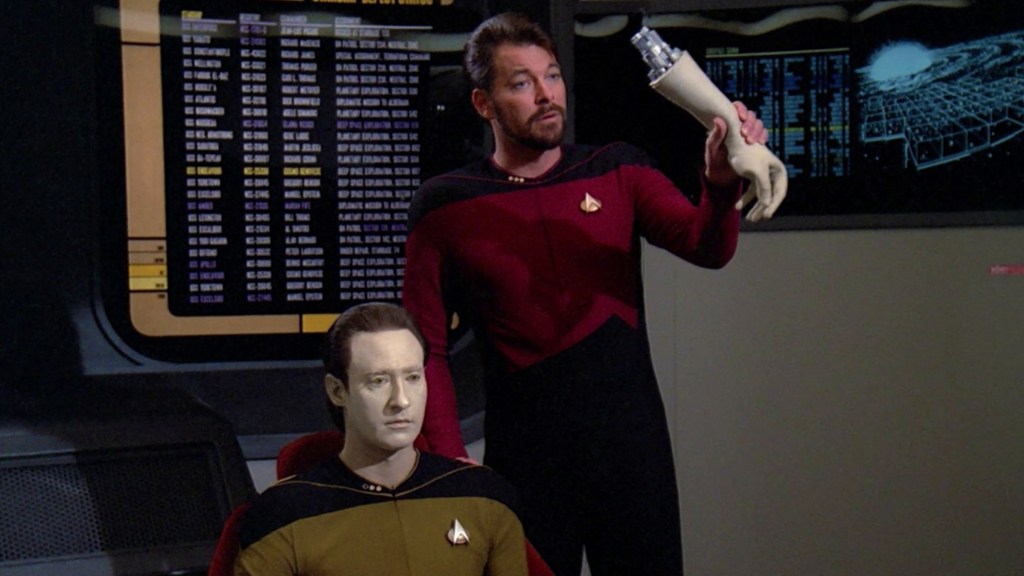
In TNG’s courtroom drama “Measure of a Man,” Starfleet cybernetics expert Commander Maddox wants to disassemble Data to understand his positronic brain and pump out more androids. When Data refuses and his resignation is denied, Picard challenges the ruling in a hearing. Riker is forced to prosecute against Data, arguing that he’s Starfleet property. Picard is then tasked with proving that Data is a sentient being with the right to choose his own fate.
The thought-provoking story explores many big sci-fi questions about consciousness and sentience in AI. Jonathan Frakes and Patrick Stewart deliver powerful performances in thier prosecution and defense, respectively. Judge Advocate General Phillipa Louvois (Amanda McBroom) adds tension by seeming genuinely uncertain. The episode also established Data’s legal personhood and remains relevant today, both in regard to Trek and the real future of AI. When Whoopi Goldberg’s Guinan provides the key insight that helps Picard win his case, it’s just the icing on the cake.
7) “The Visitor” Deep Space Nine
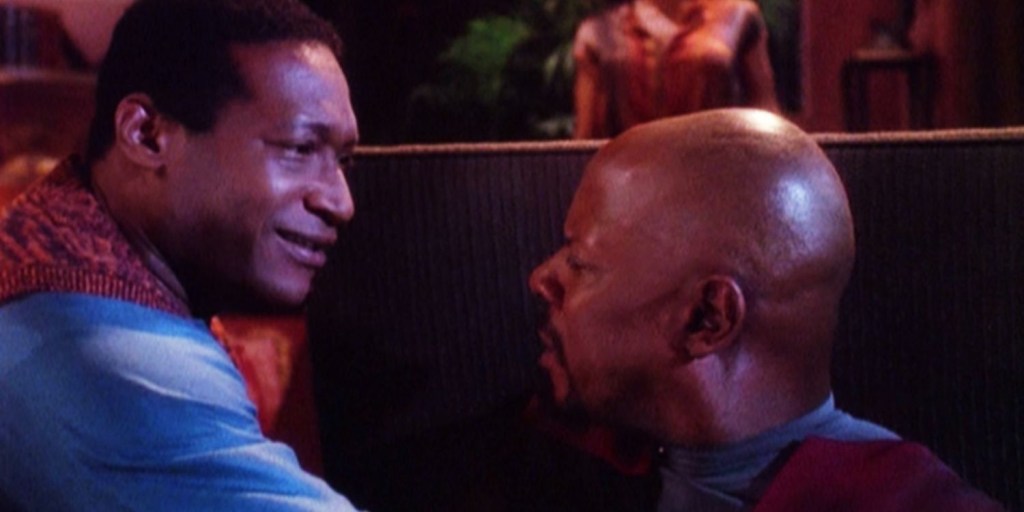
Written by Michael Taylor, Deep Space Nine favorite, “The Visitor” features an elderly Jake Sisko, who explains to a young writer how his life was defined by his father’s (apparent) death. During a warp core accident, Captain Sisko was caught in a subspace inversion, and Jake spent decades trying to bring him back. The episode reveals Jake’s final plan: to commit suicide at the moment of the next temporal overlap, freeing his father from the inversion and preventing the accident.
This fourth-season stunner focuses almost entirely on the relationship between Benjamin Sisko and his son Jake, with brief appearances by Dax and Bashir. Tony Todd delivers a tour de force performance as elderly Jake as he sacrifices everything, including his marriage, career, and life, for his father. By far one of Trek’s most emotional family stories, “The Visitor” is what fans are referring to when they talk about excellent character studies in DS9. It’s consistently rated among Trek’s most moving episodes, capable of conjuring tears and reportedly affecting even those less familiar with Trek as a whole.
6) “The Devil in the Dark” The Original Series
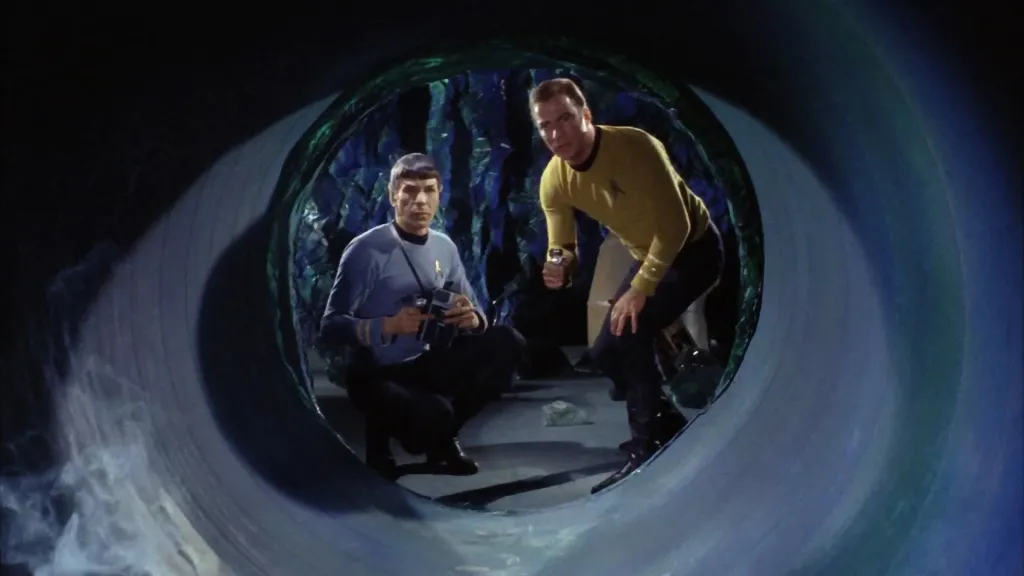
In another Season 1 all-timer from TOS, Miners on Janus VI are being killed by an unknown creature. When Kirk and Spock discover a silicon-based lifeform called a Horta, Spock performs a mind meld and learns the Horta is a mother protecting her eggs, which the miners have been destroying, thinking they were silicon nodules. In true Kirk fashion, the Captain negotiates a peace deal wherein the Horta will tunnel for the miners, who will protect her offspring.
Written by Gene L. Coon, “The Devil in the Dark” is famously William Shatner’s personal favorite from the original series. It also features the first notable use of McCoy’s catchphrase “I’m a doctor, not a…” (in this case, “bricklayer”). But it’s really a favorite because it’s a perfect encapsulation of Trek’s core philosophy. We’re shown what we initially assume to be an evil monster, only to learn it’s an intelligent being with relatable motives. The theme that understanding serves everyone better than violence is simply quintessential Star Trek.
5) “Yesterday’s Enterprise” The Next Generation
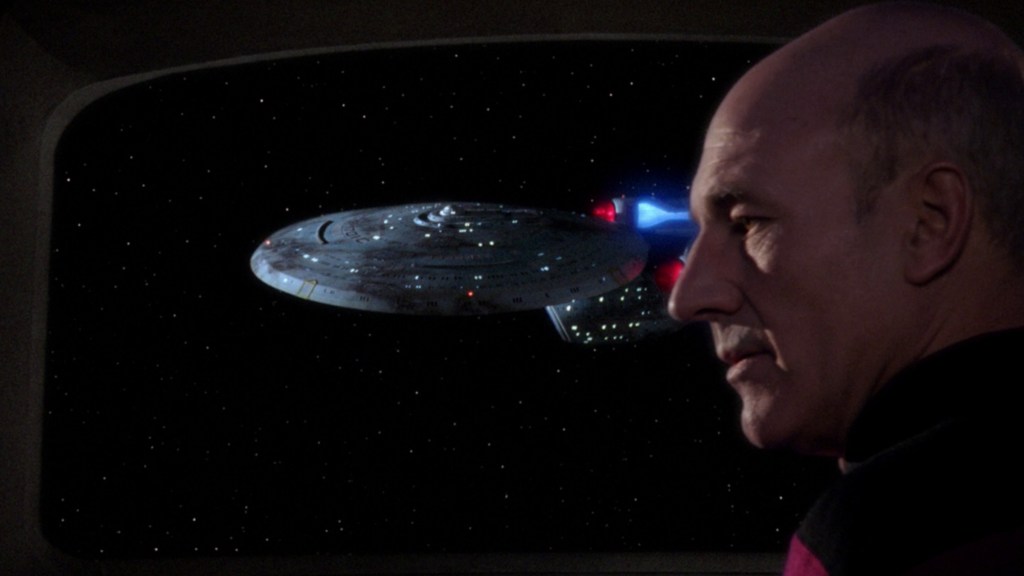
When the Enterprise-C emerges from a temporal rift 22 years in its future, it creates an alternate timeline where the Federation is losing a prolonged war with the Klingons, and Guinan senses something is wrong. Then the crew discovers that in the original timeline, the Enterprise-C was destroyed defending a Klingon outpost from Romulans, which led to the Federation-Klingon alliance. To restore history, the Enterprise-C and its crew (including alt timeline’s tactical officer Tasha Yar) must return through the rift to their deaths.
This Season 3 turning point is one of TNG‘s darkest episodes, showing a Federation on the brink of defeat. The alternate timeline is grittier and more militaristic, with the Enterprise-D as a battleship. The episode brought back Denise Crosby as Yar to give her character the meaningful death she deserved. Guinan’s doing her thing as the timeline’s conscience is a high point. Squeaking into the top 5, “Yesterday’s Enterprise” tells a bold and existential story that doesn’t shy away from showing us a genuinely different Trek universe or the crew’s acceptance of their own erasure.
4) “In the Pale Moonlight” Deep Space Nine

DS9’s best story begins with Federation losses mounting in the Dominion War, and Sisko deciding the Romulans must enter the conflict. He enlists Garak’s help to find evidence of Dominion plans to invade Romulus, but when Garak’s Cardassian contacts are killed, he proposes forging evidence. Sisko obtains an illegal biomimetic gel, bribes Quark, and secures the release of forger Grathon Tolar from Klingon prison. After Romulan Senator Vreenak exposes the sham, Garak reveals he planted a bomb on Vreenak’s shuttle. Ultimately, the Romulans declare war.
Written by Taylor, with an uncredited rewrite by Ronald D. Moore, this Season 6 episode employs a unique confessional structure with Sisko recording (and ultimately deleting) a personal log. “In the Pale Moonlight” is particularly loaded and morally complex, depicting the Starfleet captain crossing many ethical lines, including condoning forgery, bribery, and becoming an accessory to murder, all for the greater good. Avery Brooks and Andrew Robinson deliver career and show-defining performances. Widely considered DS9’s top episode, it challenges Trek’s typical moral certainty by showing us exactly how and why our beloved heroes come to compromise their principles.
3) “The Best of Both Worlds” Parts I & II, The Next Generation

A beloved two-parter which includes TNG’s Season 3 finale and Season 4 premiere, “The Best of Both Worlds” sees The Borg return to assimilate Earth. The Enterprise encounters a Borg cube that demands Picard’s surrender, but during the confrontation, Picard is captured and transformed into Locutus of Borg, the species spokesperson. Part I ends with Riker ordering the Enterprise to fire on the cube with Picard aboard. Part II then shows us Riker promoted to captain, working with new first officer Shelby to rescue Picard. The Borg destroy a Federation fleet at Wolf 359. Data ultimately accesses Locutus to put the Borg to sleep.
“The Best of Both Worlds” contains Star Trek’s best cliffhanger by far. Part I was even filmed without knowing how it would end due to contract negotiations with Patrick Stewart. The two-parter was also a major turning point for the series, officially converting many TOS purists into TNG fans. “I am Locutus of Borg. Resistance is futile,” became perhaps TV’s most iconic villain introduction. A hit with fans and critics, the episode earned Emmy nominations for Art Direction and Sound Editing. The story itself had significant implications for the canon as well, with the assimilation of Picard explored more in First Contact and Star Trek: Picard, and the Battle of Wolf 359 affecting DS9’s entire narrative.
2) “The City on the Edge of Forever” The Original Series
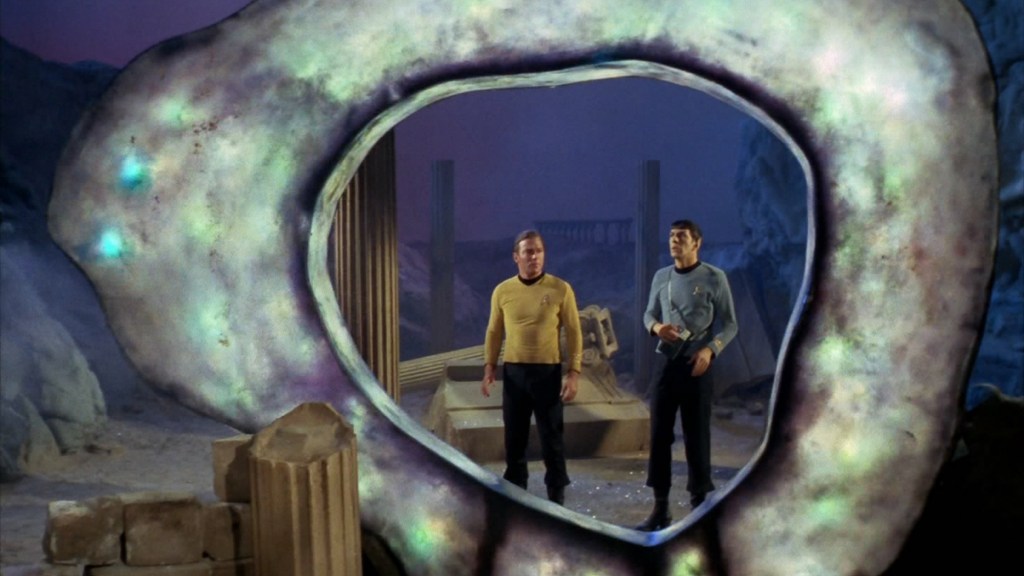
After accidentally ODing on Cordrazine, McCoy flees through a time portal called the Guardian of Forever to 1930s New York, erasing the Enterprise from history. Kirk and Spock follow, meeting social worker Edith Keeler (Joan Collins), who runs a soup kitchen, and Kirk falls in love with her. Spock discovers McCoy will save Keeler from a traffic accident, but her survival delays America’s entry into WWII, allowing Nazi Germany to develop atomic weapons first. The tragedy is that Kirk must let Keeler die to restore the timeline.
Written by science fiction author Harlan Ellison, though substantially rewritten by Gene Roddenberry, this TOS first-season classic was one of the most expensive Original Series episodes ever, at $245,316. Because director Joseph Pevney treated it like a feature film, “The City on the Edge of Forever” carries a distinct weight and high production value unmatched across the rest of the series. William Shatner named it another of his favorite TOS episodes, and it still inspires new Trek today as the gold standard for lofty sci-fi concepts, coming with impossible choices. The decision Kirk is forced to make between his own love and the survival of billions is, in many fans’ eyes, the franchise’s most emotional plot point.
1) “The Inner Light” The Next Generation

The best Trek story of all time has to go to TNG’s “The Inner Light.” In this self-contained masterpiece, an alien probe knocks Picard unconscious, and he experiences 40 years living as Kamin, an iron weaver on the planet Kataan. He marries Eline, has children, grows old, and learns the planet is dying from its sun’s expansion. Turns out the probe was a time capsule designed to preserve the memory of the extinct civilization. When Picard awakens, only 25 minutes later, he keeps the Ressikan flute from his other lifetime.
Famously, Patrick Stewart’s top pick, “The Inner Light,” actually won the Hugo Award for Best Dramatic Presentation in 1993. Written by Morgan Gendel and Peter Allan Fields, the Season 5 episode is a brilliant display of the intricate inner and outer worlds that Star Trek does so well. If you polled Trekkies, you’d likely see “The Inner Light” come out as the number one favorite episode in the franchise. The prop flute was even auctioned for nearly $200k. Beyond ticking all the Trek boxes of mortality, family, and time itself, the episode fundamentally changed the character of Captain Picard, making him more open to connections later in the series, and helping to develop him into one of Trek’s most fascinating characters.
What Trek story would you add to the list? Leave a comment below and join the conversation now in the ComicBook Forum!
More TV Shows
-
Image Courtesy of Marvel -

Image Courtesy of DC Studios