WARNING! This article contains spoilers for Hazbin Hotel Season 2, Episode 7.
Videos by ComicBook.com
The animated musical series Hazbin Hotel is no stranger to dark themes, even darker humor, and intricate character backstories. While much of the fandom’s attention is usually on Charlie Morningstar and the residents of her hotel, Season 2 gave viewers a deeper dive into the lore surrounding the Vees, particularly Vox, revealing a chilling connection to real-world history. What if the show subtly hints that the Media Overlord, once known during his human life as Vincent Whittman, played a hand in the formation of one of the most infamous cults in American history: the Branch Davidians? This theory isn’t just based on unfounded speculation, but the details from Vox himself, and draws compelling parallels between his established past, his motivations, and the origins of the notorious Waco, Texas group, adding a disturbing layer to Vox’s misdeeds.
The breadcrumbs are there, woven into seemingly throwaway lines and visuals, waiting to be pieced together into an even more sinister backstory for the former murderous TV personality.
Vox’s Human Past and His Ambition Echo a Doomed Prophecy
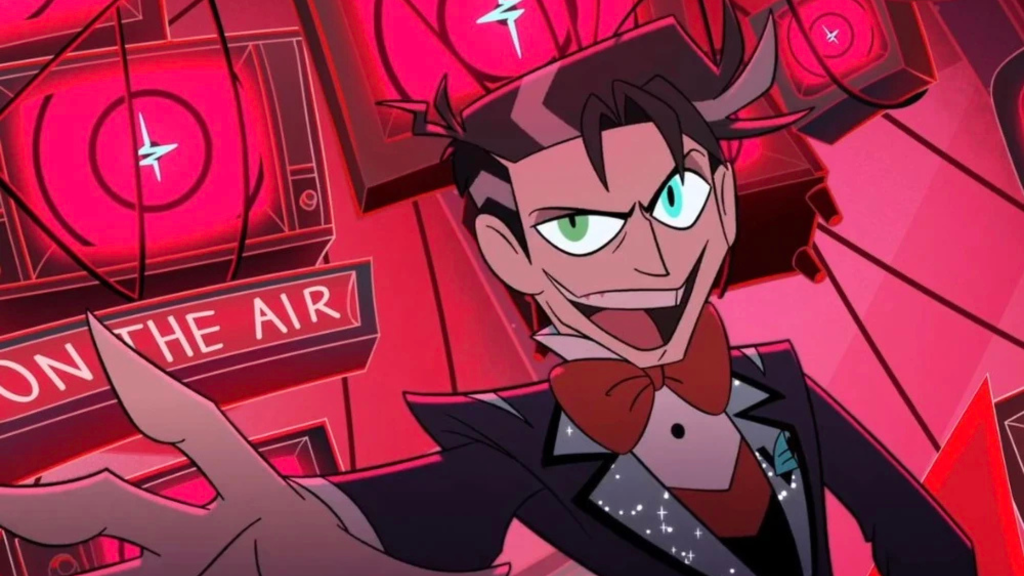
In Season 2, Episode 1, “New Pentious,” while in a meeting with his fellow Vees—Velvette and Valentino—Vox fondly reminisces about his time as a cult leader, longing to recapture that sense of absolute power over a devoted following in Hell. This offhand remark makes perfect sense narratively for someone as power-hungry and manipulative as Vox, but it is mentioned only that once. However, Episode 7, “Weapon of Mass Distraction,” pulls back the curtain on Vox’s human life as Vincent Whittman. Active in the 1950s, Whittman was a ruthless television personality with (quite literal) deadly ambition who started his career as a weatherman and clawed his way to the top, becoming a Johnny Carson-esque talk show host through manipulation and murder.
With Vox’s previous mention of being a cult leader, the timing here is crucial: the Branch Davidians, a religious movement that gained international notoriety for the tragic Waco siege in 1993, originated in 1955 as an offshoot of the Seventh-day Adventist Church. While David Koresh, the cult’s most famous leader, wouldn’t become the leader until decades later, the early stages of the movement align perfectly with Vox’s earthly timeline and god complex.

The parallels between Vox and Koresh, despite the decades that separate their earthly existences, are striking. Koresh presented himself as a prophet, a divine messenger chosen by God to interpret biblical prophecy. Vox, in his demonic form, constantly brands himself as a god—Vox Populi, the “voice” of the people—demanding worship and absolute loyalty. His obsession with ultimate power that breaks out of the confines of Hell and extends to taking over Heaven itself aligns eerily with the Branch Davidians’ devout belief in their leader’s direct communion with God and salvation through him. Background visuals of Vox also frequently depict him dressed in religious robes, such as a priest or even the Pope, accompanied by slogans like “Worship Me,” furthering his delusions of grandeur and messianic complex.
Significantly, the 1950s also marked the beginning of the televangelism phenomenon, as television sets became affordable to the masses and not just the wealthy, replacing radio as the main medium for consumption and entertainment. This historical context adds an intriguing complementary layer to Vox’s past as a cult leader. Given his connection to television broadcasting and his ability to hypnotise audiences through his transmissions in Hell, it’s entirely plausible that Vox, as Vincent Whittman on Earth, capitalised on this evolving media landscape to build his following. He could have exploited the trust placed in early television personalities and religious figures to sow the seeds of a cult, using his broadcasts to spread his ideology and gather obsessed followers. Vox’s keen ability to manipulate media mirrors how self-proclaimed religious leaders capitalised on visual media to reach the masses, establishing powerful, often cult-like followings.
Alastor’s Revelation Uncovers a Deeper Conspiracy

The theory that Vox (or Vincent) played a part in founding one of the most infamous cults in history also casts a new light on a seemingly throwaway line from the Season 1 song “Stayed Gone.” When Alastor, the Radio Demon, recounts the reason for his fallout with Vox, he explains, “[Vox] asked me to join his team. I said no, and now he’s pissy—that’s the tea.” While often interpreted as a simple rivalry between equally powerful forms of media and manipulation, this line takes on a far more sinister implication if Vox was indeed a cult leader in his human life.
Vox wasn’t just attempting to merge radio and television for mere entertainment or profit; he was seeking to combine the powerful reach of both mediums for a more devious, cultish purpose. In fact, a less experienced Vox proposes that exact merger with Alastor in a flashback in Season 2, Episode 2, but Alastor humiliates Vox at the mere suggestion of partnership, leading to their rivalry. Still, Vox’s intent with his proposal was clear: imagine the sheer manipulative power of a cult leader who could control the airwaves and television, influencing the sinners of Hell on an unprecedented scale.
If Vox was building a cult during his lifetime, his attempt to partner with Alastor, the literal Radio Overlord, could have been more than a naive proposal from a young demon trying to impress the most powerful sinner in Hell, but a strategic effort to make a power grab at media control to continue to spread his doctrine and expand his sway over potential followers. Alastor’s refusal, then, wasn’t just a rejection of a business proposal and a cruel way to humiliate/humble Vox, but a rejection of involving himself in a dangerous ideological undertaking with someone as unpredictable and power hungry as Vox. The “pissy” reaction from Vox wasn’t just about a missed opportunity for a partnership; it was the frustration of a megalomaniac whose grand plan for mass psychological domination was ruined in a split second with Alastor’s ridiculing cackle.
The notion that Vox, as Vincent Whittman, might have been instrumental in the early stages of the Branch Davidians’ movement adds a chilling dimension to his already villainous character. It ties Vincent’s Earthly lust for power and his ability to manipulate with ease through charm directly to a real-world tragedy with eerily similar undertones, showcasing how Vincent’s ambition could have left a trail of devastation even before his descent into Hell. The subtle hints and chronological overlaps between historical events and Hazbin Hotel canon suggest a deeper, more disturbing backstory for Vox, painting him not just as a technology-obsessed Overlord, but as a figure whose earthly misdeeds helped lay the groundwork for a historical cult that resulted in tragedy. It’s a testament to creator Vivienne Medrano’s intricate storytelling that such a dark and complex real-world history could be woven into the fabric of its vibrant, hellish world.
What do you think? Leave a comment below and join the conversation now in the ComicBook Forum!
Most Viewed
-

Image courtesy of Netflix -

Image courtesy of Bethesda -

Image courtesy of Nintendo