
Every art form has works that considered to be great. They’re works that changed their medium, had major cultural impact, were masters of the craft or, in some cases, are considered to be all of that and more. This includes comics. There are some comics that people view as being some of the best of the best, landmarks of the medium that have had long influence over everything that came after them and usually at the top of that list is Watchmen. From writer Alan Moore, artist Dave Gibbons, and colorist John Higgins, the limited series was published over twelve issues between 1986 and 1987 before being collected in a single volume in 1987 and its story, serving as satirization of the superhero concept, has made Watchmen not only one of the most influential comics ever written but one of the best works of literature as well but now, as the story celebrates its 40th anniversary, I’m not so sure it’s the masterpiece we’ve made it out to be.
Videos by ComicBook.com
There is no question that Watchmen is a good comic. It’s well-written and makes excellent use of various aspects of comic book storytelling. The book’s use of the nine-panel grid and the use of images that mirror others, repeated symbols — Watchmen is technically impressive. But Watchmen has its issues as well. The book is dense, slow, has some problematic elements, and ultimately operates best as a time capsule of sorts, one with a highly inflated and wildly misinterpreted legacy.

Watchmen Is a Portrait of It’s Time — And We Refuse to Look Beyond That

The biggest thing about Watchmen that contributes to the idea that the story is overrated today is how much of a product of its time it really is. A major part of Watchmen is how its story not only deconstructs the concept of heroes but leans into that as a form of political and social commentary about the anxieties of the time in which it was produced. In the 1980s, the United States is still firmly in the Cold War era and the anxieties that come along with that. At the time there were still major fears about nuclear annihilation, but also real concerns about political corruption that lead to distrust of the government, and a shift in society’s moral norms. This was the “Decade of Greed” as some called it, with rising conservatism and a sort of ends justifying means ethos. Remember, this was a time where the “good guys” were turning out to be deeply flawed (think the whole Iran-Contra scandal.
This sort of bleak social and political environment is what Watchmen leans into, just through a superheroic lens. Major events in the real world that shaped the landscape such as the Watergate scandal and the outcome of the Vietnam War were altered in Moore’s story to create a reality just off from ours but one that dialed up the flaws. World War III is growing every closer, the “heroes” have been sidelined and everything comes with a heavy dose of cynicism. It’s incredibly fitting for the era.
And if we framed Watchmen as being a product of and a commentary on its own time, it absolutely holds up. However, four decades later we’re still elevating this book as though it’s the final word on superheroes without understanding that the world Watchmen was created in and within which it functions no longer actually exists. Watchmen presents itself as unending darkness, but in the real-world society has shifted and changed several times over since the late 1980s. The 1990s, in particular, saw major social and moral shifts and we’re seeing shifts again even now. The exploration of anxieties, culture, and even our heroes today is much different. Books like The Power Fantasy are doing exactly that, using a similarly critical lens but doing so relevant to the here and now but instead of holding what that very well-crafted book is doing up in the same light, we continue to elevate Watchmen as a gold standard. It’s like continuing to cling to the analog landline telephone as the pinnacle of communication technology when we live in a world where we can make video calls from tiny computers we put in our pockets.
We Continue to Take the Wrong Lessons From Watchmen
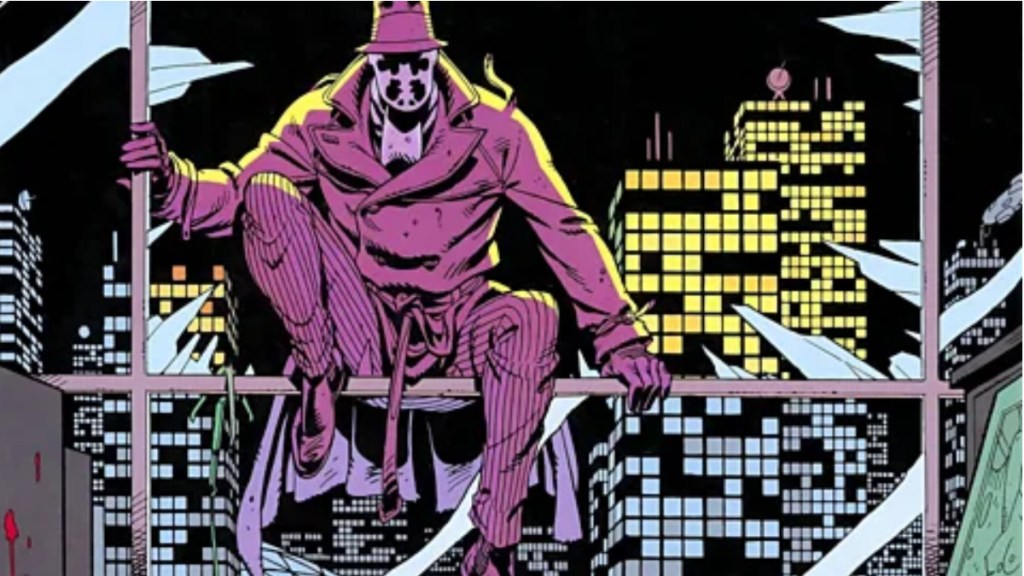
The biggest issue with Watchmen on the whole, however, is less about the book itself and more with its influence. To put it bluntly, we took away the wrong lessons. Because Watchmen was, at the time, so different and so commercially successful, it opened the floodgates for similar stories. Comics began to take a turn towards dark and gritty, which in turn led to a comics landscape that simply sought to replicate what Watchmen had done. We start to see heroes who are terrible (or just morally ambiguous) people being the norm as though capitalizing on a lucrative trend.
Fundamentally, there isn’t anything wrong with that. Heroes should never be looked at without some nuance and critique. After all, the heroes in comics (and indeed the real world) are usually just people themselves and people are multi-dimensional and flawed. Examining those flaws is important, both to telling larger stories as well as to understanding the role of these sorts of stories play in our cultural canon. However, many of the stories that came after Watchmen weren’t necessarily taking dark turns for examination’s sake. They were doing it to try to replicate the shock value and commercial success that Watchmen had. It’s not the same thing.
Outside of that, however, we’ve also taken a lesson from Watchmen that was never actually in the book or even about the book itself and that is the idea that nothing can live up to the standard it set. Even if Watchmen was truly timeless, there are still other books that do much of what it did just as well and continue to push comics forward in new and complex ways. We’ve already mentioned The Power Fantasy at being a close contemporary “take” on some of Watchmen’s concepts, but there are other titles as well, including Free Planet, Truth: Red, White, and Black, Astro City, and even Green Arrow: The Longbow Hunters (which came out in the same era as Watchmen). All of the stories approach comic book heroes from a more critical lens and contain differing levels of darkness, but they also take their own approaches to deconstruction of comics concepts and superheroes. They all do it well in their own right – and it would be wrong to diminish them just because we’ve collectively decided Watchmen can do no wrong. If anything, that itself means we’ve learned nothing from Watchmen. We’ve put that one comic on the same pedestal that the comic itself sought to tear down. Ultimately, Watchmen may be a masterpiece, but it isn’t the masterpiece and we should appreciate it as such.
What do you think? Leave a comment below and join the conversation now in the ComicBook Forum!
More Comics
-
Image Courtesy of DC Comics -
Image Courtesy of Marvel Comics -
Image Courtesy of Sony -

Image Courtesy of Marvel Comics -
Image Courtesy of Marvel Comics -

Image Courtesy of DC Comics

![Hannah Rose May Reveals Surprising Thing She Learned With The Exorcism at 1600 Penn, Teases Blumhouse Adaptation (EXCLUSIVE]](https://comicbook.com/wp-content/uploads/sites/4/2026/08/exorcism-at-1600-penn-exclusive.jpg?w=300)
