I grew up playing RPGs like Baldur’s Gate: Dark Alliance and Final Fantasy. Naturally, that means I fell in love with Skyrim and, much later, Baldur’s Gate 3, as well. These kinds of immersive fantasy RPGs are enjoyable for so many reasons. From character creation to combat to narrative, sinking into a great new RPG is one of the best feelings out there. So, I was pretty excited when Obsidian Entertainment’s Avowed finally launched for PS5. A new fantasy RPG world to step into? Count me all the way in.
Videos by ComicBook.com
While I did enjoy Avowed overall, one random detail bothered me way more than I thought it would. And it gave me a whole new appreciation for how other major RPGs handle it. I’m talking about how the game incorporates your custom character into dialogue and cutscenes, and how it managed to be weirdly game-breaking for me. It’s not a detail I ever thought much about before, but as it turns out, there is a right and a wrong way to do it.
The Avowed Protagonist’s Blank Stare Pulled Me Out of the Story
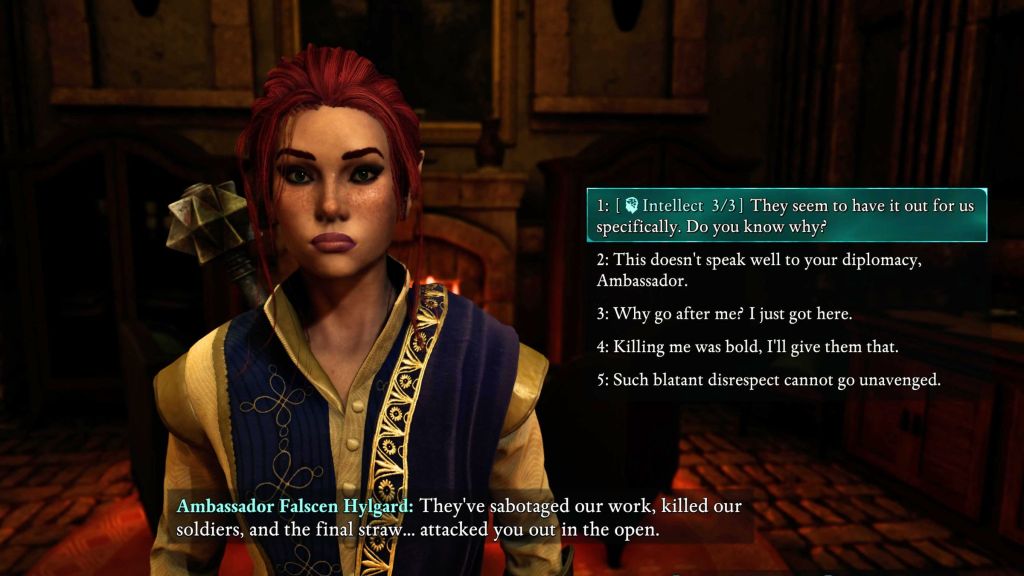
As I always do, I spent a good bit of time carefully crafting my character in Avowed. The character creator in the game is pretty solid, with lots of presets and sliders to work with. If my version of the Envoy looks a lot like my avatar in The Elder Scrolls 4: Oblivion Remastered, that’s none of your business. I like when a game gives me opportunities to see my custom character in action, but I’ve never seen it done quite like how Avowed handles it. And as it turns out, I have stronger opinions on the matter than I would’ve thought.
During dialogue cutscenes, the screen pivots to your avatar as you select dialogue options. And as much as I love getting to see my character creation handiwork up close and personal, there’s one big problem. Your avatar’s facial expression never changes. Like, at all. Just the same blank stare, right at the camera, during any cutscene that pivots to a close-up of their face. And it turns out that’s wildly immersion-breaking for me as a gamer. Here I am, watching the NPC I interact with go through the whole range of human emotions. And there the Envoy is, staring blankly ahead, no matter the situation.
Though this is a seemingly minor detail, it became a huge distraction for me. I wanted to get a sense of my character’s role in the world, but somehow, seeing that blank stare made it harder to develop my own sense of who she was. It’s one of the reasons the story of Avowed didn’t quite hit for me like I wanted it to. And it’s caused me to reflect on how other RPGs handle incorporating custom character animations during dialogue and cutscenes.
Skyrim and Baldur’s Gate 3 Approach Custom Character Dialogue Scenes Differently, But It Works
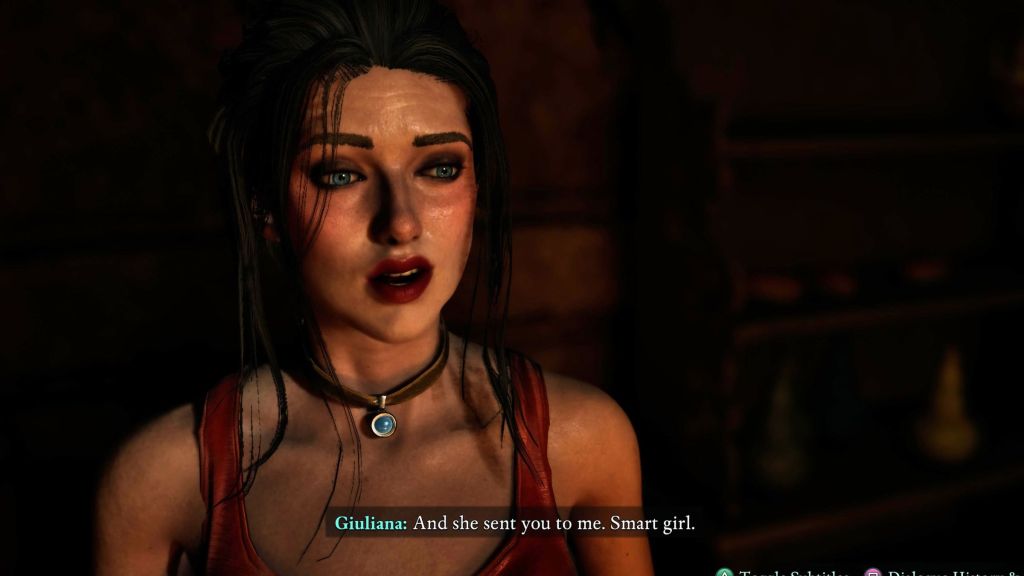

As I kept seeing my avatar’s gorgeous but very blank face in Avowed, I thought about how other games handle the situation. Surely, it’s a lot of work to animate a whole range of facial expressions for every custom-created character option out there. But there had to be better options than a blank stare looking at you whenever your character speaks. Two of the most popular RPGs around, Skyrim and Baldur’s Gate 3, have their own approaches to the situation. And both of them landed better for me.
In Skyrim, dialogue cutscenes don’t really pivot to your character’s face. Instead, you’re mainly focused on the NPC you’re talking to. That lets you really step into your character’s point of view while talking to someone. You can imagine the faces you’d make when choosing those dialogue options, and focus on the NPC you’re speaking with rather than your custom character. It’s immersive and, unlike my Avowed avatar’s blank stare, doesn’t take you out of your role as the Dragonborn.
Meanwhile, Baldur’s Gate 3 has a dialogue interface that’s more similar to Avowed. The focus shifts between your character and the NPC you’re talking to. And your custom character does, in fact, move their face. I wouldn’t say it’s the widest range of emotions, but your dialogue option choices do impact how your character moves in dialogue scenes. Even the small animations here really help you feel like your character has a personality, has stakes in what happens next in the story.
Before I played Avowed, I would have been hard-pressed to have an opinion on your avatar’s role in in-game dialogue. But as it turns out, I very much do have strong feelings about it, actually. It might seem like a minor detail, but with a story-driven game, the little things can really make the difference between full immersion and feeling like your avatar is a cyborg with no reactions to the world around them.
Have you ever thought about how your character shows up in dialogue scenes before? Did this detail stick out to you if you played Avowed? Leave a comment below and join the conversation now in the ComicBook Forum!
Most Viewed
-
Courtesy of Crunchyroll / Sony Pictures -
Image Courtesy of Ufotable -

Image Courtesy of Netflix -

Courtesy of TOHO Animation