Mario is easily the most recognizable video game mascot, and he’s been Nintendo’s leading character for decades. Mario has appeared in hundreds of games, ranging from platformers and tennis to kart racing and RPGs, so he’s well-traveled. If you’ve ever wondered why a Japanese company initially focused all its attention on an Italian mascot, originally intended for the North American market, you’re not alone. It’s reasonable to be curious because it doesn’t make a lot of sense. You’d think the company would choose a Japanese-inspired mascot, but instead, they opted for a diminutive Italian plumber with a pronounced mustache and a penchant for stomping on things.
Videos by ComicBook.com
Mario didn’t start as Nintendo’s mascot — far from it. Instead, he was the player character in 1981’s Donkey Kong, referred to only as Jumpman. In fact, the woman he rescues atop the tower isn’t Princess Peach, it’s Pauline. The real character is Donkey Kong, as he’s the focus despite being the game’s antagonist. Why, then, did Nintendo shift gears, adopt a name for Mario, and make him the leading player character in over 200 games? The reason is actually quite endearing and stems from Nintendo’s earliest efforts to break into the North American market, as Mario’s origin is deeply tied to the United States.
Mario’s Secret Origin Story Is an Endearing Tale of Nintendo’s Early Days

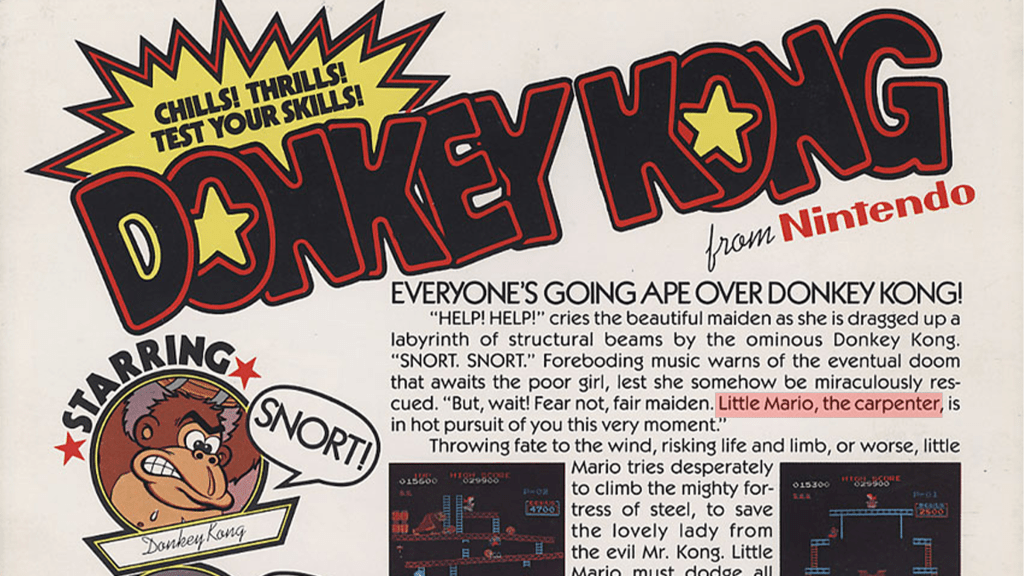
Mario got his start in Donkey Kong, but he didn’t remain an anonymous “Jumpman” for long. Shigeru Miyamoto created the character who didn’t initially have a name in the Japanese launch of Donkey Kong, but this was later changed. Eventually, the sales brochure featured the name “Little Mario, the carpenter,” which was the first mention of the character’s name. Still, this wasn’t widely known, as the brochure was distributed to arcades rather than directly to consumers. Eventually, he scored his own title, Mario Bros., released in arcades in 1983. This was the first proper use of “Mario” as the character’s name, and he received it in honor of Mario Segale.

Segale was the landlord of Nintendo of America’s warehouse in Seattle, Washington. The company had fallen behind in paying its rent, as Nintendo was just getting started at the time, and Segale took up his complaint with then-president Minoru Arakawa. They had a pretty heated argument, but with some time, Nintendo employees convinced Segale to let them keep the space, as he would eventually get paid. Because he was so generous in his willingness to accept late payments instead of pushing the company out, Nintendo named its character after him.
Stories have arisen, suggesting the naming of Mario was less done to honor Segale and more to joke about how reclusive he was. This could have been a reason, but ultimately, it doesn’t matter. Segale long felt honored at being the namesake of one of the most popular characters in entertainment. He was proud of the little Italian plumber, and shared his feelings with his grandchildren and friends, all of whom presumably loved Mario as much as the rest of us. One quirk of the name is that Mario’s full name is believed to be Mario Mario, thanks to the Mario Bros. insinuation (and the 1993 awful live-action movie).
Mario Is an Italian Plumber, Thanks to a Kind Landlord
Of course, Mario Segale was not an Italian plumber, but when you name a character Mario, you kind of have to make him Italian. The plumbing profession is straight out of Mario Bros., which features large pipes from which enemies exit at the top of the stage and escape through the bottom. It took some time for the character to truly come into his own, and Super Mario Bros. for the Nintendo Entertainment System went a long way in making him a household name. That game (as well as the NES) effectively pulled the video game industry out of the rut caused by the 1983 video game crash, solidifying Mario as a mainstay in both the video game industry and popular culture. Looking back, it’s good that Miyamoto went with Mario instead of his first choice: Mr. Video.
Do you think Mario would have been as successful had he been called Mr. Video? Leave a comment below and join the conversation now in the ComicBook Forum!
Most Viewed
-

Image Courtesy of TOHO -

Image Courtesy of Crunchyroll -
Image Courtesy of Marvel Comics -

Image courtesy of Marvel Studios