There’s a giant being in a suit who looks like a well-armed refrigerator as your escort. It’s unclear how much human is under that suit, if any at all, but, regardless, he’s guiding you — a comparatively frail technician — through some ungodly megastructure in decay. Guiding you to what exactly is a mystery, yet the thick atmosphere surrounding it is as brooding as it is beautiful. It’s a calm but effective intro for End of Abyss, and while it doesn’t fully realize its vast potential, it is still an engaging horror-lite experience that lays a great foundation for future games from Section 9 Interactive.
Videos by ComicBook.com
This foundation mainly stems from two different franchises: Little Nightmares and Resident Evil, particularly the PS1 trilogy. End of Abyss has the structure of Capcom’s tentpole horror series with its style of gunplay and puzzle box level design, while borrowing the general aesthetic and perspective of Tarsier Studios’ (and, technically, Supermassive Games’) cinematic platformers. It’s a complementary fusion where the qualities of each work in unison and demonstrate how fitting this pairing is. Even with all the PS1-era horror homages that have come out in the last few years — Signalis, Crow Country, Tormented Souls, Fear the Spotlight, and Sorry, We’re Closed, to name a few — it’s surprising no other game has put these two styles together before.
Rating: 3.5 out of 5
| Pros | Cons |
|---|---|
| Mixing the old-school horror and cinematic platformer genres is quite novel | Infinite basic ammo and expensive special ammo limit its horror and combat capabilities |
| Its unique visual aesthetic is beautiful and sets a moody tone | The unhelpful, glitchy map and weak signposting make traversing in the second half a pain |
| Bugs pop up semi-frequently and break immersion | |
| The story takes too long to come together |
End of Abyss Has Clear Inspirations but Combines Them Well Enough
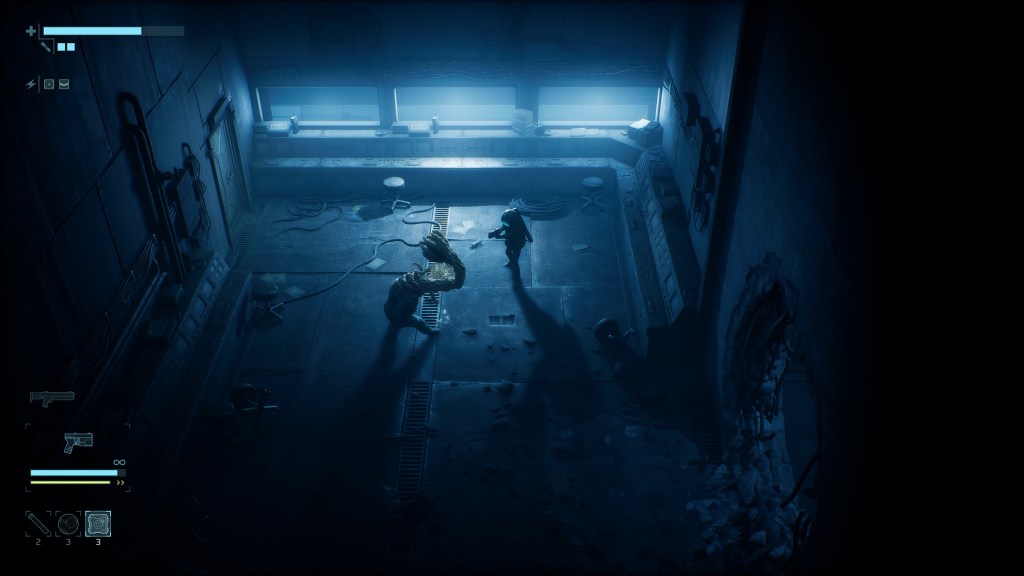
The overlapping qualities from those influences are mainly expressed in End of Abyss‘ ambience and camera. End of Abyss is a foreboding game where its gnarled beasts and haunted hallways are always fantastic sights. Some of this has to do with its remarkable visual quality — not being able to move the camera lets Section 9 pack more detail into each frame — and impeccable shadows and lighting, but its incredible art design gives it all more substance. It’s a busted world filled with old concrete and futuristic technology, all tinted blue for added mystery. The breakdown of old tech in a strange, sci-fi world is reminiscent of the work of Simon Stålenhag, which is fitting, given the Swedish origins of both Stålenhag and Section 9.
End of Abyss is a moody game, but it isn’t exactly scary. Rarely is this atmosphere used to frighten players or sow tension. Squelching noises just off screen may elicit a tiny bump in adrenaline, but the suspense is often quickly upended when said squelching creature just runs toward the player.
But it’s more likely End of Abyss‘ lack of scares lies within its mechanical limitations. Like the older Resident Evil titles — albeit, with the ability to move while shooting — the main character will automatically aim at the threat that’s the most directly in front of them. Utilizing dual-stick shooting controls, it’s up to players to run around and blast enemies without cornering themselves.
It’s as basic as it sounds, but it’s at least smooth. Players have access to a surprisingly nimble dodge, and shooting at targets, despite an occasionally fussy and hard-to-see laser pointer, isn’t too difficult. Repetitive bosses aside, there are a handful of hectic battles where players have to constantly roll out of the way of radioactive projectiles or sweeping punches, pop off a few shots, and resituate themselves in order to avoid turning into chum. The gauntlets where players are dropped in a dark or cramped space with multiple pulsating monsters are the most thrilling. Chaos can get the blood pumping.
End of Abyss’ Odd Ammo Systems Limit the Effectiveness of Its Horror Elements and Combat
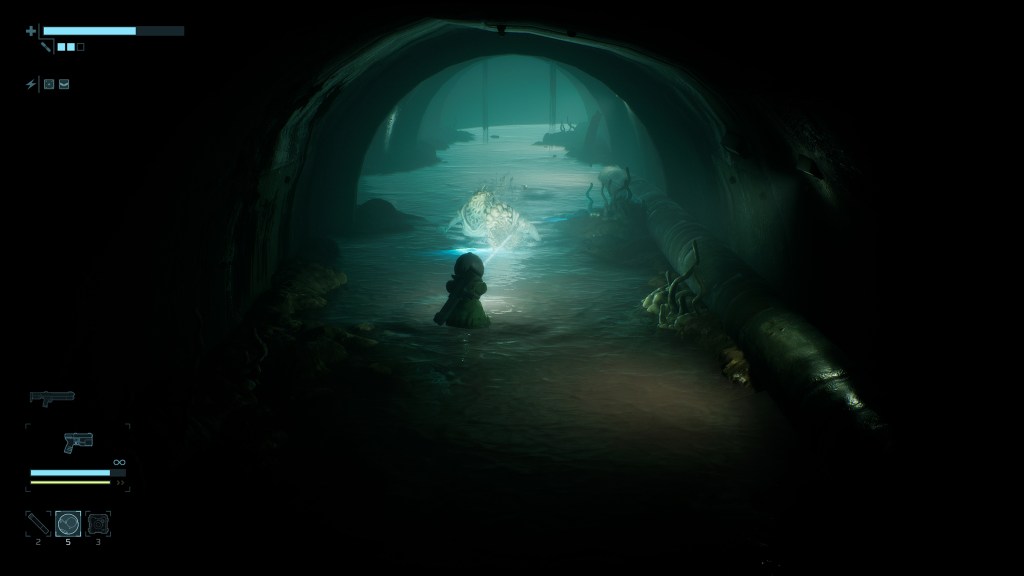
However, these thrills are often tempered or short-lived because of the way it handles ammo. Players have access to a pistol with infinite shots and another special firearm. Ammo for these special guns can only be purchased at stores using the same currency needed for weapon upgrades. This creates a poor feedback loop, since it is hard to justify temporary bullets over permanent gains, especially when the bottomless pistol is more than adequate. Spending hard-earned upgrade currency on bullets is even less appealing when considering how quickly foes respawn and how death doesn’t yield any refunds. Not having to recollect collectibles or reopen shortcuts after dying is an upside to this approach, but that also makes expensive bullets an even harder sell.
This bizarre choice also has widely negative effects on its survival horror nature. Players don’t have to scavenge for bullets since the pistol is always loaded, and special ammo doesn’t drop anyway. This unfortunate combo saps out the tension during combat and limits variety. There’s no pressure to nail pistol shots since there are always more in the chamber, so the stress associated with resource conservation — a key part of the survival horror genre — is absent. And the overly strict parameters placed around special ammo pressures players to only use the pistol, which only makes battles more stale.
It’s feast or famine, and neither extreme benefits the game. Perhaps End of Abyss wasn’t envisioned as a survival horror game, but it’s wearing the skin of one, and a more firm commitment to the genre likely would have given it more juice. The gunplay is too basic to turn away horror elements, and it’s a shame it uses its infinite ammo to infinitely shoot itself in the foot.
End of Abyss’ Map Is Often Unhelpful
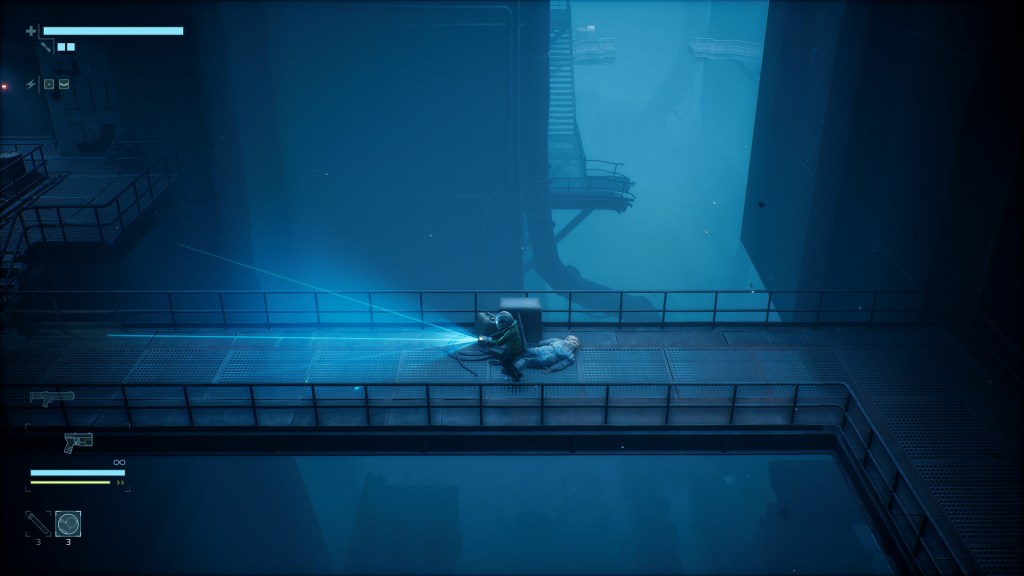
End of Abyss‘ map further sucks out tension. Like a search action game or classic Resident Evil, it is predicated on players backtracking in order to hunt for keys of all sorts, be they keycards or the jangly metal ones. Figuring out where to go is sometimes a rewarding process of analyzing which grayed-out part of the map has the next essential item. Each main goal has a big, golden icon on it, but actually getting there is the satisfying part.
It’s a tried-and-true formula, but it only works out well for the first half of End of Abyss, as it starts to get bogged down by overly vague objective markers and glitches after a certain point. As the game opens up and drops multiple new sections on the player, it becomes increasingly harder to pin down exactly how to get around and increasingly easier to wander around aimlessly. Getting lost is part of the genre, but the obtuseness that dominates the latter half takes it too far.
The map screen is the root of the issue here, though, since it hinders players almost as much as it helps them. Locked and unlocked doors are sometimes labeled incorrectly, so a five-minute trek to a blue doorway on the map screen can often be a waste of time when it turns out to be a locked door instead. Certain pathways on the map screen also cut off prematurely and don’t clearly signal if they are an unexplored pathway or a link to another section. Some locked doors also tell players what key they need, while others hide the unlock requirements. End of Abyss‘ levels already don’t flow in the most coherent way, but this friction is magnified by an actively hostile map that constantly fools players into mismanaging their time.
A few of these mishaps are obviously bugs, but those glitches aren’t limited to just the map; End of Abyss has other technical issues that need ironing out. Going to a new room causes the audio to buzz almost every single time. Hard crashes can pop up out of nowhere. There’s also a persistent problem where downloading map data from the terminals can soft-lock the game. Section 9 stated this specific glitch should be ironed out soon, but it’s evident End of Abyss needs more updates. It’s not close to being unplayable, but save points are few and far between, and it’s frustrating to repeatedly have to replay vast portions of the game because of technical errors.
In-universe technical errors lie at the heart of End of Abyss‘ story, but it takes too long to get to the bottom of it all. The intrigue layered upon players in the intro gradually dissipates in the mundanity of its objectives where players are tasked with activating things to activate three other things that are needed to activate three more things. The environmental storytelling is also limited and hardly seems to go past “things got pretty bad,” something that could have been addressed with a greater selection of more meaningful collectible notes or additional cutscenes. By the time the game gets around to rolling the ball forward and introducing compelling twists in the final quarter, it wraps up. It hides a “good” ending with presumably more context behind collectibles strewn throughout the earlier levels, but, given the antagonistic map, that’s not exactly a welcoming proposition.
It’s hard not to be frustrated with End of Abyss because of how it constantly gets in its own way. The stages, while not scary, are appropriately moody, yet are often confusingly designed and brought down by a buggy map. The amount of bugs elsewhere can deflate the atmosphere, as getting kicked to the dashboard and having to replay large sections is irksome. Its gunplay controls well and can sometimes be exciting, but the befuddling upgrade and ammo economy stifles its potential. Despite these faults, End of Abyss broadly succeeds because of the novel way it blends together key parts of the cinematic platformer and classic survival horror genres. The future in End of Abyss is rife with ruin and rot, but the game’s future, if it is able to live on and fully realize its potential in another form, is rather promising.
A PS5 copy of End of Abyss was provided by the publisher for the purpose of this review.
How does this blend of two popular franchises sound? Does it have a chance of sticking out during the spooky season? Send us your answer in the comments below.
More Gaming
-

Image Courtesy of Sony Interactive Entertainment -

Image Courtesy of IO Interactive -

Image Courtesy of Sony Interactive Entertainment -

Courtesy of Riot Games -

Courtesy of Screen Burn