Marvel’s return to video games over the last decade or so has been both unexpected and welcome. Despite failures like Marvel’s Avengers and the canceled Black Panther game, the comics giant has done a great job ensuring its comeback would cover multiple genres from card battlers and linear action games to turn-based tactical titles and old school brawlers. But there’s been a notable blind spot within this new initiative: fighting games. Marvel’s prominence within this space ended abruptly with Marvel vs. Capcom: Infinite‘s notoriously disastrous launch in 2017; a multi-decade reign snapped out of existence with one fumbled title.
Videos by ComicBook.com
Marvel Tōkon: Fighting Souls is Marvel’s way of snatching back the Infinity Gauntlet and righting past wrongs. By focusing on polish, features, and an intriguing core combat system — the Infinity Stones on this metaphorical gauntlet — Tōkon is a wonderful return to the space for Marvel and a fantastic overall fighting game.
Rating: 4/5
| Pros | Cons |
|---|---|
| The vibrant art direction and inspired character design make Tōkon a visual showpiece | Its campaigns are repetitive, predictable, and filled with shallow fights |
| Its array of training modes and practice options make the game a little easier to learn | The speedy tempo means matches can sometimes be frustratingly one-sided |
| Blazing fast fighting mechanics give combos a solid amount of player freedom | Auto combos are an annoying crutch and can’t be turned off |
Marvel Tōkon Is Visually Gorgeous
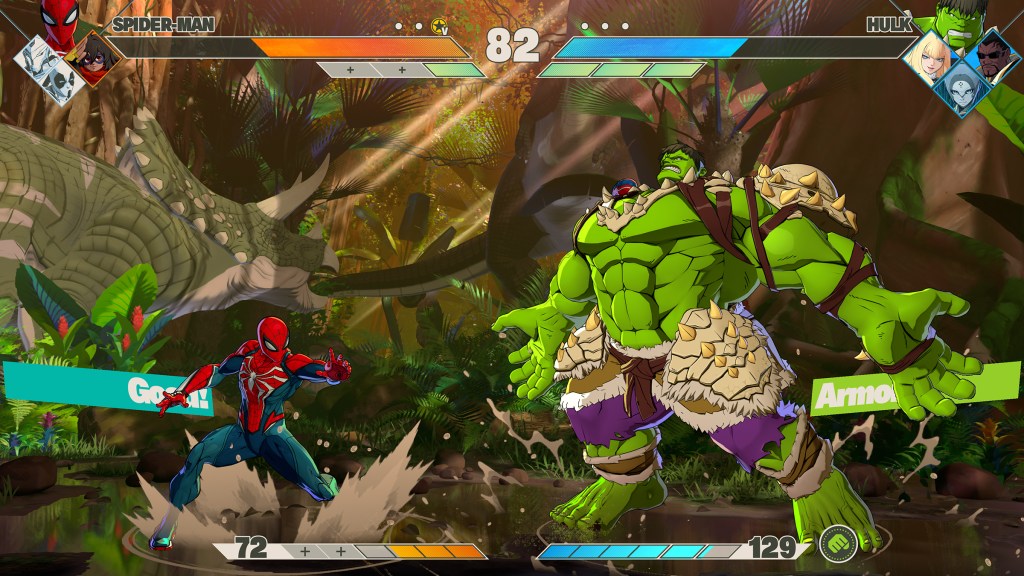
This isn’t to say, though, Tōkon is just a repeat of Marvel vs. Capcom. The two are connected in various ways, as they both have character tagging and (Infinite notwithstanding) comic book-esque art styles, but Tōkon has plenty of its own flavor and personality.
Much of this flavor stems from Tōkon‘s overall visual design. Tōkon is, to put it succinctly, one of the most vibrant AAA games out there, thanks to its array of stark and saturated colors. But it doesn’t just look a typical comic book, since Arc System Works’ style is evident in just about every character on the roster. Instead of strictly following classic designs, the team instead infused these age-old characters with its own personal touches. This means Ms. Marvel has big anime eyes, Iron Man looks like a Gundam mecha, and Blade is equal parts samurai and vampire, complete with Oni masks as pauldrons. The lip syncing in their agonizingly slow intro dialogue scenes may be awful, but at least these closeups make their designs easier to appreciate.
This bold fusion of Eastern and Western aesthetics is clever since it gives Tōkon a look that is all its own. And when paired with fluid animation that’s full of dramatic heroic poses fitting of a superhero amped up with anime-like flair, Tōkon‘s overall visual presentation ascends above most of its peers and might even surpass the high standard ArcSys set with Dragon Ball FighterZ and Guilty Gear Strive. Even the menus and user interface pop.
Marvel Tōkon‘s Fighting Mechanics Are Fast and Flexible
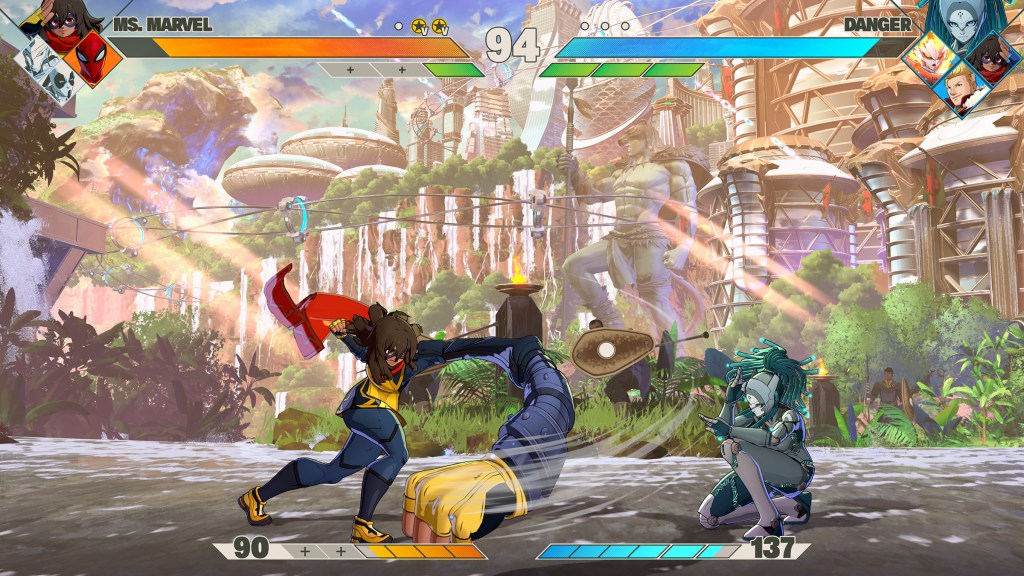
Tōkon doesn’t prioritize visuals at the cost of its mechanics, thankfully. Somewhat like the Injustice games, each fighter has a specific gimmick that gives them a leg up. For example, Spider-Man swings all across the screen, Green Goblin uses his glider for combos and aerial maneuverability, and Deadpool guts himself to gain access to a whole suite of new moves, many of which are, unsurprisingly, references. This alone gives each fighter an identity and, in turn, a healthy amount of one-of-a-kind combo potential or utility.
Tagging only ratchets up Tōkon‘s combo-heavy nature since all three (once they are unlocked during a match) can extend juggles if players are savvy enough to know when to call them in. The different slots all change how an assist functions and work alongside the cancelable assist that is the most straightforward way to extend juggles. There’s a flexibility here afforded by these systems that allows players to think thoroughly through an attack’s properties to slowly come to a conclusion how said combo can be optimized or further followed up on. Slotting four characters at once is a bit overkill since that makes the initial mental load that much bigger and can lead to unreadable chaos at times, but the tradeoff here is more depth.
The breakneck speed in which this all unfold and overall complexity can mean some matches in Tōkon can be awfully one-sided and simply unfun to endure. A skilled player can make even a slightly competent one look like they are playing blindfolded with oven mitts on. Defensive options are also rather limited — don’t expect a combo breaker — meaning overpowering offense can be overwhelming and there aren’t many ways to undo a mistake. Long matchmaking times (in an otherwise complete set of online modes) make blowouts that much more unpleasant, too.
Tōkon at least gives players the tools to overcome and improve with its surprisingly comprehensive bundle of training modes. It has many of the basics: a normal tutorial that walks players through the fundamentals, a deeper one that explains some of the more advanced parts, combo trials, and a training mode. It even has the ever-important and increasingly popular replay takeover feature that makes learning from past mistakes more interactive.
But it’s impressive how well each of these parts are done and what they are supplemented by. The training mode has an absolute bevvy of settings to mess around with, as well as presets that let players quickly test a part of their game plan (like anti-airs or punishes) with one tap. These clever shortcuts cut down on the tedious tinkering practice modes can sometimes have.
Character guides chalk out what most specials do and why they are useful. The default combo trials do a great job of showing what’s possible, and the more advanced ones go one step further by giving players a damage goal to hit and certain attacks they can use without spelling every step out. This freeform approach is brilliant because it highlights how open the game is and lets players find their own combos through experimentation. While fighting games can always do better at welcoming players in and pointing out how they can improve, Tōkon‘s collection of tutorials are solid enough to make a game this intricate much more approachable.
Marvel Tōkon‘s Auto Combos and Weak Story Mode Are Clear Downsides

Not every attempt to court more casual players works out, though. The irksome auto combo system can’t be turned off and can often lead to dropped manual combos when one or two extra buttons are pressed. It’s unsatisfying for the game to be so eager to fill in the blanks with a mindless automated juggle when that wasn’t the intent. Damage-wise, auto combos are also too rewarding and can be readily abused, especially for those sitting on a lot of meter. ArcSys’ willingness to stuff the game with helpful learning tools is slightly undercut when this brain-dead option is so powerful and can’t be flipped off.
The ultra casual Arcadia Rumble mode, with its focus on collecting buffs in an avatar-filled arena outside the typical battlefield, is a waste of space destined to be dead one week after launch, but the lackluster story is a much bigger and more disappointing part of the experience. Each of the five groups gets its own hour-long campaign set to motion graphics drawn by a number of famous comic book or manga artists like Emanuela Lupacchino and Hiro Mashima. It’s a collaboration that has its share of ugly frames as well as its gorgeous ones — Betten Court, Mike Deodato, and Yusuke Osawa are all vying for the top slot with their respective issues — but the bigger problem here is the actual story and structure.
These five threads don’t tell unique parts of the same story and, instead, retell similar stories five times, albeit with a different squad taking point. Given how each one has the same animated cutscenes, they all are forced to hit the same beats in the beginning, middle, and end. This leaves very little room for twists or experimentation; each chapter feels far too similar to the corresponding one in the other episodes. They all have various character-specific touches, like Storm’s struggle to figure out how to lead and Spider-Man’s inability to balance his personal life, but these truncated arcs are wholly ineffective because of the short runtime and rigid wider story they all have to follow.
It’s strange how Tōkon‘s campaign tells the same story five times instead of having one overarching narrative that uses its chapters to shake things up and give players different perspectives; it’s the same predictable pablum over and over. Teams don’t change, the story doesn’t affect anything, arcs are rushed through, and most fights are insultingly easy one-round affairs that don’t even help tutorialize the mechanics. Other teams like NetherRealm Studios, Quarter Up, and Bandai Namco have at least tried to experiment with cinematic fighting game story modes, and this, with its multitude of repetitive episodes, falls well short of that standard. If not for the unlockable playable character and skin palettes, these campaigns would be an utter waste of time.
Even with a few weak spots, Marvel Tōkon: Fighting Souls, in many ways, is the redemption Marvel fighting games have needed for almost a decade. It’s not exactly Marvel vs. Capcom, but it’s not trying to be. Tōkon has its own eye-catching visual style and given famed developer Arc System Works the space to flex its mechanical muscle in a different arena. Time will tell how well this game will mature and evolve, but it’s clear Tōkon has a sturdy base and demonstrates Marvel — and maybe even “Mahvel” — is back in the fighting game space.
A PS5 copy of Marvel Tōkon: Fighting Souls was provided by the publisher for the purpose of this review.
What do you think? Leave a comment below and join the conversation now in the ComicBook Forum!
More Gaming
-

Image Courtesy of Ubisoft -

Image Courtesy of Dotemu -
Courtesy of Electronic Arts -

Image Courtesy of Electronic Arts -

Courtesy of Arkane, Bethesda Studios, and Marvel Games