In the musical but secretly shadowy world of KPop Demon Hunters, nothing is ever quite as it seems. With a detailed and meticulously crafted lore, fans tend to dissect the carefully crafted music videos, cryptic social media posts, and every whispered lyric, searching for the truth surrounding the Hunters and the mysterious and intangible Honmoon. In KPop Demon Hunters, the Honmoon is an absolute, impenetrable barrier; a final wall between the world of the living and the realm of the dead, guarded by generations of Hunters—female musical trios who have existed for generations in different iterations of bands/pop groups, using their lyrics and voices to keep all evil spirits away from innocent mortals. This structure establishes the Hunters as guardians whose sole purpose is to keep demons in their own realm for defense.
Videos by ComicBook.com
However, a deep dive into the linguistic roots of the term “Honmoon” and the symbolism of gates in KPop Demon Hunters reveals a crucial and easily overlooked truth that contradicts the officially established lore and suggests the Hunters are not glorified musical prison guards, but something far more active, complex, and dangerous.
Proper Translation Contradicts the Canonical Purpose of the Honmoon

Simple and basic linguistics undermine KPop Demon Hunters’ core based on a single word: Honmoon. In Korean, the term “Honmoon” is a compound word that literally translates to “Soul Gate” or “Spirit Gate.” This translation is not meant to be strictly symbolic; it is actively telling us what the Honmoon’s function truly is. A gate, by its very definition across all cultures, is never an absolute barrier. It is, and always has been, a point of passage that swings both ways, allowing someone to both enter and exit. A wall is a barrier, but a gate is a way to circumvent that wall. By naming the supernatural force as an actual “Soul Gate,” KPop Demon Hunters implies that the Honmoon is not necessarily a seal against the dead, but rather a controllable opening.

If the Honmoon were truly meant to be an impenetrable field, the writers/creators could have chosen countless terms that translate to a permanent boundary. Their deliberate choice of Moon (“gate” or “door” in Korean) instead changes everything we thought we knew about the Hunters and their protective powers. The implication is clear: the Honmoon is not designed to keep everything out, but to carefully monitor what comes in and what goes out. The symbolism. such as the rotating, and often opening, archways in the background of many of Rumi and Jinu’s interactions, is not just a random stylistic choice. It is a visual representation of the Honmoon’s true nature, as Rumi actively allows Jinu to get close to her (physically and metaphorically). The Hunters aren’t just standing guard; they are operating a turnstile.
The Hunters’ Job Is To Allow Passage, Not Block It
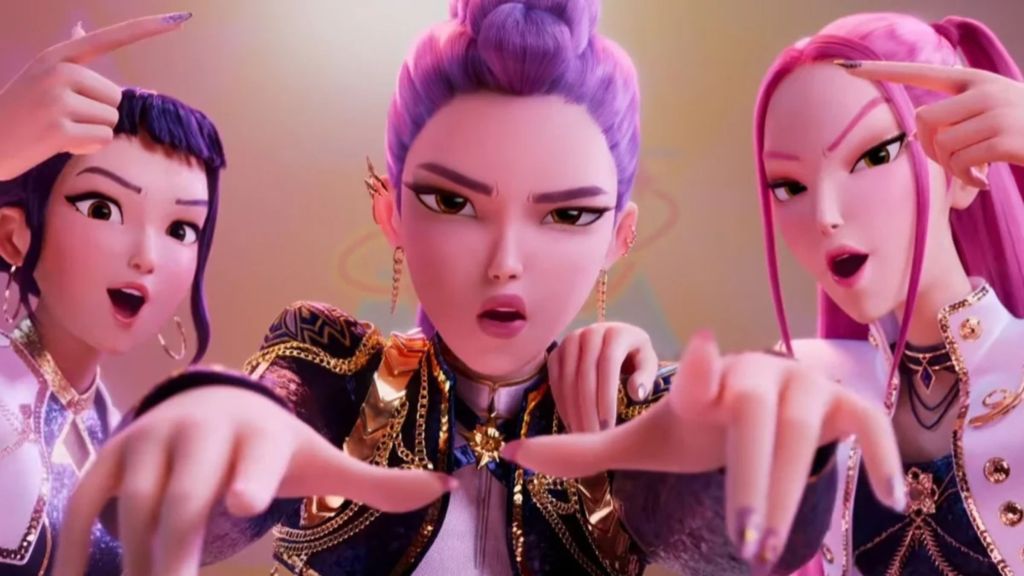
Kpop Demon Hunters’ lore establishes the Hunters as akin to shamans. The traditional role of the shaman across global cultures is not that of a simple warrior or a wall builder; a shaman is, above all, a medium for spirits. Their sacred duty is to navigate the spirit world, which includes allowing communication between spirits and the living and, crucially, guiding souls to their rightful place. They are the bridge between life and death. If the Hunters’ mission were merely to keep demons/evil souls out, they should have been soldiers or exorcists. Making the girls shamans suggests a much more complex role that, in essence, requires the Honmoon to be a gate.
A genuine “Soul Gate” would give the Hunters, as gatekeepers, a more complicated duty. First, they would have to identify and allow good and innocent souls. Second, they would be responsible for ensuring that recently departed souls were properly guided from the land of the living to the land of the dead. Finally, the Hunters could potentially use this gateway/passage for their own movements into the spirit realm to fight demons. If the Honmoon were a true barrier, the Hunters would not need their sophisticated, ritualistic practice—they would simply need military-grade protection. The elaborate choreography, the ritualistic hand signs, and the focus on “cleansing” and “guidance” all point not to defense against a wall, but to the management of a violent, two-way current.
This truth suggests a darker truth: if the Hunters control a gate, they control who passes. Their power is not defensive; it is absolute control over life, death, and the transition between. The official story—that the Honmoon is a simple barrier—would then only exist to maintain the Hunters’ image as protectors while concealing their true, terrifying power: the ability to open the door, decide who walks through it, and ultimately, determine the very balance of the two worlds, thus holding the key to the Soul Gate in their hands.
What do you think? Leave a comment below and join the conversation now in the ComicBook Forum!
Most Viewed
-

Official art by Bastien Lecouffe-Deharme -
Image courtesy of Tor Books/Macmillan -

A photo of the Retrovolt Arcade taken in 2017, showing several classic arcade cabinets and stools. -

Courtesy of TOHO Animation