Adapting a book into a film can be an exhausting process, not only because of all the negotiations involved, but also because sometimes it doesn’t even get that far and ends up stuck in a long circulation cycle. A project can land in studios, reach writers and directors as a strong idea, but just when it seems ready to move forward, something starts to fall apart, and it ends up taking several steps back. In many cases, it never actually leaves development and gets trapped in a kind of Hollywood limbo that says more about the industry’s limitations than about the original work itself. And in this case specifically, time has basically become part of the story.
Videos by ComicBook.com
We’re talking about more than thirty years of attempts, reconfigurations, and drop-offs that never reached a final cut, let alone a concrete release date. It’s true that the biggest issue with this particular film is how difficult the source material is to translate to the screen, but even so, three decades is an unusually long time for a production to remain in planning.
Blood Meridian Has Been in Development for Over 30 Years
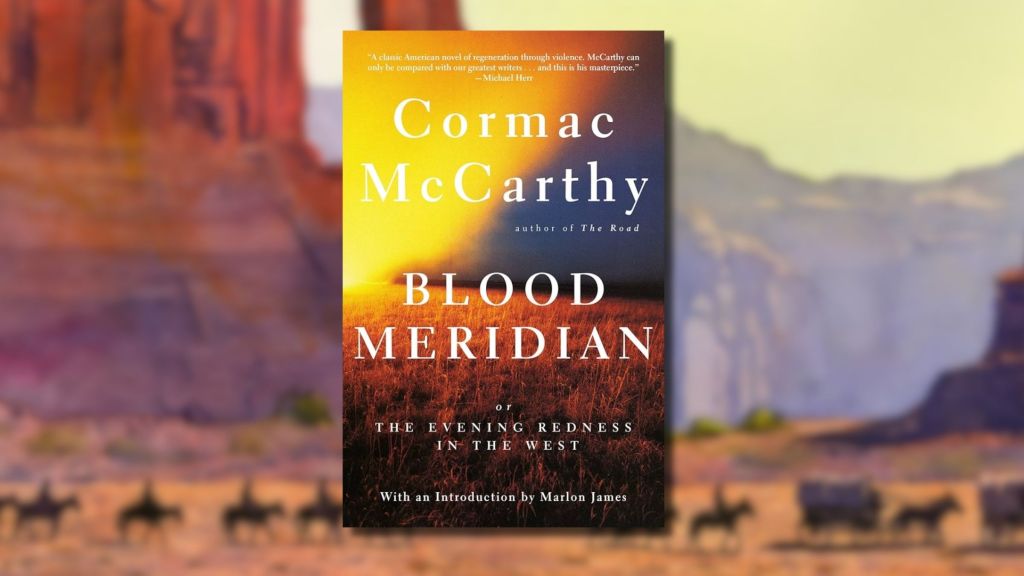
Written by Cormac McCarthy and published in 1985, Blood Meridian is still widely cited as one of the most unfilmable books ever written — and that’s not an exaggeration. The story follows a teenager known as “the Kid” who crosses the border between the United States and Mexico in the mid-19th century and eventually joins the group led by Judge Holden, a figure who functions less like a traditional antagonist and more like a philosophical presence and destructive force. The group takes part in extreme acts of violence against Indigenous populations, and the book presents all of it without softening, but also without behaving like a conventional Western.
So, essentially, there is no heroic arc, no clear journey structure, and very little narrative development designed for cinematic pacing. The material is made up of a sequence of episodic events, with dense dialogue and reflections that often feel more like a philosophical essay than a historical novel. And that’s the main issue, because it simply doesn’t fit into a Hollywood production framework.
From the earliest drafts in the ’90s, the challenge was never just the graphic violence, but the lack of a traditional narrative spine. The first well-documented attempt came around 1995 with Steve Tesich, and from there the project began circulating among big-name figures like Tommy Lee Jones and Ridley Scott, for example. However, none of these versions ever had consistent creative control strong enough to actually push the project into production. And yes, there were attempts to structure the story in a more conventional way as well, with clearer arcs and a reworked narrative closer to a classic western. In theory, that should solve the problem, right? But the more that happens, the more the adaptation loses exactly what makes Blood Meridian such a powerful story in the first place.

Over the years, the project became almost like a Rorschach test for filmmakers. Several directors saw it as an opportunity to make a great western, while studios saw it as a massive financial risk with no real guarantee of return. At the end of the day, it’s not about a lack of interest but about a lack of consensus on what the movie is actually supposed to be, because no one can land on a script that gives both sides enough confidence.
The most famous version of this entire ordeal might be the James Franco attempt in the early 2010s. Unlike other attempts that stayed only on paper, this one actually moved forward into filming, with a cast, locations, and filmed material. In fact, around 30 minutes of test footage were shot (to convince the studio and production), including a long sequence of the Glanton gang in the desert and the famous conversation between Tobin and the Kid about the encounter with Holden. But then it reached the point where no one really heard anything else about it. From what it seems, there were development conflicts and, more importantly, problems related to rights and production structure.
However, in 2023, it was confirmed that Blood Meridian would finally move forward. But how?
A New Adaptation Attempt Has Been Confirmed
Three years ago, the project resurfaced again with a new configuration: John Hillcoat attached as director. It’s worth noting that Hillcoat already has experience adapting McCarthy, having directed The Road in 2009, which is considered one of the most respected adaptations of the author’s work in terms of tonal fidelity and visual approach. So that significantly raises expectations. On the other hand, there hasn’t been much new information about the development since then, aside from John Logan being attached as the screenwriter, a move announced in 2024 by John Francis McCarthy, the author’s son, who will serve as executive producer on the film.
Speaking to Variety the same year, Hillcoat commented on Logan joining the project: “After years of dreaming and scheming about adapting this great work into a movie, after years of discussing adaptation ideas with Cormac, we are excited to have the writer John Logan weigh in with his passion and understanding of Cormac’s sensibility, to help bring Blood Meridian the movie to fruition,” he said. Logan is known for writing major productions such as Gladiator, The Aviator, Sweeney Todd: The Demon Barber of Fleet Street, Skyfall, and the recent Michael.
However, at the moment, there’s still no clear idea of when the project might actually be released. Given its long history of attempts to leave development hell, it’s understandable that it requires time and very careful planning. But Blood Meridian seems to be, for the first time, in the right hands. Now it’s just a matter of believing it will actually happen.
What do you think? Leave a comment below and join the conversation now in the ComicBook Forum!
More Movies
-

Image Courtesy of DC Comics -

Courtesy of United Artists