Science-fiction movies are so much fun precisely because they mix the real and the fantastical into such a fine blend that it’s hard to distinguish them, even when the film is over. Sci-fi films and the concepts they explore can boggle the mind for years after we experience them, for several reasons. Sometimes the concepts and quandaries fundamentally change our thoughts or outlooks on life; other times, the ideas are just so complex that we’re stuck just trying to figure the film out.
Videos by ComicBook.com
Some sci-fi movies are so complex that no friend, critic, or even article can help to unravel them. Sometimes, visual learning is the only means of understanding; a great chart or infographic is invaluable in those cases, allowing the viewer to sit, stare, process, and come to understanding at a guided pace.
Below are 5 sci-fi films that need charts to help explain them – and we’ve done you the favor of including the charts, in case you want to review them.
5. Interstellar
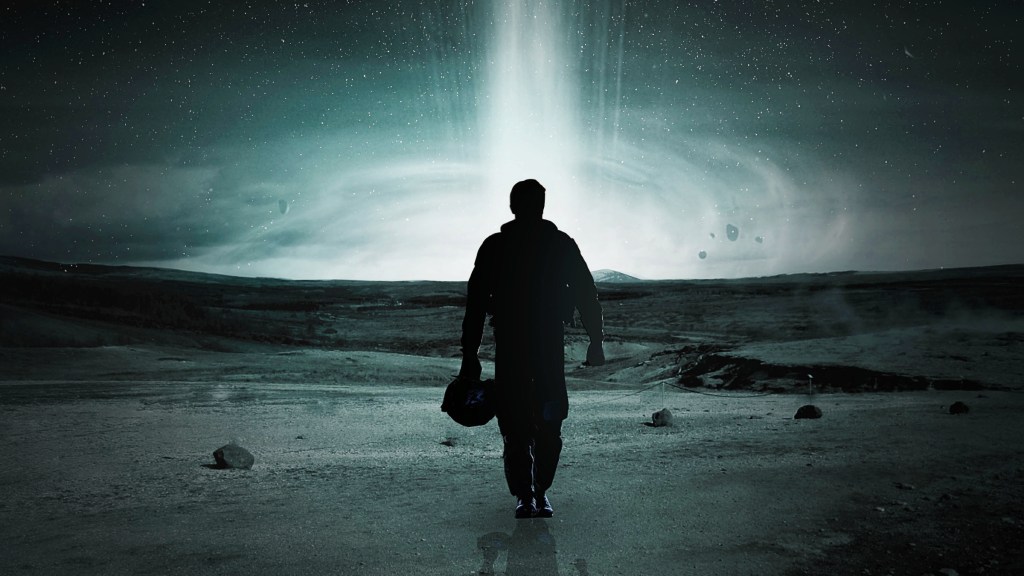
This won’t be the only time Christopher Nolan’s work appears on this list, but it is a rare case in terms of why viewers need an explainer chart. Many of the films on this list get confusing because they use the cause-and-effect of time travel as the main device of their stories; Interstellar needs a chart to help viewers understand the very real scientific theory that Nolan was working with to create the mind-bending twists of the film.
Black Holes, gravity, and time dilation are still major scientific concepts that straddle the line of proven fact and wild theory: a perfect range for Nolan to play in. The story of NASA pilot Joe Cooper (Matthew McConaughey) and his mission to save Earth is deeply human and personal; the black hole and time dilation theory was as heady as science can get. To Nolan’s credit, Interstellar probably did more to boost mainstream curiosity and engagement with astrophysics and black hole theory than any other film before it. And charts like this helped fans get the understanding they needed:
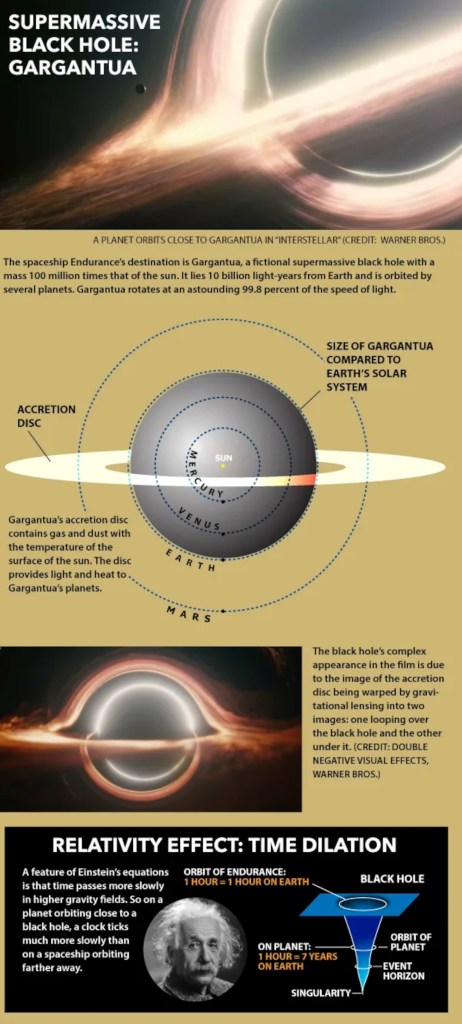
FULL INFOGRAPHIC HERE (via Space.com)
4. Looper

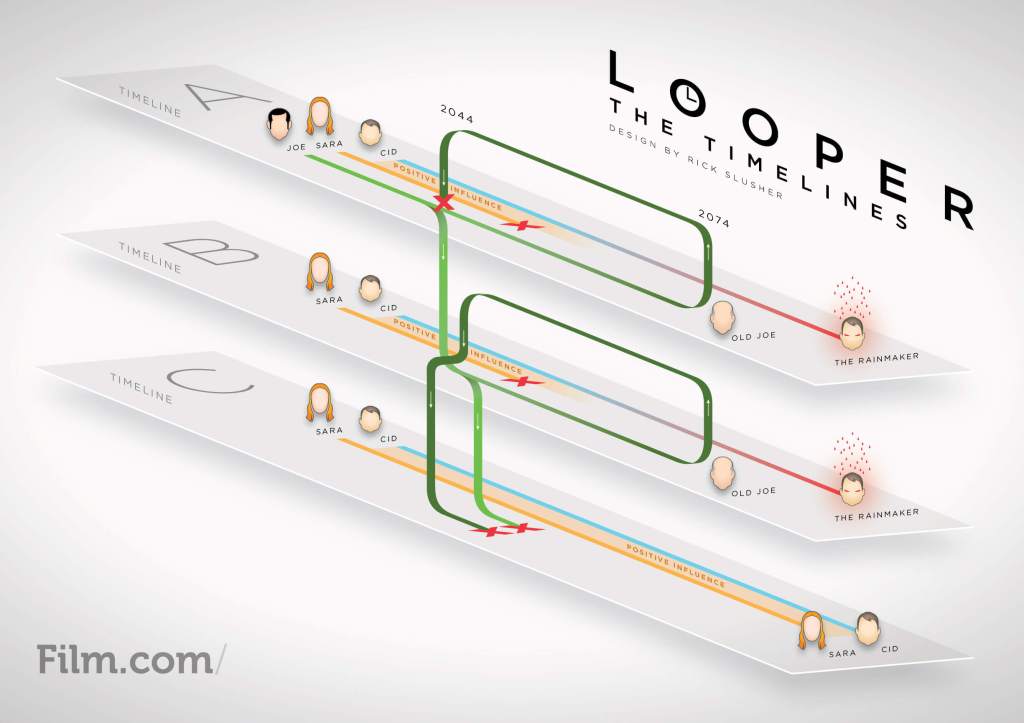
Before he hit infamy with Star Wars: The Last Jedi, writer/director Rian Johnson was already making fans consider how aging changes heroes into jaded old men, via his 2012 film, Looper. In 2044, a guy named Joe (Joseph Gordon-Levitt) works for a crime syndicate from 2074, who dispose of their victims by sending them to the past, to be eliminated by hitmen (or “loopers”) from that time period, who are then killed if they live until 2074, to cover their crimes (a “closed loop”). Joe’s work and entire sense of identity get skewed when he’s approached by his older self (Bruce Willis), as Old Joe seeks to change his own doomed fate by stopping a new crime boss, “the Rainmaker,” from ever rising to power. The rub is that Old Joe wants to kill the Rainmaker when he’s still just a kid – a crime Young Joe cannot abide.
On the surface, Looper might seem like a straightforward time travel story, but what makes it confounding for a lot of casual viewers is the lore that Johnson built into his sci-fi world. The entire process of “looping” left a lot of people confused from the outset, so when Looper starts getting intricate with three different time lines, all interconnected by the cause and effect of the film’s events, a chart becomes necessary.
3. Timecrimes

Spanish filmmaker “Nacho” Vigalondo made one of the most acclaimed indie time travel films ever with Timecrimes (2007). Set in the rural countryside of Spain, a man named Héctor (Karra Elejalde) thinks he’s having a normal day at home with his wife Clara (Candela Fernández), only to spot a beautiful young woman on a nearby hillside. Héctor tries to approach the beautiful woman, only to get assaulted by a freaky-looking man with a bandaged face. He flees the scene with the attacker in pursuit, and gets contacted by a scientist who knows what’s happening, leading Héctor to a hiding place inside a strange device, which turns out to be a time machine. Where Héctor ends up isn’t as shocking as what he realizes he must do next to keep his life intact.
Timecrimes is often hailed as being about as stripped-down and efficient about conveying the causality of time travel and variant timelines as any sci-fi ever has been, and it still needs a chart to help people work it all out. What the visual aid helps make abundantly clear is Vigalondo’s deeper theme, which is how any of us can become a monster when compelled by our darkest desires (sex, violence).

FULL INFOGRAPHIC (via Taylor Holmes)
2. Inception

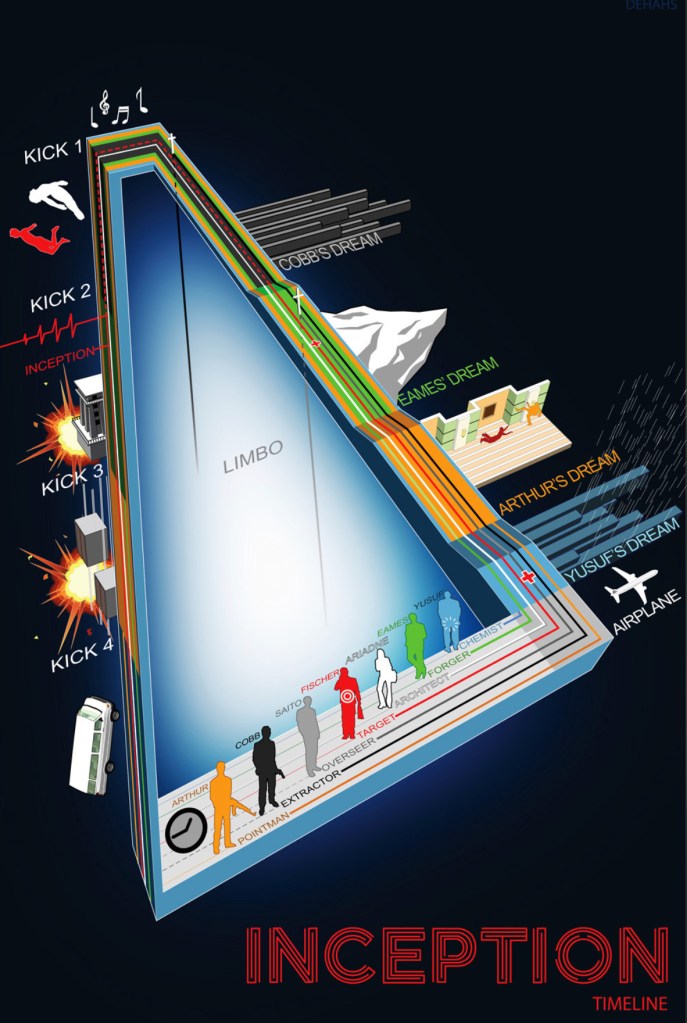
Christopher Nolan doesn’t do anything the traditional way. Interstellar used time dilation instead of time travel for its cause and effect mechanics; Inception (2010) used a sci-fi mashup of sleep study and dream logic to create an entire new world of espionage action. A man named Dom Cobb (Leonardo DiCaprio) and his team invade the minds of high-value targets via their dreams to extract valuable business and/or political secrets. However, the stakes get much higher when Cobb is hired by Japanese business magnate Saito (Ken Watanabe) to do the opposite of his usual work: placing an idea inside the mind of a major corporate rival (Cillian Murphy). But “inception” is said to be far more difficult than “extraction,” and Cobb secretly knows firsthand just how bad a single suggestion can be for the mind.
With Inception, Nolan blurred the line between high-concept sci-fi and mainstream blockbuster entertainment, leaving many casual viewers stumped about what they had just watched. There were so many questions about Inception‘s dream-world time dialtion, and the ambiguous ending to the film, that it inspired a whole new form of “Ending Explained” articles (invented by me!), filled with charts and breakdowns about what happened in the film. Over a decade and a half later, those explainers are still getting plenty of use.
1. Primer
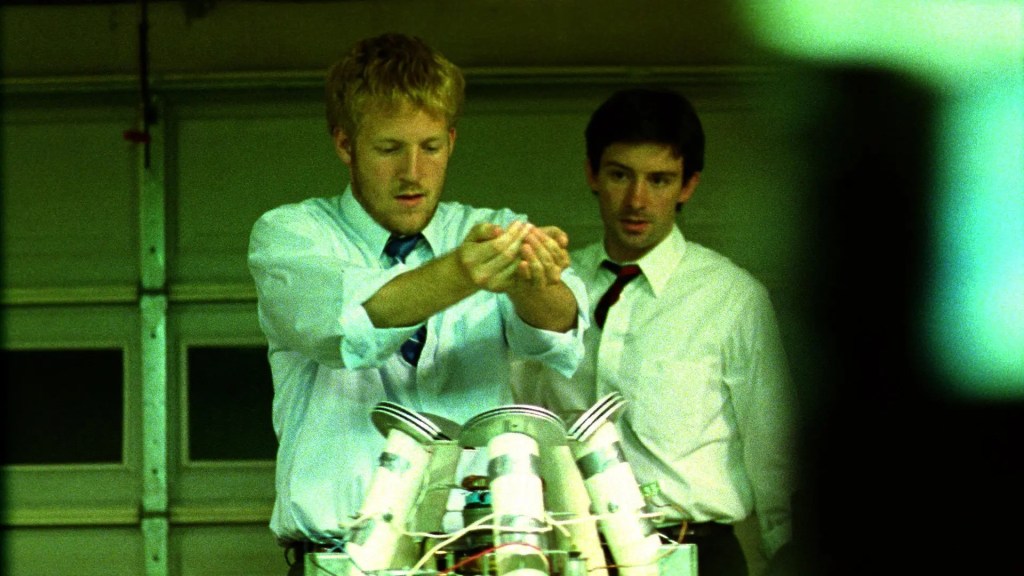
Director/writer/producer Shane Carruth’s 2004 indie sci-fi time travel film was made for $7,000, only made $840,000 at the box office, but it remains the Gordian Knot of time travel sci-fi cinema. The film follows two engineers named Aaron (Carruth) and Abe (David Sullivan), who try to supplement their income by developing their own projects in Aaron’s garage. They accidentally stumble upon a form of “casual loop” time travel, which Abe harnesses through the construction of a device called “the box.” At first, Aaron and Abe use the box cooperatively, running six-day time travel experiments like betting on the stock market with future knowledge, or observing their past selves. However, time travel begins to strain both men mentally and physically, and soon, they are scheming and deceiving one another in a chess game of time travel cause and effect, with one man trying to master the box, while the other wants to erase it from ever existing.
Do not look here for a long explanation of what happens in Primer: it truly is for only the most dedicated sci-fi fan to unravel. Just look at the charts for a while, and see if you don’t feel time displaced…
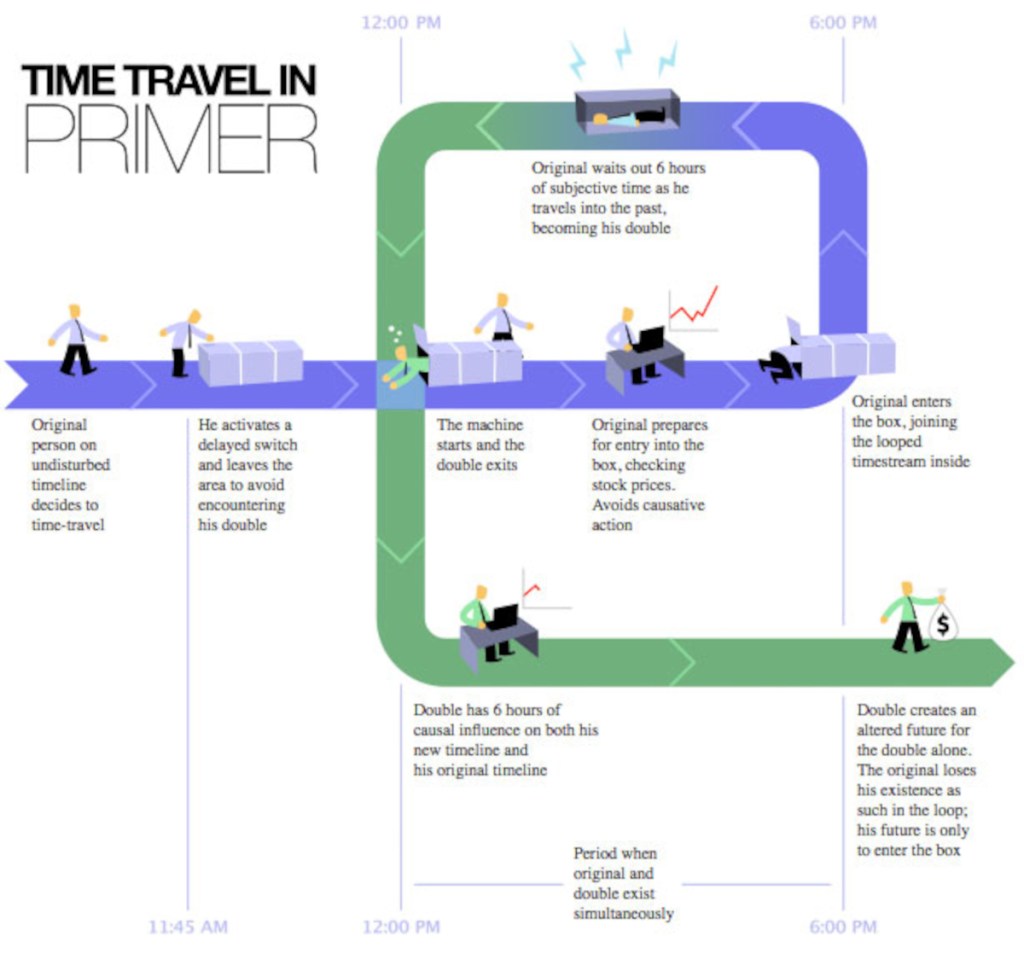
Full INFOGRAPHICS via CK’s Technology News
Discuss your favorite sci-fi films with us on the ComicBook Forum!
Most Viewed
-

Image Courtesy of Warner Bros. -

Sony- Columbia Pictures -

Image Courtesy of Netflix