Directed by Joe Carnahan and released in 2021, Copshop used a high-concept premise to revitalize the “siege” subgenre of action cinema. The narrative follows a cunning con artist named Teddy Murretto (Frank Grillo), who deliberately assaults a rookie officer to seek refuge within a small-town police station. Unfortunately for Teddy, his pursuer Bob Viddick (Gerard Butler) is a professional hitman who gains entry to the same facility by feigning a DUI. As the two antagonists confront each other from opposing jail cells, the situation escalates into a violent struggle that forces Officer Valerie Young (Alexis Louder) to navigate a lethal environment of corruption and professional rivalry. The production prioritizes practical stunt work and a sharp, cynical script that emphasizes.
Videos by ComicBook.com
Despite securing an 82% approval rating on Rotten Tomatoes and garnering significant critical praise for its performances, Copshop suffered a disappointing theatrical run. The film earned a meager $2.3 million during its domestic opening weekend, eventually concluding its cinematic window with a global total of roughly $6.7 million. This commercial failure was largely attributed to a crowded release schedule that overshadowed mid-budget genre entries. However, the production underwent a massive reputational shift upon its arrival on streaming platforms and VOD services, where it quickly cultivated a dedicated following. Today, Copshop is regarded as a modern cult classic that demonstrates the enduring appeal of well-made thriller movies.
5) The Fugitive
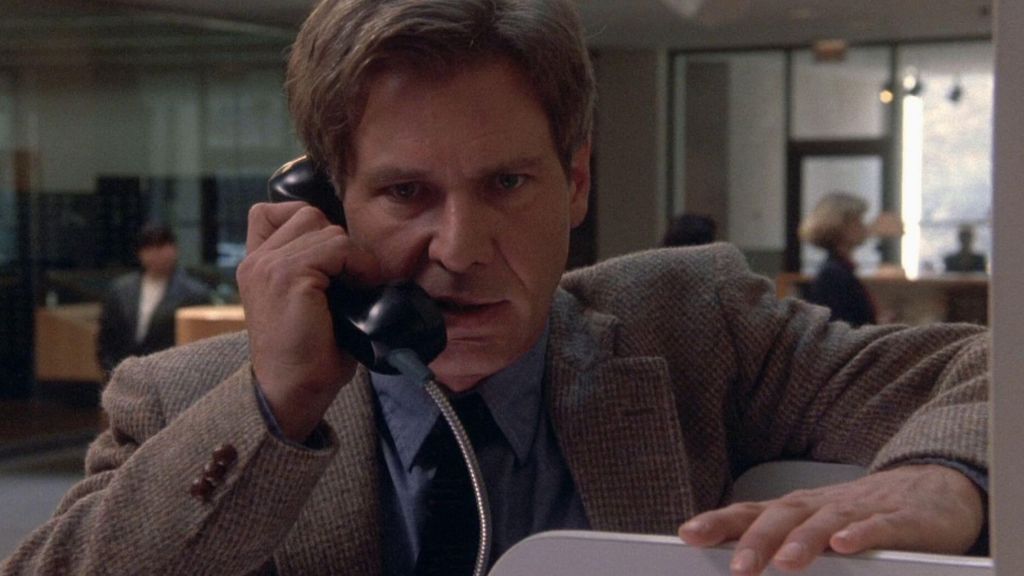
Directed by Andrew Davis, The Fugitive functions as a high-velocity procedural that centers on the tactical logistics of a multi-state manhunt. The story follows Richard Kimble (Harrison Ford), a vascular surgeon who escapes a transport bus after being wrongfully convicted of his wife’s murder. His survival depends on his ability to utilize his medical expertise and urban anonymity to identify the true killer while evading the U.S. Marshals. The pursuit is led by Sam Gerard (Tommy Lee Jones), whose team utilizes real-time communication and geographic tracking to close the distance on their target.
The Fugitive’s strength lies in the intellectual parity between the hunter and the hunted, where every tactical decision leads to a calculated response from the opposition. The narrative also avoids typical action clichés by focusing on the competence of the law enforcement officials and the protagonist’s logical problem-solving. This commitment to procedural realism helped the film gross over $368 million and secured an Academy Award for Best Supporting Actor for Jones.
4) Den of Thieves

Directed by Christian Gudegast, Den of Thieves explores the morally ambiguous world of elite law enforcement and tactical bank robberies. The film features Gerard Butler as “Big Nick” O’Brien, a hard-drinking, rule-breaking detective leading a specialized unit of the Los Angeles County Sheriff’s Department. His target is a crew of ex-military specialists led by Ray Merrimen (Pablo Schreiber) and the cunning driver Donnie Wilson (O’Shea Jackson Jr.), who are planning a high-stakes heist on the Federal Reserve Bank.
Den of Thieves echoes Copshop through its focus on the gray areas of heroism, depicting the police as a gang that is just as aggressive and territorial as the criminals they pursue. The narrative emphasizes the physical and psychological toll of this lifestyle, utilizing hyper-realistic sound design and meticulously choreographed shootouts to convey the lethality of modern urban combat. Den of Thieves prioritizes procedural detail and heavy-duty practical action, making it a perfect follow-up to Copshop.
3) Reservoir Dogs

The 1992 directorial debut of Quentin Tarantino, Reservoir Dogs, mirrors the character-driven confinement of Copshop by trapping a group of professional criminals in a single warehouse after a diamond heist goes bloodily wrong. The narrative focuses on the psychological erosion that occurs when Mr. White (Harvey Keitel) and Mr. Pink (Steve Buscemi) begin to suspect that their team has been infiltrated by an undercover police officer. This suspicion is exacerbated by the presence of a dying Mr. Orange (Tim Roth), whose deteriorating physical state serves as a ticking clock for the group’s unraveling trust.
Much like the dialogue-heavy jailhouse scenes in Copshop, Reservoir Dogs’ script prioritizes the “professionalism” of the characters, using their distinct criminal codes to heighten the friction between them. Tarantino also utilizes a non-linear structure to reveal the tactical errors of the heist, ensuring that the eventual explosion of violence feels like a logical conclusion to the mounting paranoia. The film’s $1.2 million budget forced a reliance on performance and pacing, establishing its legacy as a masterpiece of independent thriller cinema.
2) Assault on Precinct 13
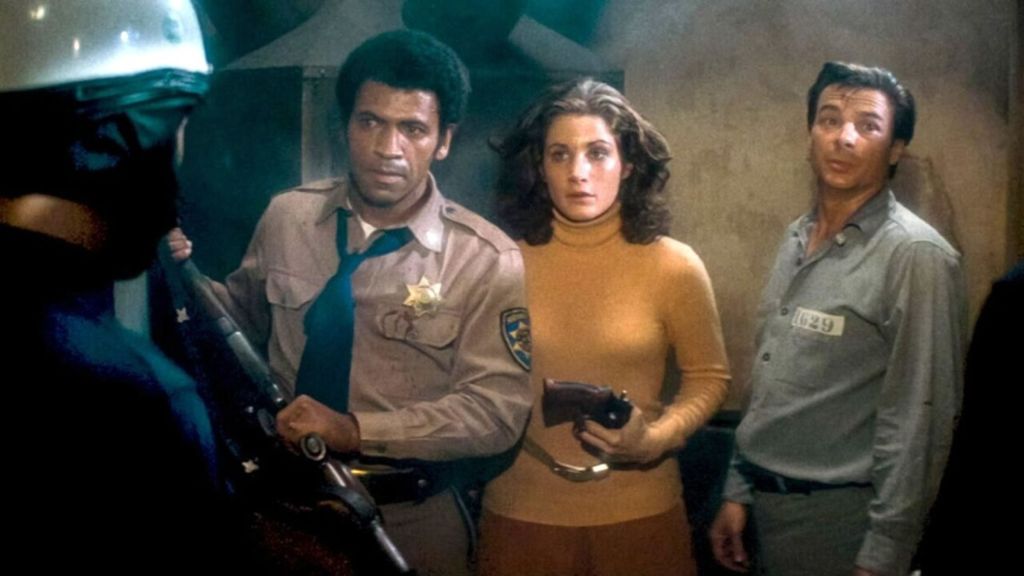
John Carpenter’s 1976 classic Assault on Precinct 13 serves as the foundational blueprint for the “isolated siege” narrative utilized in Copshop. The plot centers on a decommissioned police station where a skeletal crew, led by Lieutenant Ethan Bishop (Austin Stoker), must defend themselves against a relentless street gang seeking revenge for a police shooting. This desperate situation forces an uneasy alliance between the law enforcement officers and a convicted murderer named Napoleon Wilson (Darwin Joston), whose survival instincts become the station’s greatest asset.
Assault on Precinct 13 utilizes a minimalist score and stark lighting to build an atmosphere of claustrophobic dread, emphasizing the vulnerability of the protagonists against an overwhelming force. By stripping the antagonists of individual identities, Carpenter transforms the siege into a primal struggle for survival that deconstructs the traditional boundaries between criminals and heroes. This lean approach to storytelling allowed the production to achieve a level of tension that many big-budget contemporary thrillers fail to replicate.
1) Heat
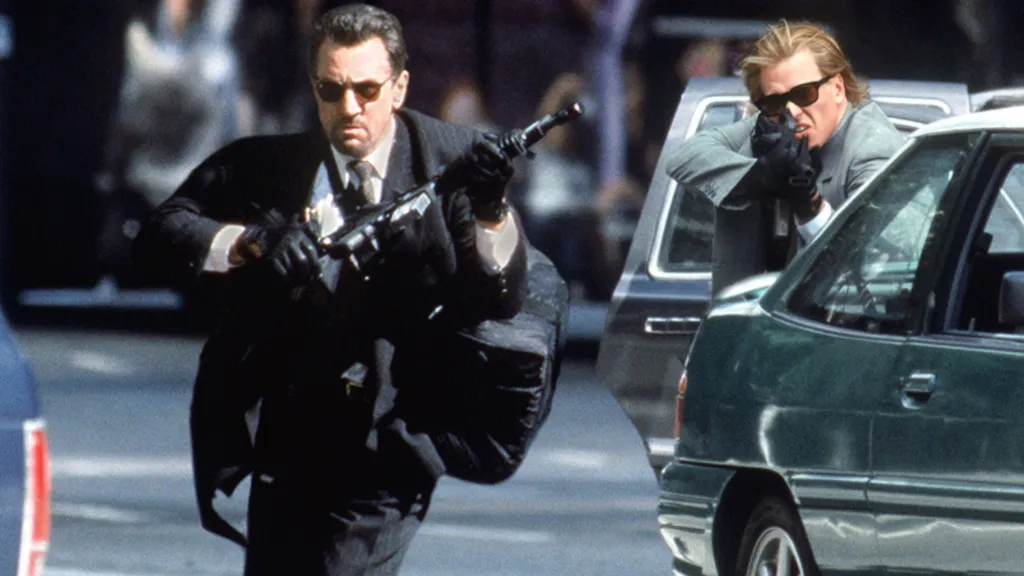
Michael Mann’s Heat stands as the definitive exploration of the professional respect that can exist between antagonists on opposite sides of the law. The narrative follows LAPD Lieutenant Vincent Hanna (Al Pacino) as he obsessively tracks a disciplined crew of bank robbers led by Neil McCauley (Robert De Niro). The film’s core revolves around the realization that both men are defined by their singular commitment to their craft, a trait that renders them incapable of maintaining functional personal lives or stable relationships. This thematic focus is famously encapsulated in a restaurant scene where the two characters confront each other with calm, professional honesty, acknowledging that they will not hesitate to kill the other if necessary.
Heat utilized live recordings of weapon fire during its landmark downtown Los Angeles shootout, creating a visceral sonic environment that redefined the standards for cinematic realism. This technical precision and philosophical depth allow the 1995 film to function as both an expansive epic and an intimate character study regarding the cost of professional excellence.
Which thriller do you think best captures the high-stakes tension found in Copshop? Leave a comment below and join the conversation now in the ComicBook Forum!
Most Viewed
-

Image Courtesy of TOHO -

Image Courtesy of Crunchyroll -

Image Courtesy of Marvel Comics -

Image courtesy of Marvel Studios -

Image Courtesy of Good Shepard Entertainment/Sony Interactive Entertainment