The Predator franchise has endured for nearly forty years as a cornerstone of the science fiction and horror genres, primarily due to the strength of John McTiernan’s original 1987 masterpiece. While the series experienced several decades of inconsistent quality and narrative direction, director Dan Trachtenberg is currently spearheading a significant Predator renaissance. By prioritizing a more focused approach to the Yautja lore, Trachtenberg has successfully revitalized interest in the species’ ancient history and cultural complexity. That’s because the modern entries have provided a connective tissue that allows audiences to view the series as a layered chronicle of the interstellar hunters’ relationship with Earth.
Videos by ComicBook.com
Despite the newfound narrative stability of the Predator franchise, certain cinematic installments remain excluded from a definitive canon watch order. The Alien vs. Predator crossovers, for instance, are on the fringes of the mythology, operating within a separate continuity that prioritizes spectacle over rigorous internal logic. Similarly, the 2018 film The Predator is widely disregarded by fans and Trachtenberg due to its poorly received narrative choices and tonal inconsistencies. Also, since that specific installment failed to provide any lasting lore implications that the current renaissance cares to explore, it is best omitted from a streamlined marathon. Instead, by following a chronological path through the most vital entries, fans can experience a world where the Yautja’s presence on Earth spans centuries of evolution.
1) Prey

Released in 2022, Prey serves as the foundational entry in the chronological watchlist, underlining how the Yautja are an ancient threat rather than a modern interloper. Set in 1719 within the Great Plains, the narrative follows a young Comanche warrior named Naru (Amber Midthunder) as she attempts to protect her tribe from a highly evolved extraterrestrial hunter. By stripping away the high-tech military hardware of previous films, director Dan Trachtenberg emphasizes the primitive skill and environmental awareness required to survive an encounter with a Feral Predator. This historical setting is also critical for the franchise’s lore because it establishes that Earth has functioned as a ceremonial hunting ground for the Yautja for hundreds of years. Furthermore, the movie introduces the Raphael Adolini 1715 flintlock pistol, a crucial artifact that bridges this prequel and the later events of the Predator sequels.

2) Predator
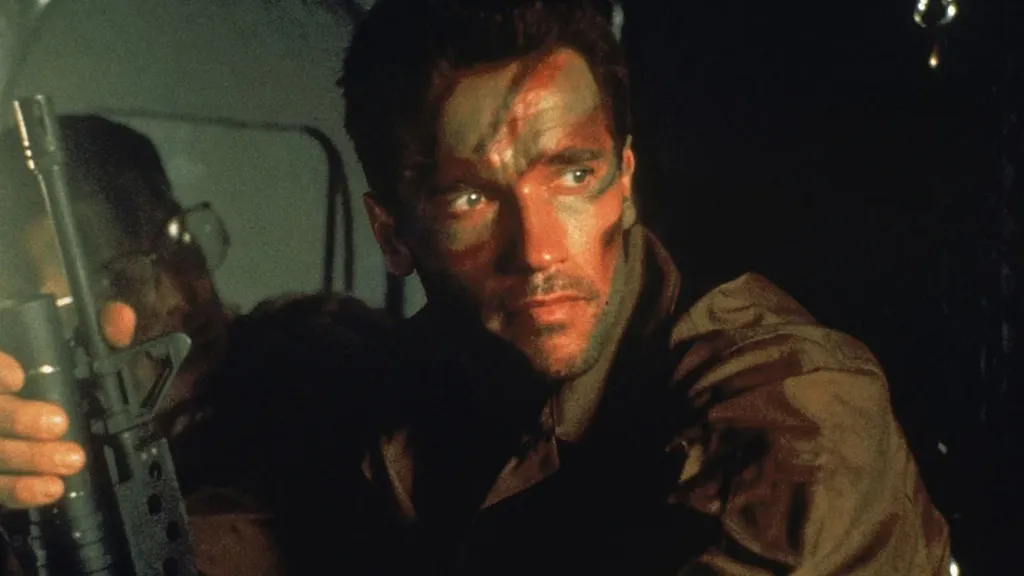
The original Predator remains the definitive template for the series, establishing the rules that every subsequent filmmaker must follow. The plot centers on a paramilitary rescue team led by Dutch (Arnold Schwarzenegger), who are systematically hunted in a Central American jungle by a cloaked entity utilizing thermal vision and advanced plasma weaponry. Unlike the historical setting of the previous entry, Predator focuses on the peak of human military capability being rendered obsolete by an indifferent and superior creature. On top of that, the production’s use of practical effects and Alan Silvestri’s iconic score creates a mounting sense of dread that transitions from a standard action thriller into a claustrophobic horror film. By the time Dutch engages in his final battle with the creature, the movie has successfully defined the Yautja’s code of honor and their habit of collecting trophies from worthy adversaries.
3) Predator 2
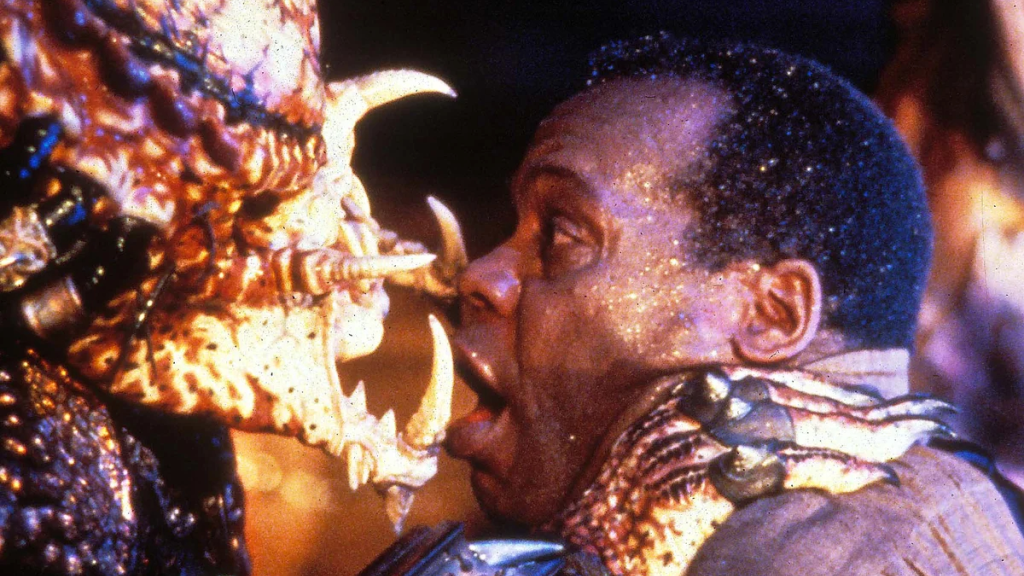
Taking the hunt from the jungle to the urban sprawl of 1997 Los Angeles, Predator 2 significantly expanded the scope of the Yautja’s presence in human society. In the movie, detective Mike Harrigan (Danny Glover) finds himself caught in the middle of a brutal gang war that is being exploited by a new Yautja who thrives on the city’s extreme heat and chaos. This sequel is essential for lore enthusiasts because it offers the first glimpse into the interior of a Yautja spacecraft, revealing a trophy room that includes a Xenomorph skull and various historical weapons. The most significant lore connection occurs during the film’s climax when the elder Predator rewards Harrigan with the Raphael Adolini 1715 flintlock pistol first seen in Prey. This exchange confirms that the hunters honor those who defeat them and suggests a lineage of successful hunts that ties the 18th-century prequel directly to the modern era.
4) Predators

Produced by Robert Rodriguez, the 2010 film Predators took the franchise off-world to explore the social hierarchies of the hunter species. The story follows a group of elite human killers, including a mercenary named Royce (Adrien Brody), who are abducted and dropped onto an alien game preserve planet. This installment is particularly noteworthy for introducing the concept of different Yautja clans, specifically the “Super Predators,” who are larger and more ruthless than the classic version seen in earlier films. By depicting a bloody feud between these two subspecies, the narrative reveals that the Yautja are not a monolithic culture but are instead prone to internal civil wars and evolutionary competition. While the film is far from perfect, its primary contribution to the lore is the realization that the hunt is a universal industry for the Yautja, spanning multiple planets and utilizing biological engineering to improve their efficiency.
5) Predator: Killer of Killers

The animated anthology Predator: Killer of Killers reinforces the Yautja’s long-standing history with Earth by depicting several distinct hunts across different centuries. The narrative initially presents three separate vignettes featuring a Viking warrior named Ursa (voiced by Lindsay LaVanchy), a disgraced samurai called Kenji (voiced by Louis Ozawa), and a World War II fighter pilot named Torres (voiced by Rick Gonzalez). While these historical sequences highlight the Yautja’s tactical adaptability, the film’s significant contribution to the lore occurs during a brutal finale set within a gladiatorial arena on an arid alien world. The gladiatorial setting reveals that those who manage to kill a Predator are often abducted and held in suspended animation. The film’s final image confirms this practice by showcasing Naru from Prey inside a cryogenic pod alongside other legendary survivors like Dutch Schaefer and Mike Harrigan.
6) Predator: Badlands

Set decades in the future on the hostile planet Genna, Predator: Badlands shifts the franchise’s perspective by making a Yautja the primary protagonist. The story follows Dek (Dimitrius Schuster-Koloamatangi), an outcast runt of his clan who must survive in a “death planet” to prove his worthiness to his father and leader, Njohrr. Along his journey, Dek forms an unlikely alliance with Thia (Elle Fanning), a synthetic being belonging to the Weyland-Yutani Corporation. This dynamic allows the film to delve deeper into Yautja culture and worldview than any previous installment, exploring the internal social pressures and ritualistic requirements of their species. Furthermore, by removing the traditional human victim narrative, Trachtenberg examines the Predator’s sense of honor and survival from a biological and cultural standpoint, transitioning the franchise into a sprawling space-fantasy epic.
Which era of the Predator timeline do you think offers the most untapped potential for future historical sequels? Leave a comment below and join the conversation now in the ComicBook Forum!
Most Viewed
-

Image courtesy of Amazon MGM Studios -

Image courtesy of Tor Books/Macmillan -

Image Courtesy of MAPPA