For lifelong fans of Marvel’s First Family, Fantastic Four: First Steps was more than just another superhero movie; it was a chance to see beloved characters, iconic moments, and the very essence of what made the Fantastic Four so special brought to life on the big screen in a way previous adaptations could not. We yearned for the camaraderie, the scientific wonder, and yes, the catchphrases that had echoed through comic panels for over six decades. As the story unfolded, following the team’s efforts to save their world and Reed and Sue’s baby from Galactus, there was one glaring omission.
Videos by ComicBook.com
While the film focused on establishing Reed, Sue, Johnny, and Ben as a family who would go to great lengths for one another, it inexplicably sidestepped a moment synonymous with the Human Torch: Johnny Storm’s electrifying catchphrase of “Flame On!” This wasn’t merely a missed line of dialogue; it was a significant aspect of Johnny’s fiery persona that was purposefully overlooked.
First Steps Presents A Whole New Version of Johnny Storm

The decision to leave Johnny Storm’s quintessential “Flame On!” catchphrase out of Fantastic Four: First Steps was a curious choice, especially given the character’s long history and the immediate, exciting, and nostalgic effect that phrase evokes among comic book enthusiasts. Instead of Johnny’s famous line, the film opted for a more organic and less clumsy manifestation of Johnny’s powers. Johnny Storm in Fantastic Four: First Steps is a master of his powers, having lived with them for four years when the film begins. He does not struggle with trying to ignite his powers or control them; he is already an expert like the rest of his teammates.
This approach undoubtedly aimed for a more grounded and realistic portrayal of Johnny’s expertly honed extraordinary powers. He does not need a trigger phrase, so to speak, as his powers are an inherent part of him from the outset of the film. This deliberate sidestep from a direct “Flame On!” reference allowed for more visual storytelling of his powers, focusing on the sheer spectacle and precise control Johnny has over his flames.

The film does, however, ingeniously acknowledge the catchphrase in a meta-textual way, though it only serves to highlight its absence from Johnny’s lips. In a humorous moment, Johnny discovers a cereal box toy of himself – a clear nod to the commercialization of the Fantastic Four in their universe– which is pre-programmed to repeatedly say “Flame On!” This brief, almost mocking inclusion allows the film to wink at the audience, acknowledging the phrase’s existence in the pop culture of the Fantastic Four’s Earth while simultaneously ensuring Johnny himself never says it.
His gleeful teasing of Ben with the toy, making it repeat the phrase to Ben’s mounting frustration until Ben ultimately crushes the toy, is a moment of pure comedic brilliance. It perfectly encapsulates their teasing yet affectionate and brotherly dynamic. It’s almost as if the filmmakers were saying, “Yes, we know the phrase, but we’re choosing a different path for Johnny.”
The Film Prioritized a Different Catchphrase, Leading to a Balancing Act of Iconic Moments
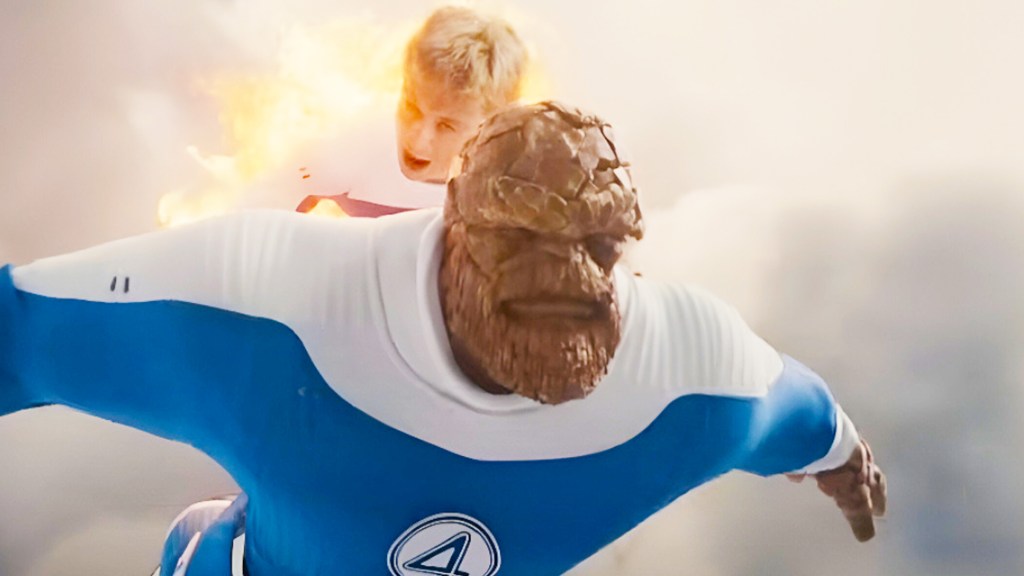
While Johnny’s iconic phrase was notably absent from his own dialogue, the film made a conscious and very deliberate effort to establish another classic Fantastic Four catchphrase: Ben Grimm’s “It’s clobberin’ time!” Throughout the movie, considerable weight is placed on Ben’s refusal to say the line that originated in an in-universe cartoon of the team and not from Ben himself. He constantly reminds those calling for him to say the catchphrase that he never actually coined or spoke those three words. Even Johnny teases Ben, trying to get him to say the phrase multiple times in a playful manner. This recurring joke ultimately culminates with Johnny finally convincing Ben to say “it’s clobberin’ time” during their climactic battle with Galactus.
The journey to this moment is meticulously crafted and is perfectly placed, as no threat is more worthy of “clobberin’” than Galactus. This slow burn, leading to the climactic moment, undeniably lands with a significant emotional punch. The audience is primed for this moment, and when it finally arrives, it feels earned and impactful, eliciting cheers from many movie-goers.
This clear emphasis on “It’s clobberin’ time” suggests that the filmmakers might have felt that two prominent, almost equally iconic catchphrases in one film would have been excessive or potentially gimmicky. Director Matt Shankman repeatedly stated that he wanted to bring a more grounded and family-focused feel to the Fantastic Four’s long-awaited debut in the MCU. Introducing both “Flame On!” and “It’s Clobberin’ Time!” might have tipped the scales a bit too far into self-referential territory. The decision to prioritize Ben’s catchphrase could be seen as a strategic move to focus on one character’s crucial emotional arc and allow that particular moment to land more powerfully without competition.
While the absence of “Flame On!” for Johnny is certainly felt by fans, the film’s dedicated build-up to “It’s Clobberin’ Time!” demonstrates a clear choice. It highlights a potential balancing act on the part of the filmmakers, weighing the desire to include fan-favorite elements without making the entire film about fan service. Ultimately, while Fantastic Four: First Steps succeeded in delivering a memorable “It’s Clobberin’ Time!” moment, it did so at the expense of an equally anticipated “Flame On!” for Johnny Storm, leaving the opportunity open for Johnny to have his own moment in a future outing‒ perhaps even Avengers: Doomsday.
Most Viewed
-
Courtesy of TOHO Animation -

Image Courtesy of A-1 Pictures -
Image Courtesy of Marvel Comics -

Image Courtesy of Marvel