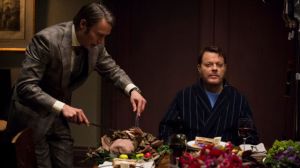
Given how many conversations we’ve heard about a potential revival for Hannibal, it’s shocking to note that a decade has now passed since NBC pulled the plug. In the end, it was ratings that killed the show and Mads Mikkelsen’s all-timer villain performance, and several attempts to revive Hannibal for a fourth season have so far amounted to nothing. Here’s hoping another course will be on the menu at some point, but in the meantime, Mikkelsen and Hannibal creator Bryan Fuller do have another horror collaboration arriving this month.
Videos by ComicBook.com
Fantastical horror Dust Bunny brings the Hannibal pair back together after ten years, and heads into cinemas on December 12. Inevitably, when ComicBook sat down with Fuller, the question of the reunion came up, and specifically what it was like directing Mikkelsen in a role that wasn’t their most famous collobaration:
“Liberating because Mads is nothing like Hannibal. He is kind of a sloppy guy who likes his soccer and his McRib sandwiches and who loves his grandchildren and dog. He isn’t as refined or pretentious as that character. I was excited about working with him on a character that is much closer to the Mads that I know as my friend, as my brother from this industry. So, I was excited to show people, particularly the scene with Sigourney outside the elevator, the version of Mads that I get to see when I talk to the playfulness of him. I was like, “You are so charming and funny and light on your feet and quick.” I wanted to tell a character that had access to that levity that Hannibal never had.”
In a separate interview, ComicBook also sat down with both Fuller and Mikkelsen, and the actor also gave his thoughts on the different challenges his Dust Bunny character – The Neighbor – presented, compared to Hannibal, given both have, let’s say, social issues:
“I think that Hannibal is not detached. He’s just very picky when he’s emotionally attached, right? He chooses. This guy is socially awkward: he just doesn’t have
social skills for that reason. He’s also living by himself, and he’s doing fine with that. So… he’s just a different character. Whether it was an adult or a kid, it didn’t really matter; he’s just not good at communicating with people. And uh and when it’s a in this case, it’s a kit and it’s an insisting kid and it’s a lying kid, it’s a very uphill battle for The Neighbor.”
Our full interview with Bryan Fuller continues below.
Buffy the Vampire Slayer’s Anya will tell you that absolutely nothing is more frightening than bunnies. That rings true in Dust Bunny, the feature film directorial debut of Hannibal and Pushing Daisies creator Bryan Fuller.
Bouncing into theaters on December 12, the movie follows Aurora [Sophie Sloan], a 10-year-old girl convinced her parents were consumed by a ravenous floppy, hoppy monster dwelling under the apartment floors. To quell those fears, she contracts a skeptical hitman-for-hire neighbor [Mads Mikkelsen] to slay the beast. But as the two bond and the danger mounts… including a horde of assassins descending upon them… it becomes abundantly clear that this bunny menace is no figment of a child’s imagination. And if Aurora and her new protector don’t tread carefully, they could be next on its menu.
ComicBook sat down with Fuller the day after Dust Bunny’s TIFF Midnight Madness premiere to discuss the film’s inception, conceptualizing the nightmarish critter, leaning into practical effects, drawing on personal experiences and reuniting with Mikkelsen.
ComicBook: Dust Bunny began as an Amazing Stories pitch. How did that idea shape into a feature film?
Bryan Fuller: Television is one form of storytelling, so when it was an Amazing Stories, it was smaller and more contained. It’s pretty contained now, but it was broader strokes… probably less about Aurora… and more about the hitman. Then when it didn’t make it though the Amazing Stories gauntlet, I was like, “This is a movie and it should be my first movie.” I really wanted to dig into Aurora and make it a very personal story of somebody in a tricky home environment, who is managing to survive this adverse condition.
You not only have to flesh it out, but there’s a larger scope and scale in play…
We were under 20, which is a lot of money. There is one thing I learned in television is that style is cheap, and it elevates a production in a way that is unexpected. Hannibal was so dark because our sets look so cheap. I was like, “We can’t turn on the bright lights with this.” There’s those lessons and how the selective insert will elevate the production value of a story in unexpected ways because if you are photographing this teapot and it looks beautiful, then everything on either side of the teapot will be raised by how beautiful that insert is. There are a few select inserts in Dust Bunny. I wish we had the time and resources to do more.
What was your vision for this big, badass bunny? And in what ways did it evolve from concept to screen?
I reached out to Jon Wayshack, who is a comic book artist that did the art for the Pushing Daisies comic that never came to pass. I loved his look on characters. They feel slightly mad. They are a little bit heightened. The right things are exaggerated so that they are totally the characters that you identify, but they are mad. There’s an insanity to them that I found really captivating.
Once the movie started to move forward, I reached out to Jon. I was like, “Hey, want to design a monster?” And he was like, “Absolutely.” I said, “It’s part highland cow, part piranha, part hippopotamus and all bunny.” He did a couple of sketches. One had horns. We made a couple of tweaks. Legacy took that and evolved it as they were making the practical puppet. Then, our visual effects house took that and made it into something that was going to match the puppet and be a full-bodied figure that we needed to stomp around the room when appropriate.
Viewers don’t witness the monstrous bunny in all its glory until near the end of the film. Why was it important to go practical as opposed to going full CGI?
If it were adult characterizations, I would have been less likely to do a puppet because they are expensive. It’s a big chunk of the budget. You are like, “Oh shit. That’s money we no longer have that is going to this thing, that could be CG.” But having the real guy on set and seeing Sophie’s reaction to the puppet and knowing that is her monster and that was the thing she would be facing, that was important to build a reality for a child actor to be able to access and react in a way that is more authentic. Sophie is a lovely actor and she could have done it without it, but it’s more fun. To build a puppet is more fun.
This movie contains so much heart and soul. One of the poignant themes involves fixing yourselves. What do you want people to take away from this experience?
One of my favorite friendships from the movie is we had a fantastic wardrobe team. Catherine Leterrier did all of Sigourney Weaver’s costumes. She has been working with Sigourney since Gorillas in the Mist. And Olivier Beriot did everybody else. They worked in collaboration because they had been working together for a decade.
When he first got to Budapest, we had been talking vis zoom. He came up to me after a production meeting and was like, “Can I just talk to you about this? Can we sit down and talk about the script? I have so many questions and they are not about the work. They are about why you wrote it.” We had this wonderful brunch at the Four Seasons in Budapest and he was like, “How are you Aurora? Are you the neighbor or are you Aurora?” I was like, “I’m Aurora.” “How are you Aurora?” And I was like, “How are you Aurora?” That’s the conversation I would love people to have is how they are a self-reliant, heroic child who also needs a friend. He told me how he is Aurora. And I was like, “This is what I want. I want people to tell how they see themselves in the character.” The movie doesn’t give too much away about Aurora’s backstory. It’s a couple of lines and its very purposeful because I want people to interact with the experience and say, “What is something that has happened to me that I would make the wish that Aurora wishes?” Anybody who has had a tricky childhood can answer that question more quickly than others.
My takeaway is Sigourney says in the film, “This isn’t going to fix you, but I think it will help.” It definitely helped me writing the character and saying things that were very common to me as a child in terms of making that wish everyday and having it not come true. And people who might have made a different wish, but being able to say, “That’s actually a real place of pain experience that the movie doesn’t want to distract you with.” So, it’s about the audience member bringing that to their experience and how they see themselves in Aurora and why they might have made some of the choices as children that she does.
Dust Bunny will open in theaters on December 12 from Lionsgate and Roadside Attractions.
What do you think? Leave a comment below and join the conversation now in the ComicBook Forum!
Most Viewed
-

Sony Animation -
Image courtesy of Lucasfilm -

Image courtesy of DC Studios