The revival of the Star Trek franchise that began with the Kelvin timeline movies and continued with the premiere of Star Trek: Discovery transformed a dormant property into a sprawling television universe. Paramount successfully utilized the brand to anchor its streaming platform, launching a diverse slate of programming that modernized the visual language of the Alpha Quadrant, ranging from the nostalgia-heavy reunion of Star Trek: Picard to the comedic animation of Star Trek: Lower Decks. As a result, the franchise is currently celebrating its 60th anniversary in 2026 with an unprecedented volume of content, including the recent premiere of Star Trek: Starfleet Academy, which explores the complexities of the 32nd century.
Videos by ComicBook.com
While it’s great that the franchise is thriving, the current iterations of Star Trek frequently abandon the deliberate pacing of the classic broadcast era in favor of serialized streaming models. While Star Trek: Strange New Worlds successfully recaptured the episodic structure of the original adventures, viewers who grew up watching practical models soar across the screen often desire a return to an era of rigid naval protocols, brightly lit bridge sets, and standalone moral dilemmas. Fortunately, there are other great sci-fi series that offer a combination of optimistic diplomacy and great ensemble chemistry.
5) Star Trek Continues

Star Trek Continues stands as the definitive triumph of independent, fan-funded television production. The web series centers on Captain James T. Kirk (Vic Mignogna) and is specifically designed to complete the original five-year mission that was abruptly canceled by NBC in 1969. The production team meticulously recreated the original Desilu Studio sets, ensuring that every console button and uniform fabric accurately matches the 1960s aesthetic. This dedication to visual authenticity extends to the lighting and cinematography, resulting in episodes that seamlessly blend with the classic broadcast run. Furthermore, the writing prioritizes the humanist philosophy established by Gene Roddenberry, tackling complex social issues through the lens of classic science fiction allegories. The series provides an essential viewing experience for audiences who desire the exact tone and structural pacing of the original 1960s space western, and even though it’s a fan-made web series, it maintains a high quality across all episodes.
4) Andromeda
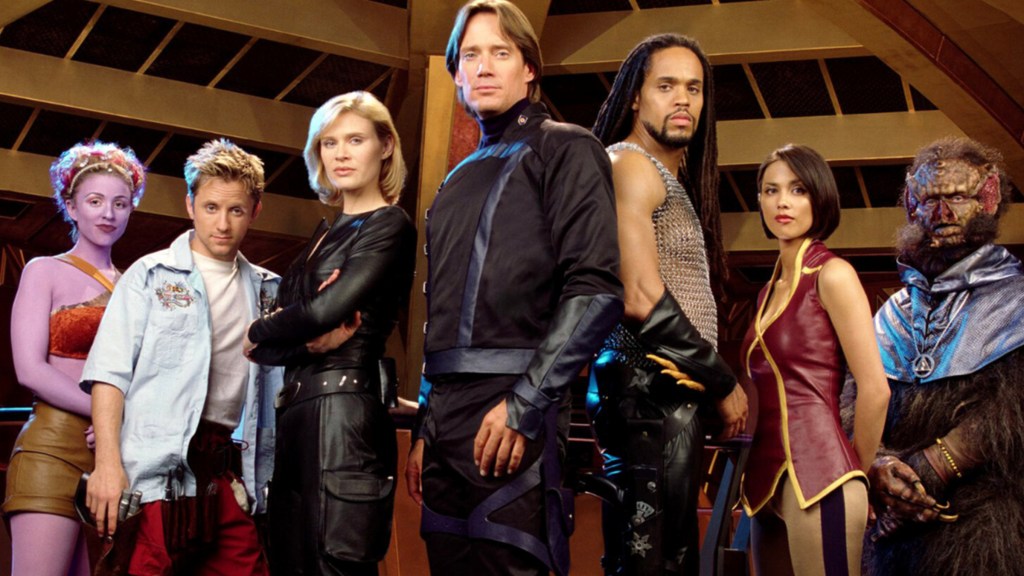
Developed from unused concepts written by Gene Roddenberry, Andromeda functions as an aggressive exploration of space operatic tropes within a post-apocalyptic universe. The narrative follows Captain Dylan Hunt (Kevin Sorbo), a commanding officer who is frozen in time for three centuries, only to awaken and find his utopian Systems Commonwealth destroyed. Hunt utilizes his advanced warship, the Andromeda Ascendant, to recruit a cynical crew of mercenaries and embark on a mission to restore order to the galaxy. The premise explicitly mirrors the foundational optimism of the Federation, framing the protagonist as an unwavering beacon of diplomacy in a lawless era. The early seasons, overseen by Robert Hewitt Wolfe, emphasize the tactical challenges of commanding a massive vessel and the ideological friction between the diverse crew members. The series also utilizes physical prosthetics for its alien species and relies on episodic planetary conflicts, satisfying the specific craving for old-school Star Trek.
3) Stargate SG-1

Stargate SG-1 successfully expanded a feature film concept into one of the longest-running and most reliable science fiction shows in television history. The series centers on a specialized military exploration team led by Colonel Jack O’Neill (Richard Dean Anderson), tasked with traveling through an ancient portal network to defend Earth against parasitic alien conquerors. The narrative structure relies heavily on episodic planetary exploration, forcing the main characters to navigate bizarre cultures, negotiate complex alliances, and solve intricate ethical dilemmas. This formula provides the exact sense of weekly discovery that defined the golden age of Star Trek. In addition, the chemistry among the core cast members anchors the high-concept mythology, establishing a profound sense of workplace camaraderie that rivals any starship bridge crew.
2) Babylon 5

Created by J. Michael Straczynski, Babylon 5 revolutionized televised science fiction by committing to a pre-planned, five-year narrative arc long before serialized storytelling became the industry standard. The setting is a massive space station that functions as a diplomatic neutral zone for rival alien empires, commanded initially by Commander Jeffrey Sinclair (Michael O’Hare) and later by Captain John Sheridan (Bruce Boxleitner). The rigid focus on interstellar politics, trade negotiations, and the looming threat of an ancient war mirrors the complex sociopolitical conflicts found in the darkest corners of the Alpha Quadrant. The narrative treats alien ambassadors like G’Kar (Andreas Katsulas) and Londo Mollari (Peter Jurasik) with intense psychological depth, transforming them from standard antagonists into tragic figures. This intricate world-building offers a politically charged alternative for viewers who appreciate the gritty realism of Star Trek‘s deep space diplomacy.
1) The Orville

The Orville executed a remarkable tonal evolution, beginning its broadcast life as a comedic homage and subsequently maturing into a sincere spiritual successor to old-school Star Trek. Created by Seth MacFarlane, who leads the series as Captain Ed Mercer, the show utilizes a familiar aesthetic of brightly lit corridors, color-coded uniforms, and orchestral musical scores. The writers deliberately mimic the narrative cadence of the late twentieth century, focusing heavily on workplace dynamics and the philosophical responsibilities of space exploration. On top of that, the episodes frequently employ the classic morality play format, using alien societies to investigate terrestrial issues like gender identity, religious dogmatism, and the ethics of artificial intelligence. The Orville proves that the structural conventions of classic Star Trek remain incredibly effective vehicles for sincere and intellectually stimulating storytelling.
Which science fiction series do you think best captures the optimistic spirit of planetary exploration set by Star Trek? Leave a comment below and join the conversation now in the ComicBook Forum!
Most Viewed
-

image courtesy of Studio Ghibli -

Image Courtesy of Toei Animation -

Image courtesy of Studio Bones