In 1973, Doctor Who treated viewers to the first-ever multi-Doctor story as part of the show’s 10-year anniversary. It began a tradition of anniversary epics, including some of the memorable Doctor Who stories ever made. In theory, these completely break the laws of time – so much so that some early stories required Time Lord technology to make them possible. But what makes a good multi-Doctor story, and how do these rank?
Videos by ComicBook.com
Before we begin, a quick clarification. A proper multi-Doctor story isn’t one in which another Doctor has a brief cameo (such as the end of “The Reality War” with Jodie Whittaker’s unexpected return). Nor is it a regeneration story with a gimmick, meaning “The Giggle” and its bigeneration is ruled out of this too. What’s more, we’re only going to look at the main TV show, not the (phenomenal) Big Finish multi-Doctor stories or the “Time Crash” Children In Need event featuring David Tennant and Peter Davison. With that said, here’s our multi-Doctor ranking.
5. The Two Doctors
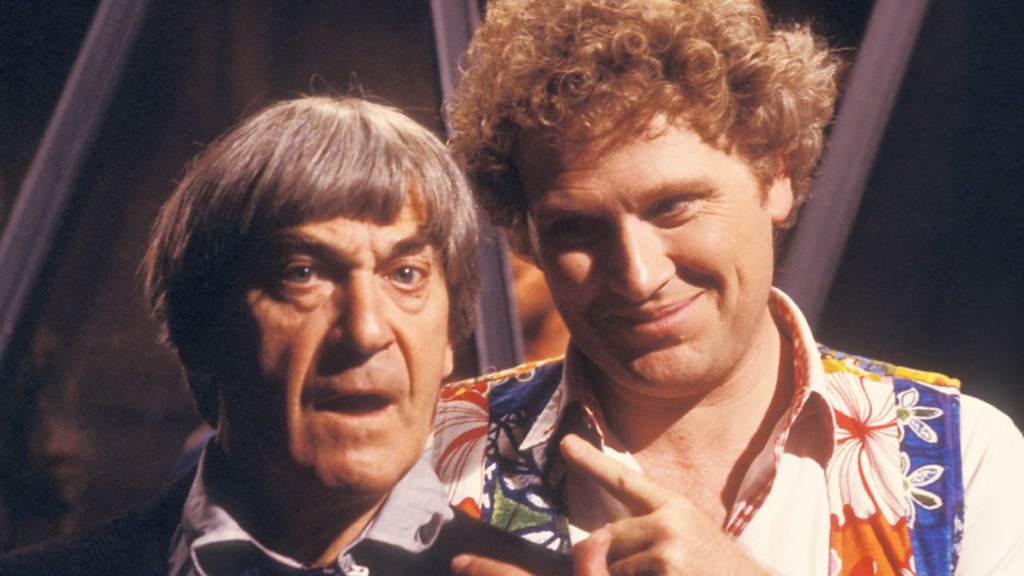
Most of these stories are essentially anniversary specials, celebrations of Doctor Who‘s history. 1985’s “The Two Doctors” is an exception, because it was commissioned purely because a previous multi-Doctor story had been a hit. Featuring Colin Baker and Patrick Troughton, it’s also one of the most bizarre Doctor Who stories ever, written as an allegory of the meat industry. There’s something rather oddly meta to the narrative, a criticism of nostalgia in a story driven entirely by nostalgia.
That, ultimately, is what makes “The Two Doctors” a failure. Writer Robert Holmes penned a script that’s rather more cynical than celebratory, and it manages to make Troughton’s Second Doctor feel utterly unlikable as a character. When he learns that experiments are being conducted on aliens known as Androgums, he isn’t appalled for their sake; rather, he insists that you can’t change the nature of an Androgum, viewing them with distaste and disgust as “barbarians.” “You give a monkey control of its environment, it’ll fill the world with bananas,” he insists.
Colin Baker’s tenure as the Sixth Doctor had a strange edge to it. The writing stressed the Doctor’s sense of superiority over his companions, giving him an almost abusive relationship with them. Sadly, “The Two Doctors” applies that idea to Troughton as well, meaning not one but two incarnations of the Doctor feel utterly unlikable. It’s really not hard to see why this story is seen as one of the worst Doctor Who stories, despite its all-star cast and sheer potential.
4. Twice Upon a Time
Doctor Who‘s 2017 Christmas Special, “Twice Upon a Time,” is a delight despite its many flaws. Steven Moffat had planned to end his tenure with Season 10, but his replacement Chris Chibnall didn’t want to start with a special, so chose to stay on and save the Christmas slot. The entire story is inspired by a line reportedly cut from Doctor Who‘s first regeneration story, “The Tenth Planet,” that hinted the Doctor resisted the change. Moffat made this the main hook, with Capaldi’s Twelfth Doctor colliding with the First while both were in a similar emotional state.
Like many Moffat stories, “Twice Upon a Time” is an interrogation of Doctor Who‘s evolution. The dynamic between Capaldi and David Bradley’s version of the First Doctor is tremendous, with the First Doctor utterly bewildered by all the tropes modern viewers have come to know and love. Initially intimidated by his future, even considering letting the regeneration fail because he fears it, the First Doctor eventually learns his lives are in safe hands and chooses to allow the change. The Twelfth Doctor, meanwhile, finds cause for the same optimism and chooses regeneration too.
“Twice Upon a Time” has a general reverence for Doctor Who‘s history and lore (one subplot features the grandfather of Nicholas Courtney’s Brigadier Lethbridge-Stewart). That said, one aspect of the First Doctor’s portrayal sits uncomfortably with many Whovians; several scenes use the First Doctor as an image for social change, demonstrating a casual misogyny and a degree of homophobia. It’s easy to see what Moffat was trying to do there, but he doesn’t quite pull it off, because the Doctor is the wrong character through which to explore these ideas.
3. The Three Doctors

Doctor Who‘s first multi-Doctor story released in 1973, uniting William Hartnell, Patrick Troughton, and Jon Pertwee. Recognizing the significance of this milestone, writers Bob Baker and Dave Martin penned a script in which the team-up has to be arranged by the Time Lords. The stakes are higher than ever before, driven by the Time Lord solar engineer named Omega who seeks to return from a universe of antimatter – and intends to do so by draining Gallifrey of all its power. The Time Lords are forced to turn to the Doctor(s) for help, the only Time Lords they can safely reach who aren’t trapped on Gallifrey.
The concept is a smart one, and the dynamic between Pertwee and Troughton is a particular delight; the script plays to the Doctor’s confidence and arrogance, his tendency of being “the smartest man in the room,” which means the different incarnations clash. William Hartnell was ill during filming, meaning he only has a minor role, trapped in a “time eddy” but able to give advice. Appropriately, both the other Doctors treat him with an enjoyable deference. Nicholas Courtney’s Brigadier Lethbridge-Stewart tends to serve as comic relief, an aspect of the story that has sometimes come in for criticism but generally works.
What’s most striking, though, is that “The Three Doctors” wasn’t just an anniversary story with no stakes or greater significance. It’s the end of an entire arc that had run through the Pertwee era, with the Doctor exiled to Earth; his services to Gallifrey mean the Time Lords decide to lift his exile, radically changing the Doctor’s status quo going forwards. This also set a precedent for the Time Lords using the Doctor as something of a catspaw, an idea that would recur throughout the Pertwee and Tom Baker years. It would have been easy for Doctor Who to make an enjoyable adventure full of spectacle, but this is actually a key storyline as well.
2. The Five Doctors
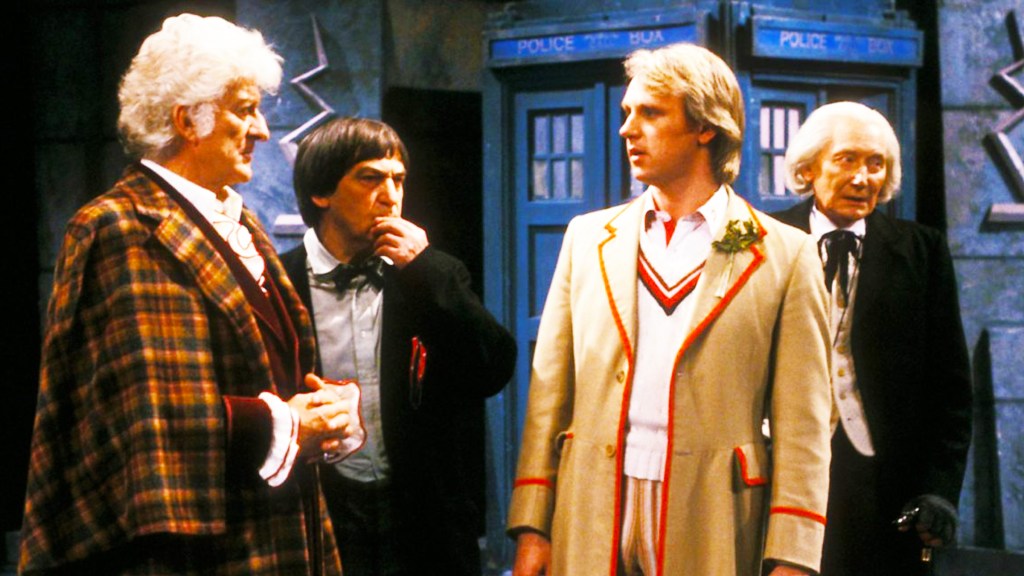
Releasing in 1983, “The Five Doctors” was a single feature-length episode with Jon Pertwee’s Third Doctor, Patrick Troughton’s Second, and Peter Davison’s Fifth. Richard Hurndall replaced the late William Hartnell as the First Doctor, while footage from the unfinished story “Shada” brought back Tom Baker’s Fourth (Baker was unwilling to return). Written by Terrance Dicks, the story saw the Doctors summoned to the Death Zone on Gallifrey, a last legacy of the Dark Times, where they were had to survive some of their most terrifying foes. The real villain was Gallifreyan president Borusa (Phillip Latham), who believed the secret to immortality lay at the heart of the Death Zone.
“The Five Doctors” plays more to nostalgia than most of these other multi-Doctor stories, which does make it something of a crowd-pleaser. Because it’s only a single feature-length episode, the script is much tighter and the narrative flows more easily than “The Three Doctors.” Again, the story anchors itself in the ongoing story of the Fifth Doctor, but this time through a smart way of upping the stakes; he feels himself diminishing as other incarnations are taken to the Death Zone, meaning he’s fighting for his lives and his entire past could be erased if one Doctor died. Unlike “The Three Doctors,” the final twist – in which he becomes the new president – is quickly ignored by the show going forward.
This particular story ranks second simply because it’s a lot slicker and more efficient, with less of the “drag” that the previous multiple-episode stories. Even better, “The Five Doctors” brings back enough former companions and enemies to feel like a real celebration of Doctor Who‘s 20th anniversary. It’s genuinely impossible to see any way this story could have been improved (at least, barring somehow persuading Tom Baker to get involved). And yet, for all that’s the case, one single multi-Doctor story still ranks higher on this list.
1. The Day of the Doctor
2013’s “The Day of the Doctor” was the ultimate Doctor Who celebration, releasing in theaters in a worldwide simulcast for the show’s 50th anniversary. It starred Matt Smith’s Eleventh Doctor alongside David Tennant’s Tenth Doctor, with the “timey-wimey” twist of John Hurt as a new “War Doctor.” This was practically a Doctor Who movie, and Moffat deliberately tied it in to the biggest even in the franchise’s history: the Time War, previously unseen. Teased since the show’s 2005 revival, the Time War had (apparently) ended with Gallifrey’s destruction.
“The Day of the Doctor” is gloriously optimistic, brimming with hope and joy as Tennant and Smith collide in spectacular fashion. Hurt, meanwhile, puts in an incredible performance as a war-weathered Doctor who has come to the point of giving up on his own people, but will be inspired when he catches a glimpse of his future. Jenna Coleman’s Clara Oswald gets to play against all three Doctors, while Billie Piper returns in a slightly different role as the manifestation of an ancient Gallifreyan weapon called The Moment. There’s even a final cameo from Tom Baker himself.
As enjoyable as all the other multi-Doctor stories may be, “The Day of the Doctor” is likely to always be top of this list. It plays to nostalgia, but it does so in a wonderfully refreshing way, and it institutes what should have been one of the biggest changes in the show’s status quo when it brings back Gallifrey in style. There’s even a glimpse of Peter Capaldi’s “attack eyebrows,” meaning this is really his debut as the Thirteenth Doctor. There’ll probably never be a Doctor Who story on this scale again, which means it will always stand out from the crowd.
What’s your favorite Doctor Who multi-Doctor story? Leave a comment below and join the conversation now in the ComicBook Forum!
More TV Shows
-
Courtesy of Toei Animation / McDonalds / Nickelodeon -
Image courtesy of Fox -

Image courtesy of The Pokémon Company