Let’s face it, no TV show can last as long as Doctor Who without quite a few continuity problems. That’s especially true given the show started back before anyone ever believed would want to rewatch episodes, meaning writers didn’t really worry about canon and continuity. Even now, time travel means the timeline’s more than a little “wibbly-wobbly,” and events can change at the drop of a hat; Doctor Who accepts problems with Daleks and more without a second thought.
Videos by ComicBook.com
Surprisingly, though, there are even major problems when it comes to the main character. That’s because the Doctor’s history is a patchwork quilt of revelation and retcon; the Time Lords themselves were only introduced in 1969, subtly contradicting previous reveals, and the recent Timeless Child retcon has just made things worse. So here are some of the biggest things about the Doctor that just don’t make sense.
5. Why Doesn’t the Doctor Have More Control Over Their Regenerations?
For the Doctor, regeneration is a lottery. That’s one major reason the Doctor’s different regenerations often clash whenever they cross paths with one another; there’s a delightful conflict between Patrick Troughton’s Second Doctor and Jon Pertwee’s Third, as the most prominent example. Recent stories have suggested the Doctor has some sort of subconscious control over the process, explaining why the Doctor took on the likeness of Peter Capaldi, and also driving the strange backwards-regeneration back into David Tennant. We can only assume showrunner Russell T. Davies meant to do something similar when Ncuti Gatwa apparently regenerated into Billie Piper.
But here’s the odd thing; other Time Lords appear to have much more control over the regeneration process. When Fourth Doctor companion Romana regenerated from Mary Tamm into Lalla Ward, for example, the character actually went through an extended scene trying out different bodies. She went for one she’d rather liked, based on a previous interaction. The key point, though, is that Romana hand-picked the form she took. The Doctor appears to have no such ability.
4. How Did the Doctor Die on Trenzalore?
According to Eleventh Doctor Matt Smith, there is one place he has always been running from: Trenzalore, the planet where he is destined to die. He went there, in the end, of course; he saw his own tomb, found the tear in the timestream that manifests when someone as important as the Doctor dies. But that death was ultimately averted, his future rewritten when the Time Lords chose to give the Doctor a gift of regeneration energy. They averted the Doctor’s death on Trenzalore.
But how was it even possible in the first place? According to “The Timeless Children,” the Doctor is not a Time Lord at all; he is the Timeless Child, originating from somewhere beyond the boundaries of this universe. Unlike Time Lords, the Doctor has an infinite number of regenerations. Many fans object to the Timeless Child retcon, arguing it sits uncomfortably with some of Doctor Who‘s greatest themes, but the biggest clash is here – with the Eleventh Doctor’s regeneration. The Doctor should never have needed a boost of regeneration energy in the first place, because he doesn’t even have a typical cycle.
3. When Will the Doctor Become the Valeyard?
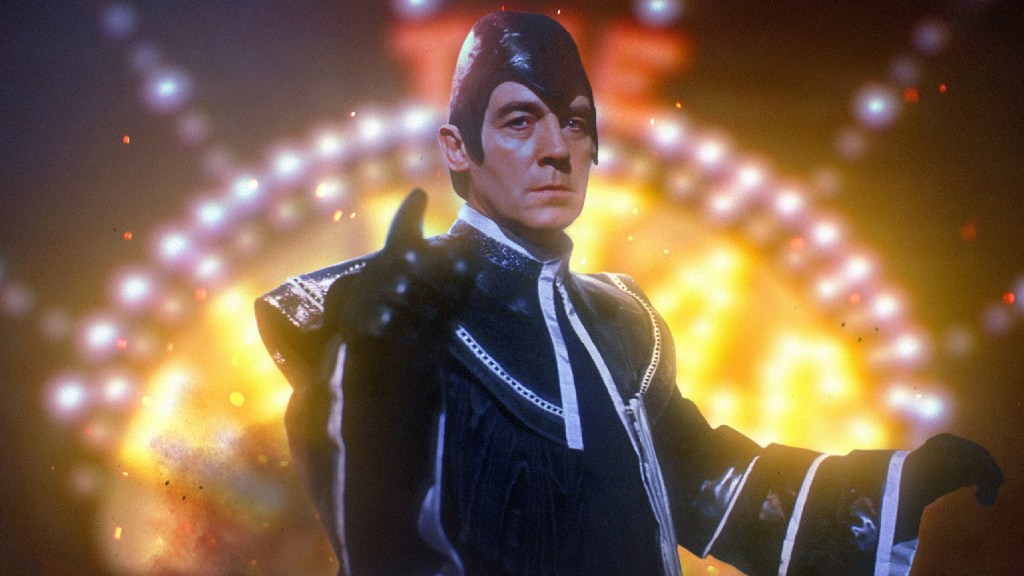
When the Time Lords wanted a match for the Doctor, they knew they couldn’t just depend on the Master. He, after all, had been defeated so many times. Instead, they found the Valeyard; an incarnation of the Doctor somehow pulled out of his timeline during the Doctor’s final regeneration. An embodiment of all the Doctor’s darkness, the Valeyard was literally created to be the Doctor’s nemesis. Which, granted, makes it rather amusing that he appeared in the much-maligned Sixth Doctor story “The Trial of a Time Lord,” and hasn’t been seen since.
The problem, though, is that this no longer works. The Time Lords who created the Doctor only knew of the one regeneration cycle, which means they must have created the Valeyard from David Tennant’s transformation into Matt Smith. But it doesn’t make sense for them to see that timeline, because knowledge of it would have allowed them to avert Gallifrey’s fate in the Time War. What’s more, we haven’t seen a trace of the Valeyard, although he did get reference in “Twice Upon a Time.” There, the Doctor was told one of his official titles is “The Shadow of the Valeyard.”
2. What’s the True Story Behind the Doctor’s Granddaughter, Susan?

How do you solve a problem like Susan? Played by Carole Ann Ford, Susan was the Doctor’s first real companion; his granddaughter, the titular character in the episode “An Unearthly Child.” Curiously, although she’s family to the Doctor, there were precious few hints her physiognomy differed to that of basic humans; she certainly possessed greater telepathic powers, but didn’t seem to have two hearts. Frustratingly, as the show has continued, the Doctor’s family background has become ever more mysterious. Susan remains a riddle, wrapped in a mystery, inside an enigma.
Russell T. Davies appears to have intended to solve this deep-cut Doctor Who debate in Season 15, even persuading Carole Ann Ford to reprise the role. Unfortunately, whatever plans he had for Susan changed in the end, and nods to the character became loose threads that will likely never be pulled together. No future showrunner is likely to pay any notice to deep lore running all the way back to the 1960s, so we’ll assume this will be left to the various tie-ins.
1. How Much Does the Doctor Really Know About History?
The Doctor has encyclopedic knowledge of history. Drop any incarnation of the Doctor at any point of spacetime, and they can usually deliver a lecture. Except for the times they can’t, when they’re suddenly blissfully ignorant and need to figure out what’s going on. Or the times when history’s been changed, rewritten because of the intervention of time-sensitive races like the Daleks and the Time Lords themselves. Essentially, the rule is this: the Doctor knows exactly as much about a given point in time as the plot requires them to know. One minute, they’re omniscient; the next, they haven’t got a clue.
In narrative terms, it makes sense. But, by now, the timelines have been rewritten so many times that the Doctor really shouldn’t know anything at all anymore. Human history in particular has been meddled with, so much so that a great and bountiful human empire became an insular society focused on the Solar System and secretly ruled by the Daleks. The Doctor has always liked exploring and, by now, every journey should be a discovery. Because nothing should be remotely like the timeline the Doctor apparently memorized.
What do you think? Leave a comment below and join the conversation now in the ComicBook Forum!
More TV Shows
-
Image Courtesy of Paramount+ -
Courtesy of The Sci-Fi Channel -

Image Courtesy of Warner Bros