Real-time strategy games are usually about conquest. You expand your influence through various means to ultimately crush your opposition, as your economy and military scale out of control. The genre traditionally rewards aggression and long-term planning that culminates in overwhelming force. Even when things go wrong, the arc usually bends toward empowerment.
Videos by ComicBook.com
Battlestar Galactica: Scattered Hopes flips that expectation entirely. Developed by Alt Shift, this upcoming RTS injects roguelike progression into a structure built around desperation rather than domination. You command a fleet of survivors relentlessly pursued by the Cylons, and the goal is not conquest but endurance. After spending time with a hands-on demo provided by Alt Shift, it is clear this is a game about surviving just long enough to jump to the next sector and continue the journey back to the Battlestar Galactica. So say we all.
A Roguelike RTS Where Survival Is the Win Condition
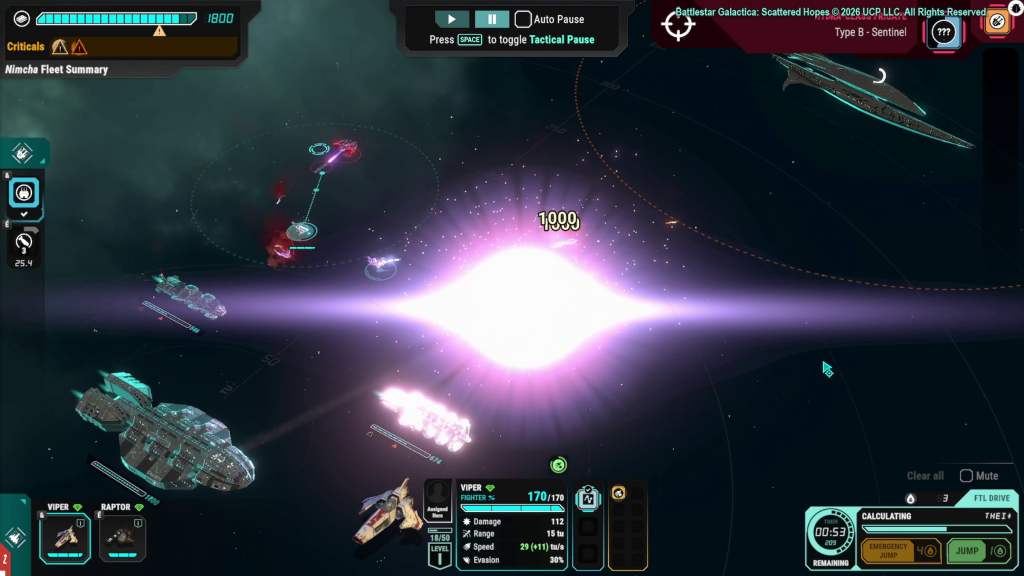
At a glance, Scattered Hopes resembles a traditional space RTS experience, complete with fleet management, squadron commands, and real-time engagements against enemy forces. Under the surface, however, it is structured like a roguelike, with each run shaped by randomized events, evolving upgrade paths, and persistent meta progression. The Cylons are not an enemy faction you are meant to outscale or eventually overpower, but a constant, superior force designed to keep you under pressure. Your objective in every encounter is to survive long enough for your jump drive to charge so you can escape to the next sector. That simple shift in win condition fundamentally changes how you approach every decision, as winning is not about overpowering.
Each run introduces new tactical wrinkles, whether through different upgrade opportunities, sector layouts, or scenario events that alter your trajectory. Sector-to-sector movement itself feels roguelike, with unpredictable encounters that demand adaptation rather than rigid planning. One journey might provide early defensive tools that help stabilize your fleet, while another might throw you into high-risk situations with minimal preparation. The repetition never feels static because the variables constantly change course, in standard roguelike fashion.
What makes this fusion compelling is how naturally it fits the Battlestar fantasy. This is a universe defined by scarcity and impossible odds, not by triumphant expansion. The roguelike loop mirrors that narrative reality, turning each failed run into another tragic attempt and each successful jump into a small, hard-earned victory. Survival is the emotional backbone of the experience, and that cohesion between theme and design is what gives Scattered Hopes its identity.
The Preparation Phase: Decisions That Cost Time
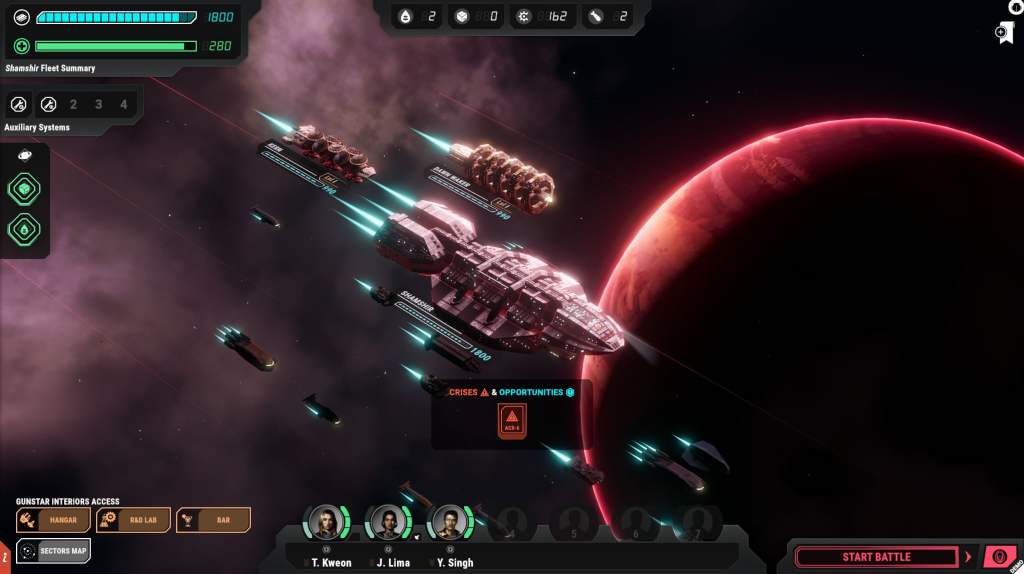
Scattered Hopes is divided into two primary phases, and the first is Preparation, where fleet management takes center stage. Here, you assign Heroes to stations, train crew members for greater efficiency, level up squadrons, and invest in upgrades that shape your strategy for the next battle. Heroes act as elite specialists who provide powerful buffs to the systems they oversee, meaning their placement can dramatically influence your fleet’s strengths. Crew training enhances performance in subtle but meaningful ways, whether through faster repairs, material efficiency production, or better system management. These incremental gains add up quickly in a game where even small advantages can determine survival.
The most critical resource in this phase is time, and nearly every action pushes it forward. Training crew members or resolving a random event all bring the Cylons closer to your position. This creates a constant tension between preparation and restraint, since overcommitting to optimization can result in a stronger enemy response. Random scenarios frequently appear, offering tempting rewards or dangerous trade-offs that force difficult choices. Ignoring them can save time, but at the risk of missing key advantages that could help in the long run. The opposite is also true. Special crisis events can break out. If ignored, they can be catastrophic for your run in the long-term.

Because time pressure is always looming, the Preparation phase never feels like true downtime. You are making calculated gambles, weighing short-term gains against long-term consequences, while shaping the identity of your fleet under the shadow of pursuit. The structure encourages thoughtful decision-making rather than checklist optimization, since there is no way to do everything before the next battle triggers. The lack of time and constant resource scarcity simply won’t allow that. By the time the Cylons arrive, you are keenly aware that every choice you made helped shape the conflict to come. That sense of accountability carries directly into combat.
The Battle Phase: Holding the Line Against the Cylons
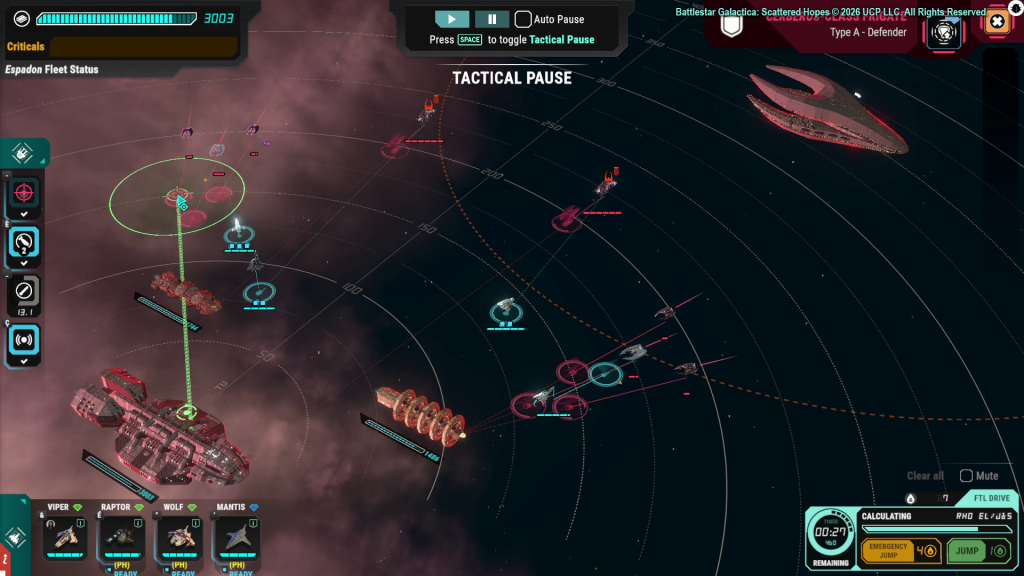
When the Cylons finally catch up, the game shifts into its Battle phase, and the tone becomes immediately urgent. Combat revolves around defending your Gunstar, which functions as the heart of your fleet and your most critical asset. Waves of Cylon ships pressure your defenses, ranging from basic fighters that chip away at your formation to boarding craft that threaten internal chaos if they breach your vessels. On top of that, the enemy deploys devastating nuclear payloads that must be intercepted by your squadrons before they inflict catastrophic damage. The battlefield quickly becomes a juggling act of priorities.
The survival timer displayed during combat reframes your mindset from aggression to endurance. You are not chasing total annihilation of enemy forces, but buying seconds until the jump drive is ready. This forces hard decisions about resource allocation, squadron positioning, and which threats demand immediate attention. Do you intercept the incoming nuke at the risk of leaving your flank exposed, or focus on clearing boarding ships before they cause internal damage. Every misstep can compound into larger problems down the line.
Damage is persistent and carries over into the next Preparation phase, reinforcing the connection between the two halves of the game. A brutal encounter can leave your fleet limping into the next cycle, demanding precious time and resources for repairs, which you may or may not have based on your previous choices. This continuity makes each battle feel consequential rather than isolated, since the aftermath directly impacts your future options. Even successful escapes often feel narrow, as though you barely held the line against overwhelming odds. That constant sense of vulnerability defines the combat experience.
Building a Fleet Identity Through Roguelike Progression
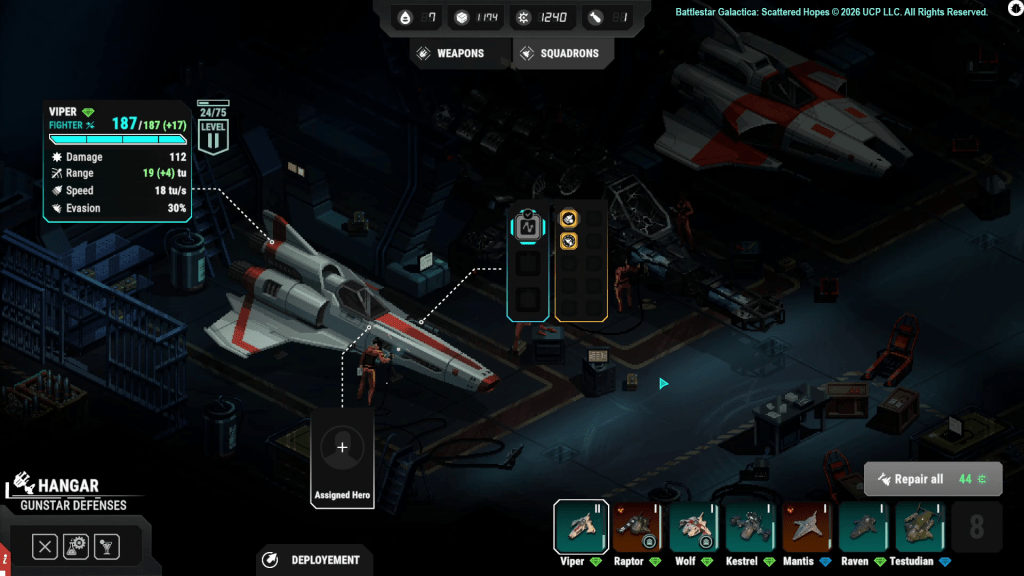
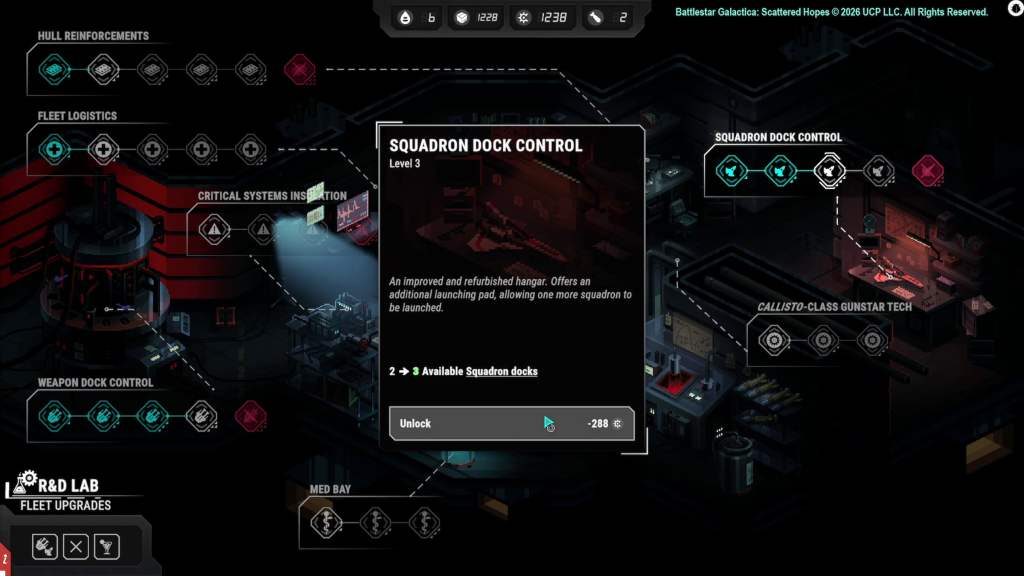
Across multiple runs, Scattered Hopes allows you to shape your fleet’s identity through layered progression systems. Upgrades enhance ship systems, unlock new squadrons, and grant traits that meaningfully alter how your fleet responds to threats. Some runs may lean into fortified defenses and durability, while others emphasize faster interception and aggressive threat neutralization. Because upgrade opportunities vary from run to run, your strategy must remain flexible rather than fixed. The game rewards adaptation over rigid optimization.
Heroes deepen this customization by offering specialized bonuses to the stations they occupy. Assigning the right Hero to the right role can significantly boost efficiency or resilience, creating synergy with your broader upgrade path. Over time, you begin to recognize combinations that complement your preferred playstyle, yet the randomness of each run ensures you cannot rely on the same setup every time. Meta progression further expands your options, gradually increasing the breadth of tools available in future attempts. Even in failure, you are building toward greater potential.
This evolving identity keeps the loop engaging well beyond the first few runs. Instead of chasing a single optimal build, you are constantly experimenting with new configurations based on the opportunities presented. The roguelike framework ensures that mastery comes not from memorizing a script, but from understanding systems deeply enough to adapt under pressure. That emphasis on flexibility mirrors the narrative premise of a fleet constantly on the move, forced to adjust to ever-changing threats. It is a design choice that reinforces both replayability and theme.
A Story Rooted in the Battlestar Legacy
Narratively, Scattered Hopes stays grounded in the core mythology of Battlestar Galactica. The Twelve Colonies are destroyed in a sudden resurgence of the Cylons, and you are among the few who escape the initial devastation. Your mission is clear and urgent: return to the Battlestar Galactica, where a plan is in motion to confront the Cylon threat and preserve what remains of humanity. The journey itself becomes the focus, rather than an elaborate web of subplots. This streamlined premise supports the game’s systems-driven structure.
The roguelike loop enhances the emotional resonance of that journey. Each failed run feels like another timeline where the fleet did not make it, while each successful jump forward represents hope carved out of chaos. The repetition becomes thematic rather than mechanical, reinforcing the idea that survival is never guaranteed. Much like XCOM 2, scarcity, pressure, and uncertainty define both the gameplay and the narrative tone. Even moments of stability feel fragile.
Based on this early demo, Battlestar Galactica: Scattered Hopes appears to understand what makes the franchise compelling. It translates themes of desperation and endurance into tangible mechanics that shape every decision you make. If the full release maintains this balance of tension and replayability, it could stand out as a distinctive hybrid in both the RTS and roguelike spaces. For now, the question is not whether you can defeat the Cylons, but how long you can survive them on the road back to the Battlestar Galactica.
What do you think? Leave a comment below and join the conversation now in the ComicBook Forum!
More Gaming
-

Courtesy of The Coalition -
Courtesy of Arrowhead Game Studios