I started playing Everquest in 2002. I was in high school, not having any clue as to what I was doing in the Commonlands, dying constantly… and loving every second of it! By college, I’d made the jump to World of Warcraft. I solo-queued my way through most of it, questing and leveling alone, not because I didn’t enjoy playing with friends online, but because the lone-wolf style just suited me. The world was my oyster, and I had all the time in the world to poke around in it. (And I did… much to the detriment of my grades for at least one of my semesters at college.)
Videos by ComicBook.com
That was a lifetime ago, though. My wife and kids are my priority now, and my career takes up whatever’s left. Video games obviously still have a place in my life, but the sheer commitment that MMOs demand, from the daily login pressure and gear treadmill to the guilds that expect you at raid night by 9 PM sharp, that reality belongs to a different version of me.
So when I heard about Dominus Automa, a game being built around the idea that maybe players don’t need to be chained to their gaming keyboards for an MMO to work, I paid attention. After going hands-on with a build at PAX East 2026 and sitting down with Rafał Bieniek, Co-founder and CEO of developer Metashift Labs, I walked away thinking this might be the most ambitious game I’ve seen in years.
You’re Not the Hero. You’re the Boss.
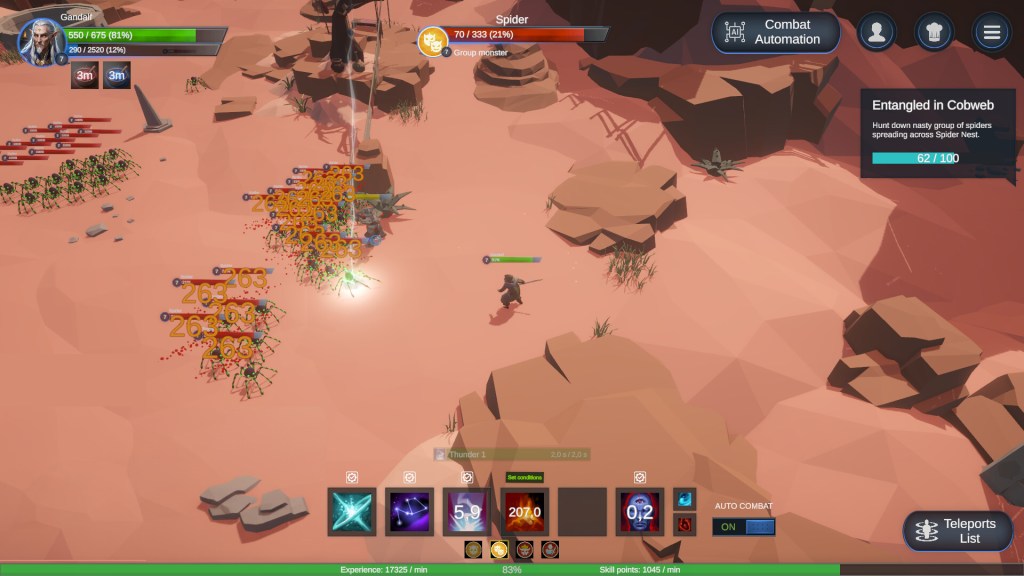
The elevator pitch for Dominus Automa is deceptively simple. It’s a multiplayer RPG where your hero lives on the server 24 hours a day, seven days a week, fighting, farming, and progressing whether you’re logged in or not. You’re not directly controlling a character. Instead, you’re scripting one. You define combat priorities, behavioral conditions, spell rotations, and long-term goals, then step back and let your hero execute. You’re kind of playing God.
Bieniek traces the idea back to a behavior most MMO developers have historically tried to stamp out. “We are familiar with the concept of botting,” he told me. “Players have been doing it for three decades. The industry was seeing it as an issue, rightfully so. But for us, it showed that there’s a big amount of players who like to play this way. Maybe because they treated their time as more valuable.” Instead of fighting that impulse, Metashift Labs built an entire game around it.
The result is something that sits in an interesting space between an MMO, a strategy game, and a companion app. You are, as Bieniek put it, “the master of the hero.” You’re the overseer, rather than the true protagonist.
Programming Your Fighter
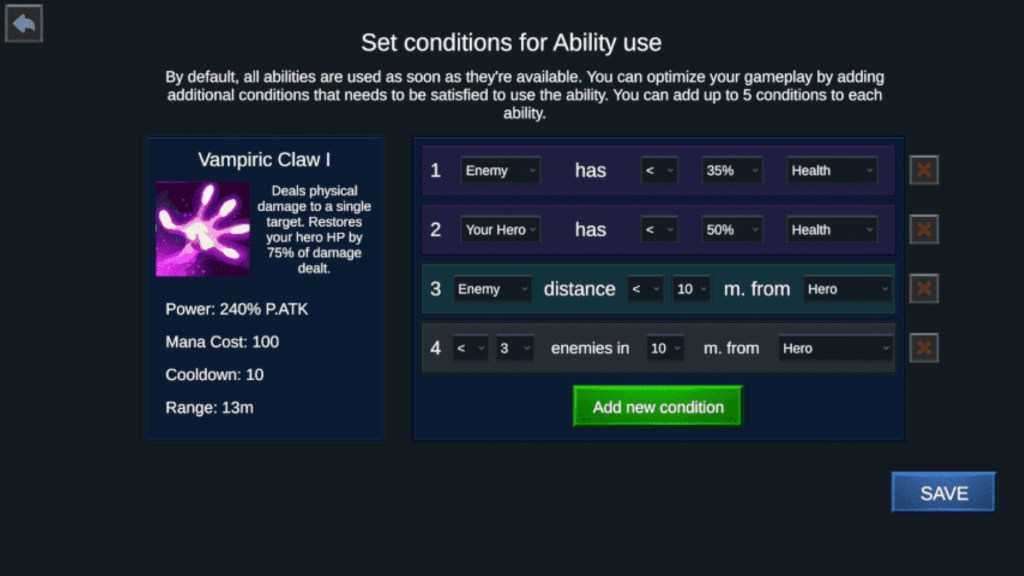
In the demo build I played, there’s no WASD movement outside of towns. Your hero navigates automatically between waypoints you’ve designated. What you’re actually managing is a logic system with a skill bar where abilities are slotted left to right, with order determining execution priority. At first glance it feels like you’re setting up a spreadsheet or some sort of backend data application. Within a few minutes, it feels like something far more interesting.
The condition-based combat scripting is where Dominus Automa starts to show its depth. During my session, Bieniek walked me through setting up an AOE spell with a conditional trigger to only cast it when five or more enemies are within five meters of the target.
“Right now he’s using his AOE spell against a single target enemy, which doesn’t make sense,” he pointed out, watching my hero hack through werewolves with all the tactical nuance of a lawnmower. “So you add the condition: enemies around, more than five, within five meters. Now it makes sense.”
It clicked immediately. The system needs that detailed, strategic thinking about how you want your character to behave when you’re not there watching.
There’s also a separate slot for passive abilities, and spells like a blink skill can be conditioned based on positional triggers like: set it to fire only when an enemy is closing in, for instance, rather than burning it on cooldown. The prototype I played had about an hour and a half of content, but Bieniek was quick to note that the next build will introduce full itemization and gear-based stat growth (wear heavy armor enough and your strength climbs, RuneScape-style) with all of that progression ticking along whether you’re online or not.
Your Hero Has a Personality. And Opinions.
Each hero in Dominus Automa develops an AI-driven personality shaped by their in-game experiences. Push your character into relentless combat and they’ll grow harder and more direct. Build them as a crafter and they’ll reflect that life. Bieniek described it as the hero recording what happens and developing in response to it, and then literally talking to you about it.
You can tap your hero at any time and have a conversation. Text or voice. The hero responds in generated audio, and that audio reflects their personality. The demo hero I interacted with was notably sassy (Bieniek warned me going in).
“This guy’s responses surprise every time,” he laughed, and he wasn’t wrong. I asked the hero about his orders, and got back something with a distinct edge to it. Apparently he also has very… let’s say strong feelings about dwarves.
But the real magic of this system isn’t the personality quirks. It’s the natural language command layer underneath. “Let’s say you change your plans,” Bieniek explained. “You told me to kill spiders because you thought you’d be back in a few hours. Turns out you’re going to stay with your buddies for the whole night. At any moment, you can change the course of actions for the hero.”
How? Well, you simply pull out your phone, type or say “go back to town,” and your hero interprets the command and executes it, even while you’re out having a beer. The hero is running on a script, sure. But it’s also actively listening.
A Living World Built for Grown-Up Schedules
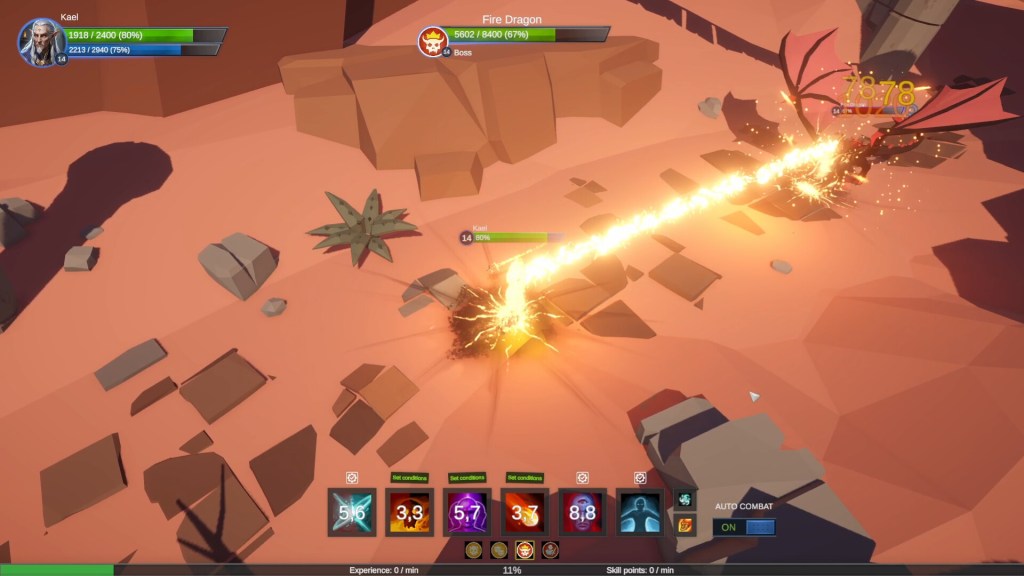
The multiplayer infrastructure around all of this is massive in scope. Dominus Automa is a full MMO. Guilds fight for territories and castles, there’s a player-driven economy built around gathering, crafting, and trade, and heroes from other players populate the world continuously, whether those players are online or not. Want to be the best fisherman on the server? There’s a life for that. Want to spend all your time in town crafting gear for other players? Also a worthy cause. Want to run with a guild and contribute to castle warfare on your own schedule? The game is explicitly designed for that asynchronous co-op loop.
Bieniek painted a picture that resonated with me more than I expected: two friends, both parents, both with maybe thirty minutes to spare. “We’re gonna socialize, we’re gonna be buddies, we’re gonna do something together,” he said. “But it’s increasingly hard to get together at the same time to play. Almost impossible.” Dominus Automa’s answer is to let the game be the shared project—a thing that’s always running, always progressing, that you and your friends check in on and steer together when you can.
Do I Dare Re-Enter the World of MMOs?
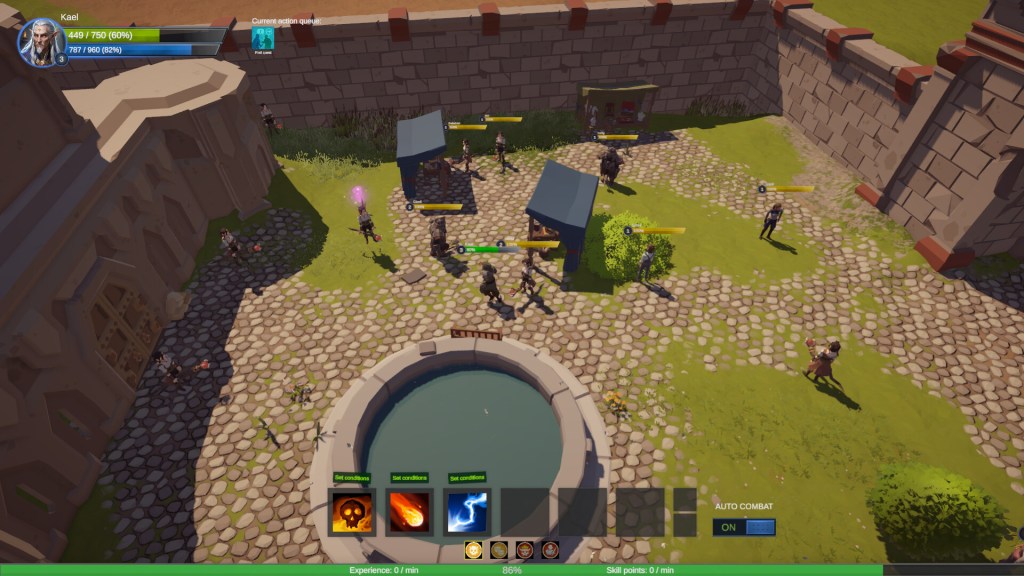
Dominus Automa is currently a prototype, and Metashift Labs is a small team with significant ambitions. The current build is rough around the edges in places (internet hiccups affected the voice interaction demo, and the content is thin, but the bones of the system are already cause enough for excitement from someone like me who is, quite literally, the definition of the ideal customer profile for this game. The condition-based scripting has a satisfying logic puzzle quality, the hero AI personality adds a warmth that idle games typically lack entirely, and the asynchronous MMO vision is one of the more thoughtful responses to the “I used to love MMOs, but don’t have time anymore” problem I’ve encountered.
Will the inclusion of AI elements deter some players? For sure. But for me personally, Dominus Automa hits close to home. I still miss the feeling of a persistent world that has weight to it, that other players are living in alongside you. I just can’t justify the time tax anymore. If Dominus Automa can deliver on its promise of being an MMO that respects that reality without gutting what makes MMOs worth playing, it might be the first game in a long time that pulls me back in. Even if my hero’s doing most of the work. (Ok… ALL of the work.)
Dominus Automa doesn’t yet have a release date, but it is currently available to Wishlist on Steam.
More Gaming
-

Courtesy of Ubisoft