Throughout the Fallout franchise, one beastly monster above all instills fear in anyone who sees its shadow: the Deathclaw. These creatures weren’t named because they’re cute and cuddly; they’re the Wasteland’s most feared and vicious predators. Still, while every gamer’s heart skips a beat the first time one pops up on screen, their origin isn’t as well-known as with other mutated monsters. The origin of the Super Mutant populations is well known, as are the many larger or more grotesque versions of pre-war animals. Deathclaws, on the other hand, remain somewhat ambiguous within the game’s lore.
Videos by ComicBook.com
Of course, the games don’t hide what a Deathclaw is or where they came from, but you have to dig deep to learn everything there is to know about these hulking beasts. Their existence predates the Great War that destroyed civilization. The United States government sought to create the ultimate super soldiers to replace humans on the battlefield. Imagine running up to an enemy in a fight, and instead being confronted with death looming over you with massive claws and a bad attitude. That’s what they wanted, and it’s what the government got. Unfortunately, like all experiments in Fallout, things didn’t go according to plan.
Deathclaws Started Out As Cute Lizards
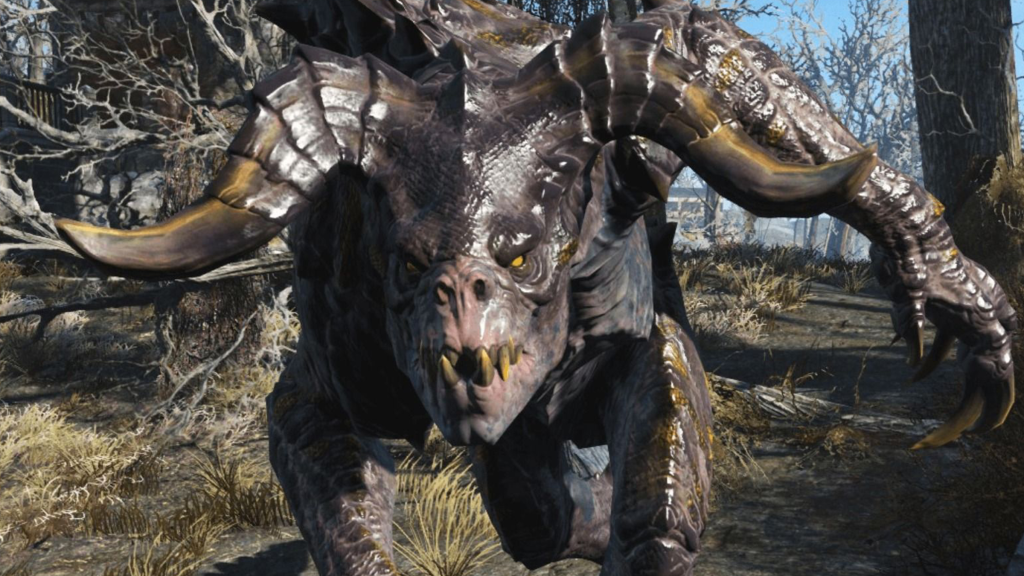
To create the greatest super soldier of all time, the government began with an ordinary Jackson’s horned chameleon. You’ve likely seen them in zoos and some pet stores, but in Fallout, their genetic code set the base for a truly horrific monster’s evolution. Scientists began with the chameleon, and mixed its genes with those of other species to make it less docile. The idea was to create a creature that could be controlled, fight on the world’s battlefields, and adapt to its environment. In many ways, the experiment was a success, though controlling the creatures was strictly out of the question.
Deathclaws never made it onto the battlefield before the Great War kicked off in 2077, or, if they did, there’s no surviving record of it. Instead, the bombs dropped, and the Deathclaws, locked away in various laboratories, escaped and found their way into the Wasteland. Unlike most species, Deathclaws, which were genetically engineered to survive and thrive, carved out a niche in every environment they came upon. The apex predators spread throughout North America, and likely beyond, though sightings haven’t been reported elsewhere.
Eventually, the Enclave sought to renew research on Deathclaws to engineer a weapon that could be controlled. The Enclave succeeded in this respect, unleashing a population of Deathclaws along the West Coast that had considerably greater intelligence than previous generations. They carried out a single combat operation, but broke away from the Enclave, forming a sentient society within the depths of Vault 13. These were eventually exterminated, and continued experimentation refined humanity’s ability to control the horrifying predators.
Deathclaws Are the Preeminent Predators of the Wasteland

One reason that Deathclaws are such an enduring element of the Fallout franchise is how much their biology has expanded since their debut. They are bipedal, reptilian predators that are incredibly strong. They’re also armored, and while there are varying traits throughout the species, all Deathclaws sport two imposingly large horns jutting out of the sides of their heads. They also boast elongated claws and opposable thumbs. They’re territorial and lay eggs for reproduction. While all of that is interesting, almost all players know is that if you see a Deathclaw, run! If not, you’re about to spend an unholy amount of ammunition taking them down, as they’re easily the most formidable beasts in the games.
Be honest … you dookied your pants the first time you encountered a Deathclaw, didn’t you? Leave a comment below and join the conversation now in the ComicBook Forum!
Most Viewed
-

Image Courtesy of Netflix -

Image courtesy of Warner Bros. Pictures -

Image Courtesy of Ufotable -

image courtesy of Studio Ghibli