Believe it or not, there once was a time when you could look at a game and immediately understand where it came from. The edges were clearer. The budgets were obvious. The scale spoke for itself. Now the industry feels like someone spilled a bucket of black paint across a once-white canvas, and the lines that used to define indie and AAA have blurred into something hard to parse at a glance.
Videos by ComicBook.com
The line between indie and AAA is more blurry than ever, and that confusion is not accidental. Crowdfunded projects now boast massive teams that rival mid-sized studios. So-called indie titles launch with major publisher backing. Meanwhile, the term “AA” has resurfaced as a middle ground term that feels more honest than either extreme. When labels become marketing tools instead of meaningful descriptors, you are left wondering what any of it actually means anymore.
When “Indie” Has a Publisher and a 200-Person Team
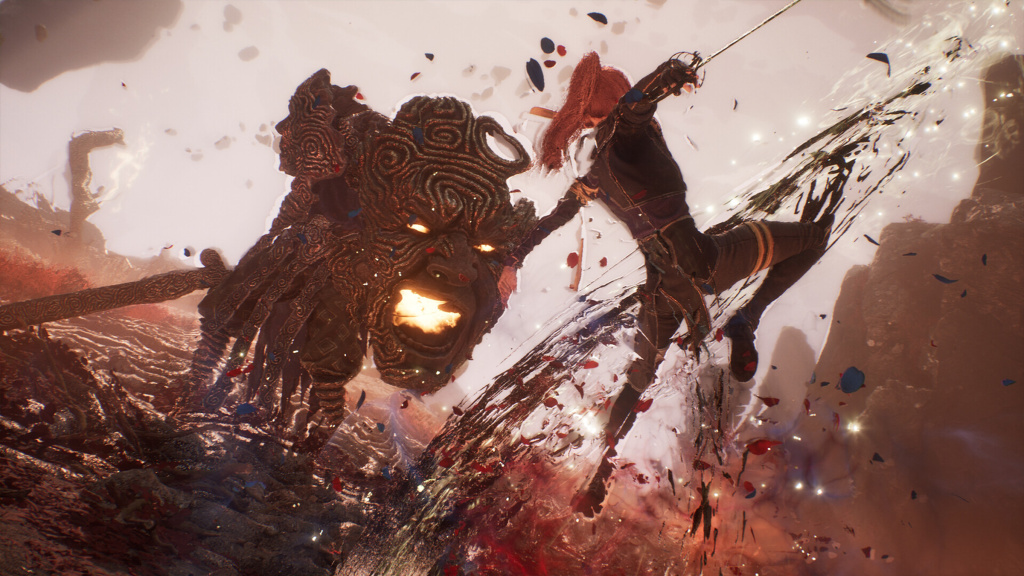
Indie once implied independence. Small teams working without the safety net of a major publisher. Limited budgets forcing creativity through constraint. That image still exists in pockets of the industry, yet it no longer defines the category as a whole.
Today, you can encounter an “indie” game funded through crowdfunding campaigns that raise millions before development even fully ramps up. Some of these projects expand into teams that number in the hundreds, complete with cinematic trailers and global marketing pushes. The independent spirit might still be present in creative direction, but the scale can rival what used to be considered traditional studio development.

Then there are titles marketed as indie despite being published by major corporations. Financial backing, distribution muscle, and platform partnerships blur the notion of independence beyond recognition. At that point, is indie about ownership structure, creative control, team size, or simply aesthetic style? The word has stretched its meaning so far that it now functions more as a vibe than a concrete classification.
You might expect scrappy experimentation and discover a polished production with a substantial budget. You might anticipate AAA spectacle and instead find focused design that feels intimate in scope. The mismatch between expectation and reality reflects an industry where labels struggle to keep pace with how games are actually made.
The Rise of AA and Why Budget No Longer Defines Scope

As the extremes blur, the red-headed “AA” has quietly reentered the conversation. Once considered an awkward middle child, it now feels like the most honest descriptor available. AA projects often balance ambition with restraint, delivering focused experiences without the sprawling excess that defines many blockbuster releases. These are the titles you hear the least about, and that is why “AA” is rarely uttered in any conversation.
Budget no longer cleanly defines scope because technology has transformed development in ways that were unthinkable decades ago. Smaller teams can access powerful engines and very easily outsource specialized tasks, while reaching global audiences through digital storefronts all at the same time. On the other hand, massive studios sometimes pursue narrower concepts that would have once been dismissed as too modest for their scale.

The result is an ecosystem where presentation often deceives at every turn. A game may look AAA in trailers yet operate with a lean production philosophy. Another might carry an indie label while leveraging resources that rival established publishers. The traditional markers of scale have lost their clarity, replaced by a spectrum that shifts depending on funding models and creative priorities.
That spectrum is not inherently a bad thing, though, and I hope I am not portraying this as such. In many ways, it reflects a healthier diversity of approaches. Still, there is a lingering sense that the industry hides behind buzzwords that no longer communicate much. When indie, AA, and AAA start to overlap so heavily, you are left navigating a landscape where marketing language paints over nuance. The line between indie and AAA may never sharpen again, but perhaps that ambiguity signals an era where creative identity matters more than the label attached to it.
What do you think? Leave a comment below and join the conversation now in the ComicBook Forum!
Most Viewed
-

Image Courtesy of Studio Bones -

Image Courtesy of Science SARU -

Image Courtesy of Studio Pierrot