An Avatar is supposed to be a master of elements, but the Avatar Legends franchise has not been a master of media. Live-action adaptations and video games have been its key weaknesses, both of which have utterly failed to translate Avatar’s trademark charm and grace time and time again. Avatar Legends: The Fighting Game has had the best shot of stopping this curse, given the fighting game pedigree of the team behind it, but a great pairing did not save PlatinumGames’ surprisingly terrible and oft-forgotten Legend of Korra game from 2014. Legends is a better realization of its developer’s talents and a far stronger game, yet it’s hampered by its bare-bones presentation, missing features, and general lack of polish.
Videos by ComicBook.com
It seems as though every cent of Legends’ production was funneled directly into its fighting mechanics. Even with only 12 characters — two of which are doubles of the most famous Avatars, Aang and Korra — Legends has a ton of variety and complexity baked into that launch dozen. The feisty earthbender Toph is built around armor and manipulating the arena. Azula’s fiery instability translates into a rushdown demon with incredible setup potential and lengthy air juggles. Aang utilizes his glider and airbending to flip and fly around the battlefield, turning him into one obnoxious opponent when being handled by a particularly twitchy opponent.
Rating: 3/5
| Pros | Cons |
|---|---|
| Blazing-fast and layered mechanics give the game a ton of depth and an incredibly high skill ceiling | The story mode is bland and superfluous |
| Its overall visuals and animation are almost a perfect recreation of the animated series’ style | Many standard online features are completely missing |
| Its tutorials are often inept, unpolished, or unfinished |
Avatar Legends: The Fighting Game Has a Small but Deep Roster

Most fighting games have a solid amount of variety like this, but Legends goes even deeper. Each combatant has access to a meter-dependent Flow system that further changes how players can move around the arena and dodge attacks. Like a more nimble version of a parry, Flow Stance dodges give the game a higher skill ceiling since they are knowledge checks and introduce counterplay centered around mind games and conditioning. Flow Gauge can also be spent on various acrobatic moves, which vary by character. For example, Zaheer can freely fly around, while Sokka runs forward and gets access to multiple follow-up attacks. Flow is tricky to learn since the functions vary so wildly among the cast and requires quick button presses, but this system makes defense more involved and varied across the board.
The well only gets deeper with Legends’ various character-specific traits and variations. Said traits are fairly straightforward but offer buffs or nuances for those who want to truly plumb the depths of their mains. This often takes the form of offering extra meter for fulfilling certain conditions, rewarding those who pay attention to every part of the move list. However, the variations have a greater impact. Like Mortal Kombat X before it, each fighter has three versions that all cater to a specific playstyle. Experimenting with new combo routes without having to learn a completely different character is an economical way to stretch out the roster and add more variability.
All of these potential ways to play and mechanics to learn make Legends one of the densest fighters to come out in recent years. This density means the possibility of getting blown out by an Evo-ready Zuko player or an over-caffeinated Aang tryhard online is always high, and that can be rather frustrating. Legends is absolutely one of those fighting games where it’s possible to play a match and then not actually play during the match. But the depth here means there’s always a new combo to master, another variation to explore, or movement style to look into. And that process of continually getting better is often a rewarding journey and what carries most of the genre as a whole.
Many of Legends‘ Tutorials and Training Tools Are Unfinished or Unhelpful
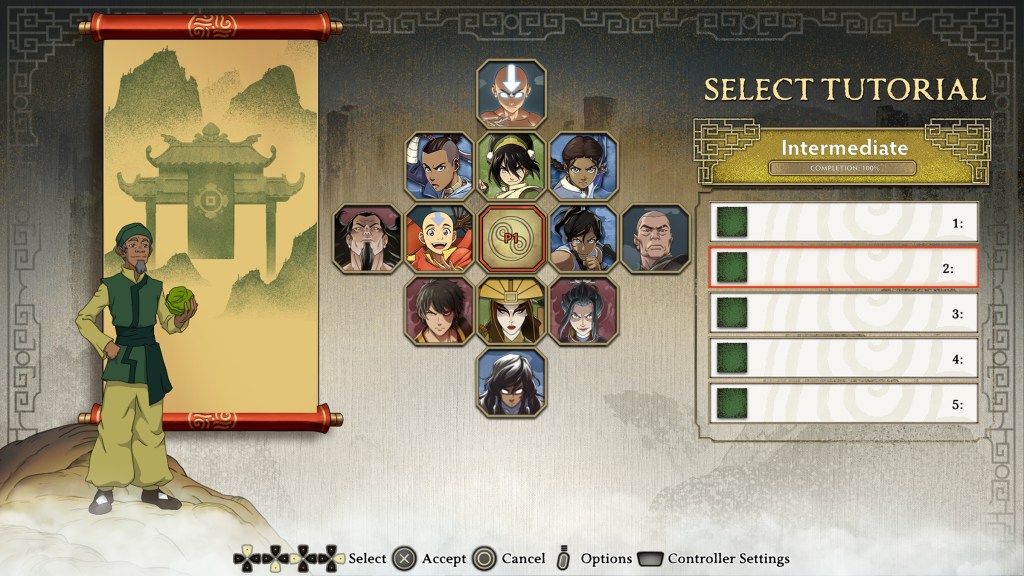
However, Legends doesn’t go out of its way to streamline this learning process or make it any easier. To its credit, there are tutorials, a training room, combo trials, and various character-specific guides, but they’re all tainted in several ways. The vanilla tutorials are unlabeled for some befuddling reason and don’t even have text explaining what’s going on. And many of the mechanics don’t even have interactive components; they’re just boring text-based notes. The training room is mostly fine with enough expected features, yet doesn’t include every genre standard like replay takeovers or a combat-ready NPC dummy, to name a few. Command lists for some fighters are also simply not finished and have temporary art or incorrect descriptions.
The character-specific guides sometimes explain the basics of a fighter well enough, however, they don’t delve into the quirks of each variation and, worse yet, are just incomplete. As is the case with the generic tutorials, a few on the roster don’t even get any explanatory text, meaning there are lessons that show players random moves without even describing what’s going on. When coupled with the handful of tutorials across the board that don’t work as intended, can be completed incorrectly, or don’t show the right input, it becomes more and more obvious how inept this crucial part of Legends is. A game this complicated — especially one based on such a legendary franchise with broad casual appeal — should not defer so much of learning the game to YouTube.
Legends‘ Solo Modes Have Little to Offer

The issues related to its polish are universal, though, and also manifest through its lack of features. The single-player modes have no difficulty settings and are quite unforgiving when starting out. Unlocks are mostly limited to concept art and don’t include notable skins or many palette swaps. Online offerings are also severely limited. Despite the claim in its features trailer, ranked play is nowhere to be seen and having only one hopper for online play can often lead to unbalanced sets that are either aggravating or unrewarding. Lobbies also only hold two people, which makes them almost worthless.
Its story mode is defined through its annoying quirks, and the game would be better without it. Taking out existing mechanics like variations, occasionally cutting various meters, nixing difficulty settings, and adding out-of-place modifiers makes it a poor way to both learn the basics and flex combo prowess. The light and underbaked RPG mechanics don’t help, either.
But it is also narratively underwhelming, despite nailing the look of the animated series. Characters stand in their fighting stances while conversing with one another no matter the tone, and every animation during these mostly static scenes is pulled from their existing move set. When combined with the handful of missing effects and inconsistently voiced characters, all of it comes off as a cheap, fan-made machinima. The story itself is also bland, makes illogical leaps, is repeatedly broken up by menus, and has to constantly bend around itself in order to justify why characters from Avatar’s various periods are in one timeline. Technically, it is canon, but that isn’t a marker of quality and such a label meant to give the story authority is best ignored. It would be like if Naughty Dog deemed Nathan Drake’s Subway commercial part of Uncharted’s official lore.
Avatar Legends: The Fighting Game’s trite campaign is just one of its many uninspired or poorly assembled parts. The slapdash tutorials don’t adequately run through Legends’ numerous mechanics. Lacking a ranked mode means matches can be widely lopsided since most players are shoved into the same queue, and not having a true lobby system further inhibits those who want to test their might online. All of its solo modes are dull and aren’t flexible or creative enough to let players truly improve. It’s a damning list of downsides, but it’s carried by its character variety and phenomenal freedom of expression. The actual combat is a load-bearing pillar here, meaning Gameplay Group International, perhaps at the expense of almost everything else, honed in on what was the most important. Like a mix between a Fire Nation soldier and an Air Nomad monk, it burns hot, but it is also rather light.
A PS5 copy of Avatar Legends: The Fighting Game was provided by the publisher for the purpose of this review.
What do you think? Leave a comment below and join the conversation now in the ComicBook Forum!
More Gaming
-

Courtesy of The Pokemon Company -
Image courtesy of Bethesda