I love TCGs. Ever since I started collecting the original Pokemon TCG in 1998. But being the only one in my friend group who was into TCGs made it hard to actually play, so I would inevitably end up falling more into the “collector” category. And there’s something inherently intimidating about rolling up to a random table or event at my local card shop looking to play as a beginner. I don’t want to bring someone else’s more experienced level of play down to my extremely novice level. That doesn’t seem like a good time for them.
Want more like this? Get the latest drops, ratings, reviews, and more with the ComicBook Gear Review newsletter — straight to your inbox.
Videos by ComicBook.com
That said, in 2026, it feels that that’s all kind of changing. There are plenty of examples of “learn to play” events and welcoming communities who are happy to bring new players into the mix. And with so many TCGs out there, from Pokemon to Magic the Gathering and everything in between, there’s no shortage of ways to find the game that’s right for you.
Riftbound feels like the answer for me.
At PAX East 2026, I sat down with Jon Moormann, Senior Game Designer on Riftbound, for a full game using two showcase decks for the new set, Riftbound: Unleashed, Riot Games’ third expansion for its League of Legends trading card game. The two dex featured Vi (aggressive, unit-buffing, built for big overkill moments) and Vex (controlling, stun-heavy, all about protecting a base and grinding the opponent down). I played Vi. I lost. But I had a blast doing it.
Because there was a moment early in my demo where I exhausted five resources to play a unit, move him to the battlefield, and actually felt clever about it, instead of lucky. I had no idea what I was doing 15 minutes earlier. That transition, from bewildered newbie to engaged player, turns out to be exactly what the game is designed to engineer.
Learning in Real Time
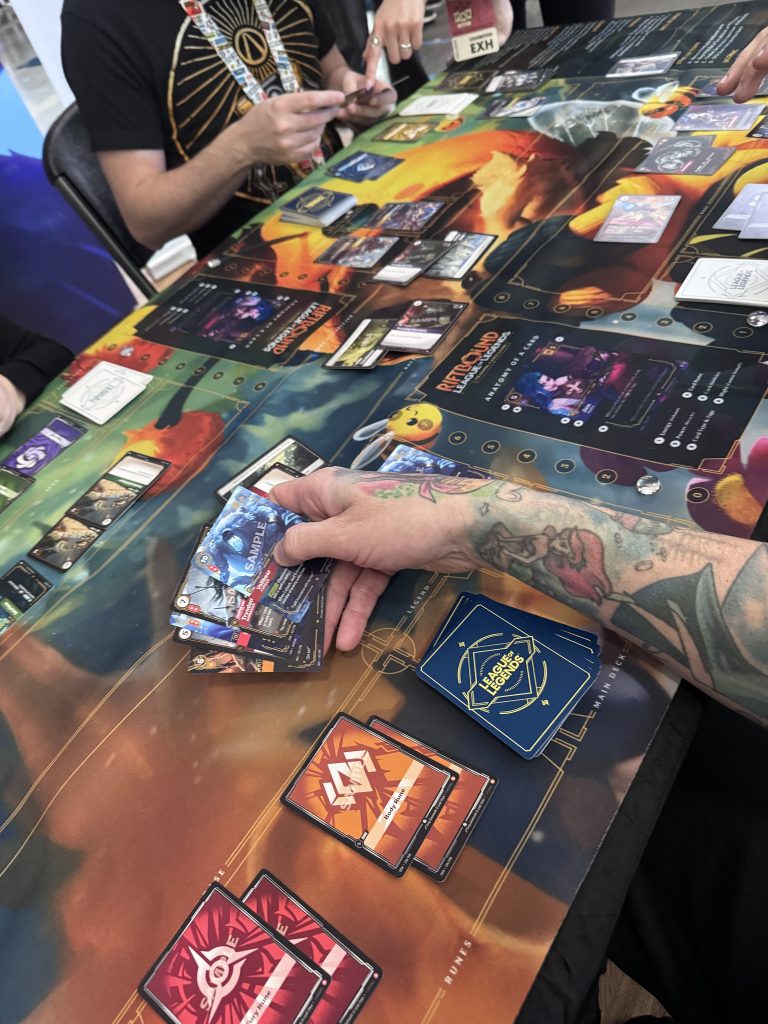
Besides watching a quick “how to play Riftbound” tutorial before my appointment, I came in cold. Some Pokémon as a kid, and zero competitive card game experience. Moormann walked me through the basics as we played: the turn structure of Awaken, Beginning, Channel, Draw; the way conquering a battlefield earns a point, holding it earns another; the way certain cards care specifically about one or the other. Within a few turns, the rhythm clicked.
That’s not an accident. “A lot of where we started on Riftbound is like, we love multiplayer card games, and we also love competitive, sweaty experiences,” Moormann told me after our game wrapped. “We really started by saying, we want something that you can play multiplayer. A big part of that is being able to just bring folks in, because we’re building for the League of Legends IP, and not everyone who plays League plays card games. So, we wanted to make sure we had something where you could get it and play right away.”
Riftbound is a game that teaches itself through play. When I asked if I could use a specific card a certain way, Moormann didn’t stop the game to deliver a lecture. He just said “yes” or “no” and explained why in one sentence. The rules have enough internal logic that most calls feel intuitive after you’ve seen them once.
The Jungle Comes to Runeterra
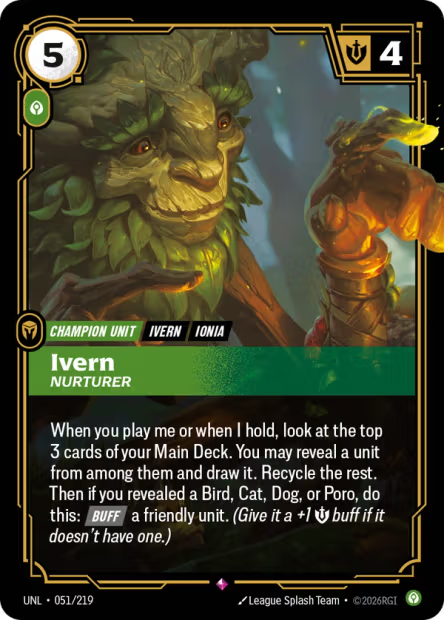
Unleashed is the third set in Riftbound, and it leans into a deep jungle theme drawn from League of Legends lore. The expansion’s four Champion Legends are Kha’Zix, Lillia, Diana, and Ivern, which is a roster that skews toward stealth, ambush, and nature magic. The set introduces three major new mechanics:
- Ambush, which lets certain units crash into a combat mid-showdown as a surprise reaction
- XP, a resource you accumulate and spend for unique benefits (and which also feeds a Levels system that evolves cards as you earn more)
- Hunt, a keyword that rewards conquering and holding battlefields with XP gains
The XP system, specifically, added a satisfying layer of progression to my game. My Moss Stomper unit started as a three-power threat, but by the time I’d accumulated enough XP through my Hunt cards, he became a four-power unit with Deflect, meaning Moormann had to spend extra resources just to target him with spells. Watching that upgrade happen mid-game felt natural, and it happened without requiring me to track what was happening on a piece of paper.
Moormann lit up talking about Ivern, his personal favorite addition to the set. “I am a huge Ivern fan in League… Mastery Level 7. Played him almost exclusively for several seasons,” he said. The challenge, he explained, was translating a champion whose in-game mechanics (a passive, pacifist jungle style) don’t naturally map to card game aggression. The answer was a character-first approach. “Who is Ivern as a character? He’s a friend of the forest. He loves everything.” Ivern’s deck in Unleashed is accordingly built around assembling an army of dogs, cats, birds, and burrows. All pets working in concert. “I love it,” Moormann said, grinning.
Mechanical Depth Without the Walls of Text
What struck me most across our full game was how the complexity surfaced gradually, and didn’t overwhelm me by front-loading itself. Early turns were simple: play units, move to a battlefield, try to conquer it. By mid-game, we were navigating a web of reactions, like Vex’s signature ability to stun units mid-combat, the Hidden mechanic (paying one power to place a spell face-down for a surprise later), and Ambush units crashing into fights I thought I had all but sewn up.
At one point (and I promise this will all make sense when you start playing yourself), Moormann used Skywood Strike to simultaneously move my Vi across the battlefield and stun my Lord Broadway, which triggered Vex’s passive to move her into an undefended position, setting up two separate combats at once. I had one reaction card left, and I had to choose. That kind of decision that is simple to understand, yet agonizing to navigate, is the hallmark of a well-designed competitive game.
“We wanted to have a nice skill ceiling where the better you get at the game, the more complex interactions are,” Moormann said. “I like to think we managed to thread that needle. There’s a way in for everybody, but there’s something really deep there too.”
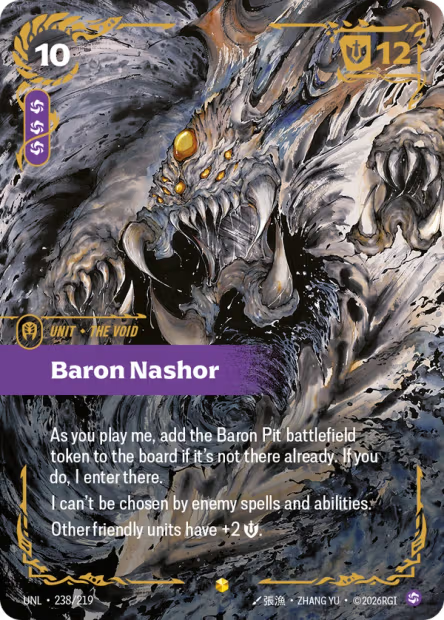
The new tokens in Unleashed add even more texture. Baron Pit tokens join the battlefield when Baron Nashor is played, Bird tokens come equipped with Deflect, Reflections copy another unit already in play, and Sprites are temporary creatures that die at the start of your next Beginning phase, creating interesting tension around how and when to spend them. The set also introduces Ultimate Rarity, a new tier of Overnumbered card appearing in fewer than one percent of packs. This expansion’s sole Ultimate Rare is Baron Nashor himself, which should make pack openings feel plenty dramatic.
You Don’t Have to Know What a Mana Curve Is (But it’s OK if You Do!)
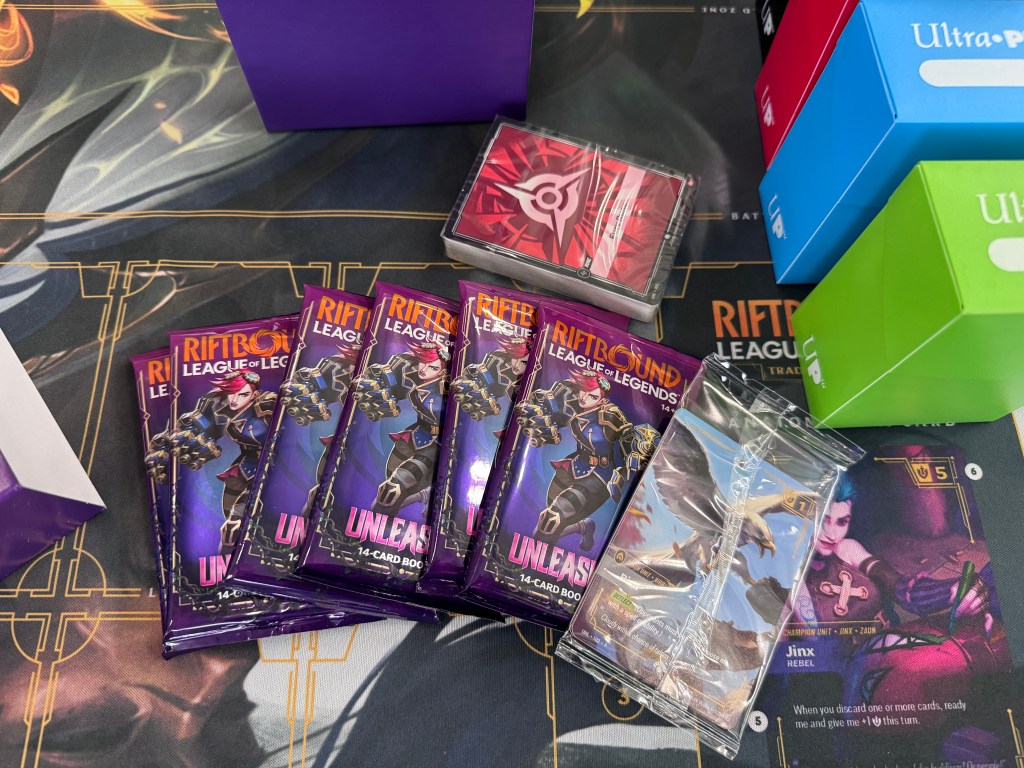
Moormann’s answer to my question of, “So, who is this game for,” is disarmingly direct. It’s for everyone, but especially the League player who has always been curious about TCGs and never known where to start. Riftbound is intentionally structured so that picking up one of the pre-built decks and sitting down with a friend (or a designer at a convention) yields a satisfying experience within minutes.
For experienced TCG players, the depth is there, too. Deckbuilding decisions around Champion synergy, the strategic interplay of Ambush and stun timing, the resource economy of XP management. To that end, Riftbound runs an Organized Play circuit, with Summoner Skirmish constructed tournaments (the Unleashed windows open May 25 and June 22) feeding into Regional Qualifiers.
When I asked Moormann which champion he’d recommend for total beginners, he didn’t hesitate: Jinx, from Set 1. “Her ability is when you have one or fewer cards in hand, you draw an extra card at the start of the turn. It’s a really straightforward request of the players. Play all your cards, get them out of there, get more cards back.” For the more experienced crowd looking for a brain-bender, he pointed to LeBlanc, whose mirror tokens copy other units on the board without their play effects, bringing some of the game’s most elaborate chain-reaction turns.
I Came to Lose a Card Game and Left Wanting to Build a Deck
I went into the Riftbound: Unleashed demo expecting to feel lost… but I walked away wanting to build a deck. That’s probably the highest compliment you can give a game that’s openly pitching itself to an audience that doesn’t think of itself as card game players. The jungle theme is fun, the new mechanics layer in cleanly, and the experience of playing a full game (even while learning on-the-fly) never stopped being fun.Riftbound: Unleashed launches on May 8, 2026, pre-orders available now. The English Pre-Rift sealed-play event at local game stores began May 1.