At one time, Star Wars was just one movie. It was a very successful movie that totally changed how marketing for blockbusters was developed in Hollywood, but it was still just one movie nonetheless. Knowing what Star Wars is now, it seems hard to imagine a time when the franchise didn’t have multiple websites to track all of the characters and connectivity across the lore, not to mention the prospect of follow-up stories and spinoffs from across the franchise. The three-year wait between movies at that time was an eternity compared to the multiple tv shows per year that are released now.
Videos by ComicBook.com
Though Star Wars fans did have to wait that long for The Empire Strikes Back after the release of the first film, George Lucas did make sure that there was an extra Star Wars story for fans that could arrive much quicker. Less than a year after the release of Star Wars, and on February 12, 1978, Del Rey published the hardcover edition of a new novel, titled Splinter of the Mind’s Eye by Alan Dean Foster, marking the first sequel to Star Wars and the creation of the Expanded Universe.
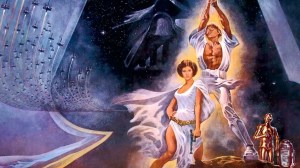
The Star Wars Expanded Universe Began By Worrying It Would Fail

Before the original Star Wars was released, George Lucas was already thinking about the future. Fans know well that he had expansive plans for the series, with ideas for multiple feature films and eras within the story, but the reality is that these were his plans for success; Lucas also had plans for the failure of Star Wars. Written at the same time that the movie was in production by Foster (who also wrote the novelization of Star Wars itself, released ahead of the movie), Splinter of the Mind’s Eye was not only the first ever Star Wars novel, but a story that was written to act as a basis for a sequel to the movie in the event that it was a financial failure.
“The only restriction placed on me was that the follow-up novel had to be filmable on a low budget,” Foster previously told Yahoo. “That’s why I set it on a fog-shrouded planet. A lot of the action takes place in the fog or underground, which facilitates shooting with cheap backgrounds. The book originally opened with a fairly complex space battle that forces Luke and Leia down on this planet, and George had me cut that out because it would have been expensive to film.”
The plot of Splinter of the Mind’s Eye sees Luke Skywalker, Princess Leia, R2-D2 and C-3PO (Han Solo and Chewbacca were not included, as Harrison Ford didn’t have a deal to appear in the sequel movies) as they head to a distant planet to bring in new recruits to the Rebel Alliance. While there, Luke learns that on the planet is an artifact called a Kaiburr crystal (note the spelling), which can magnify Force powers, so he hopes to find it. Naturally, this plan doesn’t go as expected, running afoul of the Empire, and, of course, Darth Vader himself.
In the final act of Splinter of the Mind’s Eye, Luke and Vader finally have their own confrontation, naturally, a lightsaber duel. Unlike their encounter on Cloud City in The Empire Strikes Back, Luke largely has the upper hand in the battle, due in part to being energized by the powers of the Kaiburr crystal. Thanks to this, Luke is not only able to beat Vader, but in fact cuts HIS arm off, an ironic flip on what would actually happen in the actual Star Wars sequel. The final battle is an anticlimactic one, though. Despite Vader managing to outlast Luke, who becomes exhausted from injuries sustained throughout the story, the villain simply falls into a pit, ending the fight (though Luke senses this won’t be their last encounter).
Star Wars’ Non-Canon Sequel Actually Added to the Lore

What’s especially interesting about Splinter of the Mind’s Eye is that we know the book wasn’t actually needed. Though it did allow for Star Wars to expand beyond the movie and give fans something to hold them over until the actual big-screen sequel could be released, the franchise itself would never actually acknowledge the events of the tale. Well, at least not immediately. As fans may have guessed by now, elements included in Splinter of the Mind’s Eye were later incorporated into the larger Star Wars canon, including the Kaiburr crystal.
Foster didn’t create the “Kaiburr crystal” itself for the book, but brought it into the novel because the artifact was referenced in earlier drafts of the script for Star Wars by George Lucas. As we know, they were cut out of the film and not referenced in any of the original trilogy. No part of the buffalo goes unused in Star wars though, and they would eventually become “Kyber crystals” in the canon, the gems that power lightsabers. Their first appearance in the larger Star Wars universe, though, came from this novel.
The planet where much of the action in Splinter takes place has also been brought into the canon, with Mimban appearing in a variety of comics over the years, but also on the big screen in Solo: A Star Wars Story, when the titular Han Solo is still an enlisted Imperial trooper. Just six years ago, Mimban was used in a Kylo Ren comic book, with the sequel trilogy character going to the planet in search of an artifact known as the “Mindsplinter,” clearly a reference to the novel itself. Even in Andor Season 1, the title character makes a note of visiting hte planet.
Splinter of the Mind’s Eye has a very distinct place in the larger history of Star Wars, making today’s anniversary one worth considering as the franchise itself heads toward its 50th next year. Though the success of Star Wars as a movie would make the novel’s place in the big picture almost non-existent, it proved that there was a voracious fandom for the series, which would follow it across mediums and seek out every new detail it could find about the characters and the world. As a result, the Star Wars universe exploded in size with countless comics, novels, and shows being released over the years. In fact, as fans know, Star Wars lore got so big that it had to be split into both Legends and the actual Canon, and it all started with one book, which was created on the pessimistic idea that maybe the movie would be a failure.
Most Viewed
-
Courtesy of Crunchyroll / Sony Pictures -
Image Courtesy of Ufotable -

Courtesy of TOHO Animation