Supergirl arrived on HBO Max on September 10th, seventy-six days after it opened in theaters, and it completed something. Every film in James Gunn and Peter Safran’s DC Universe is now on the same streaming service, alongside every episode of Creature Commandos and both seasons of Peacemaker. It is worth being precise about what that does and does not mean, because the one thing missing is not small: Lanterns premiered on August 16th and is still airing weekly, with five of its eight episodes out and the finale set for October 4th. So the honest version is that every DCU movie is streaming and every DCU series is streaming except the back half of the newest one. That is still the closest this rebooted continuity has come to sitting in one place, and it means the question people have been putting off for two years is finally worth answering. What order do you watch it in?
Videos by ComicBook.com
There are two reasonable answers, and ComicBook has already laid out the chronological one in detail, including where the light-canon holdovers slot in. So this is not another timeline. This is the part that comes after the timeline, which is the question of whether you should actually use it. Release order is five titles and roughly thirteen hours, and it works. Chronological order is the one that sounds smarter, and it is the one that breaks, and it does not break gradually. It breaks on the first entry, for a reason that has nothing to do with taste and everything to do with the fact that the show in question cannot physically be watched that way. That is not a complaint about the DCU being messy. Two years in, it is remarkably tidy. It is a complaint about one structural choice in one show, which happens to sit exactly where a chronological viewing has to start.
Release Order Is Five Titles, and Gunn Has Said That Is Basically the Timeline

The simple version goes Creature Commandos in December 2024, Superman in July 2025, Peacemaker Season 2 that August, Supergirl in June 2026, and Lanterns from August 16th. Five titles, one of them animated, two of them films, and the whole thing fits in a long weekend. It also happens to put the two Kryptonians in the right relationship to each other: Kara turns up drunk in Superman’s final scene, and Supergirl picks her up about a year later, which is where Gunn has publicly placed it. Nothing in release order fights the story. Gunn has said more or less directly that this is also the timeline. Asked on Threads whether Creature Commandos took place before or after Superman, he answered “Before. All of these initial projects are happening in the order they’re released,” and he has restated it since.
His fuller version is the one worth reading closely. “As of now it’s basically as the movies and shows come out,” he wrote, “although of course some of these feature flashbacks,” and then he listed them: Creature Commandos, Superman, Peacemaker, Lanterns, Supergirl. Two things in that sentence matter. The first is “as of now,” which is a man declining to sign anything, and worth remembering before treating any of this as permanent. The second is the order itself, because he put Lanterns ahead of Supergirl. At the time he wrote it that was a statement about a schedule that had not happened yet, which is the kind of thing that ages badly in a slate this young.
That is not how it happened. Lanterns was pushed out of its original window and landed in August 2026, seven weeks after Supergirl opened. Gunn’s own stated chronology and the actual release order stopped matching the moment the schedule moved. That is the cleanest possible demonstration that these are two different lists rather than one list described twice, and it came from a release-date change rather than from anything in the stories themselves. It is also, conveniently, the smallest problem chronological order has. Nobody watching in either order is going to be confused by a seven-week gap between two projects that barely touch. The next one is not like that.
Chronological Order Asks You to Cut a Series in Half
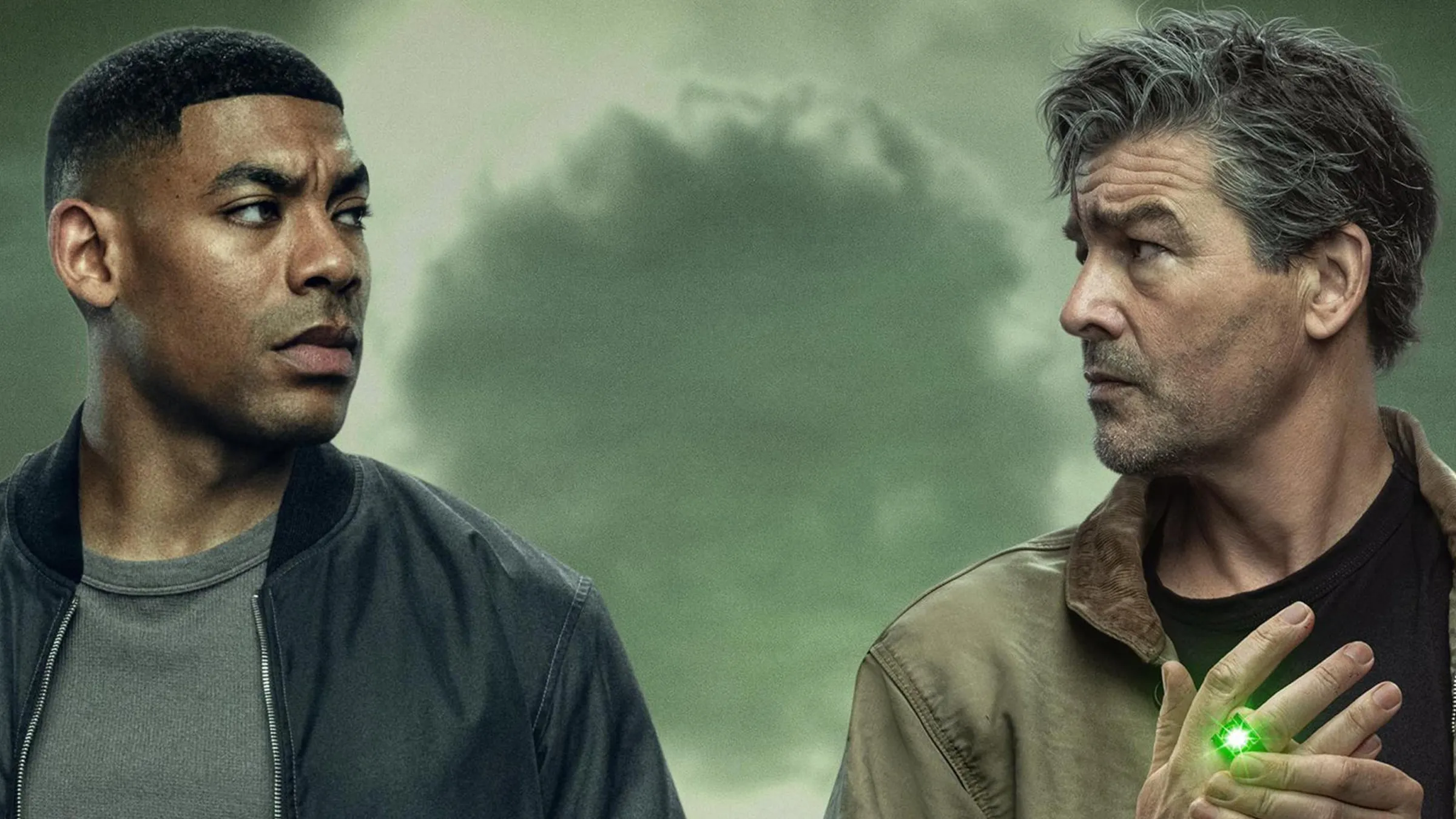
Here is the thing that makes a chronological DCU watch impossible rather than merely annoying. Lanterns is not set in 2026. It is set in three places at once. It opens in 1996 on a television interview in which Hal Jordan had already been a Green Lantern for a decade, which puts him in the ring around the mid-1980s. Its main story runs in 2016, with Hal as the established veteran and John Stewart as the newcomer. And it carries a jump forward to 2026 that the production kept deliberately quiet before release, which is why nobody could place the show on a timeline until it started airing. The showrunner has described the structure as a decade split into two blocks, with the older Lantern and his heir apparent on either side of it.
Those three periods are not three separate blocks you can reorder. They are cut into the same episodes. A true chronological viewing would have you start the entire DC Universe with the 2016 material, stop partway through an episode, go watch four other projects spanning two years of real time, and then come back for the rest of the same episode. You cannot do that without an editing bay. Every published chronological order, including the one on this site, handles it the only way anyone can: by listing Lanterns twice, once at the top and once at the bottom, and hoping you sort it out yourself.
It has a second effect that is stranger and more interesting. If you genuinely watch in story order, the Green Lantern Corps has been public knowledge since the mid-1980s, while Superman did not reveal himself to the world until 2022. Start chronologically and the DCU is a setting where cosmic policing is decades old and the guy in the red cape is the new arrival nobody is sure about. That is a defensible way to experience this universe. It is also the opposite of the one Gunn built, where Superman is the humongous epic he has called the true start of everything.
The Other Trapdoor Is Peacemaker’s First Season
The second problem is smaller and sharper. Peacemaker Season 1 aired in 2022, before this continuity existed, and Gunn has kept it rather than throwing it out. His rule for the older material is that it counts when the new material says it counts — if something gets mentioned in a DCU project, it happened. The one thing he has carved out is the Season 1 finale, where the Justice League turns up. Of that group he has said plainly that they do not exist yet. That is a narrow exception and a sensible one, and it costs nothing if you meet it in the right order. It costs quite a lot if you do not.
Season 2 handles this, and how it handles it is the argument for release order in miniature. It does not explain the change with a story beat, and it has nothing to do with that season’s dimensional-doorway plot. It fixes it in the “Previously On” recap, which was re-cut so that Adebayo asks for the Justice Gang instead, and the silhouettes at the door become Mr. Terrific, Superman, Guy Gardner, Hawkgirl and Supergirl, turning up too late to be useful. Watch in release order and that correction arrives as a joke you are in on. Watch in chronological order and you get the original version first, with a team the universe has never heard of, and nothing at all to tell you why.
All of which is manageable now, and gets worse in October. Clayface opens on the 23rd, and Gunn has confirmed it sits before everything, Creature Commandos included, with the same Matt Hagen. Asked what happened to the character afterward, he answered “Back to prison.” So the film that will eventually be chronological entry number one is a film whose ending is already spoiled by a 2024 animated series, and the moment it arrives, the two orders stop being a matter of preference at the movie level. Release order will still be five titles in a weekend. Chronological order will still be a series you have to watch twice.
More Movies
-
Image Courtesy of Lions Gate Films -
Image Courtesy of Marvel Comics -
Image Courtesy of Universal Pictures