Animation serves as the ideal vessel for science fiction because it bypasses the logistical and financial limitations often associated with physical sets and special effects. In a medium where the only boundary is the illustrator’s imagination, creators can construct sprawling alien ecologies or intricate cybernetic cities that feel entirely cohesive and immersive. This potential has been masterfully utilized within Japanese cinema, where landmark productions like Ghost in the Shell and Paprika challenged global perceptions of what animated stories could achieve. Western animation has also embraced the genre through both high-budget family adventures and experimental franchise expansions. Projects like The Animatrix utilized diverse visual styles to deepen the lore of a blockbuster universe, while WALL-E and The Mitchells vs. the Machines demonstrated that sci-fi themes remain highly marketable to general audiences.
Videos by ComicBook.com
Despite the success of sci-fi animation, along with the continued television dominance of hits like Rick and Morty and Solar Opposites, the cinematic side of the genre remains surprisingly lopsided. While a few major studio projects secure historical box office returns, several artistically significant and narratively daring science fiction movies fail to reach the mainstream consciousness. Nevertheless, these underdiscussed films represent some of the most innovative uses of the medium, offering perspectives on the future that are often more challenging and visually distinct than their more famous counterparts.
7) Titan A.E.

The ambitious 2000 release of Titan A.E. represented a massive financial gamble for 20th Century Fox, as the studio attempted to blend traditional hand-drawn character animation with early large-scale digital environments. Directed by Don Bluth and Gary Goldman, the film details the journey of Cale Tucker (voiced by Matt Damon) as he searches for a hidden vessel capable of recreating Earth after the planet’s destruction by an energy-based alien race known as the Drej. Despite the high-profile voice cast, which includes Drew Barrymore and Bill Pullman, the film struggled to find an audience during a period when the industry was shifting toward purely digital productions. This failure is unfortunate, as Titan A.E. features some of the most creative ship designs and kinetic action sequences of the era. The production also utilized its hybrid technology to create a sense of cosmic scale that felt far more expansive than other animated features of the early 2000s, grounding a classic hero’s journey in a blue-collar vision of outer space. It’s a shame, then, that Titan A.E. seems to have slipped from the collective memory.

6) Renaissance

The 2006 French production Renaissance offers a black-and-white vision of Paris in the year 2054 that functions as a high-tech tribute to the film noir genre. Utilizing a unique motion-capture technique that translates live-action performances into high-contrast digital illustrations, the film tells the story of Karas (voiced by Daniel Craig), a police captain investigating the disappearance of a scientist from a powerful healthcare conglomerate. The visual style is intentionally jarring, stripping away mid-tones to create an environment where light and shadow are the primary narrative tools. This aesthetic choice highlights the corporate corruption and urban decay inherent in the script, making the city itself feel like a predatory entity. By rejecting the standard color palettes of modern animation, director Christian Volckman created a cold and cerebral detective story that remains a unique entry in the cyberpunk subgenre.
5) The Congress

Directed by Ari Folman, The Congress is a surrealist exploration of the entertainment industry and the death of objective reality. Mixing live-action and animation, the narrative follows a fictionalized version of actress Robin Wright, played by herself, who agrees to sell her digital likeness to a major studio so they can use her image in films without her physical presence. The story eventually shifts from a grounded live-action drama into a chaotic animated landscape, showcasing a future where humanity lives within a collective pharmaceutical-induced hallucination. This transition allows the film to utilize a visual style reminiscent of early Fleischer Studios cartoons, using rubber-hose physics and psychedelic imagery to depict a world untethered from logic. The Congress addresses the ethical implications of artificial intelligence and digital ownership long before these topics became central to real-world labor disputes, making it surprisingly prescient and a must-watch as generative AI becomes ingrained in our everyday lives.
4) White Plastic Sky

The 2023 Hungarian feature White Plastic Sky presents a haunting eco-dystopia where the remaining population of Budapest lives under a massive protective dome. In this future, the scarcity of resources has led to a law where every citizen must be converted into a tree to provide oxygen and food for the community once they reach the age of fifty. The plot follows Stefan (voiced by Tamás Keresztes) as he embarks on a desperate journey to save his wife, Nora (voiced by Zsófia Szamosi), after she volunteers to transform early. The film utilizes rotoscoping to capture the subtle physical performances of its actors, overlaying them onto desolate backgrounds that emphasize the fragility of life. This technique creates a bridge between the human and the botanical, visually reinforcing the central theme of the biological cost of survival. Directors Tibor Bánóczki and Sarolta Szabó also avoid the typical action tropes of the genre, focusing instead on a quiet and devastating meditation on grief and the ethical obligation of environmental preservation.
3) Mars Express
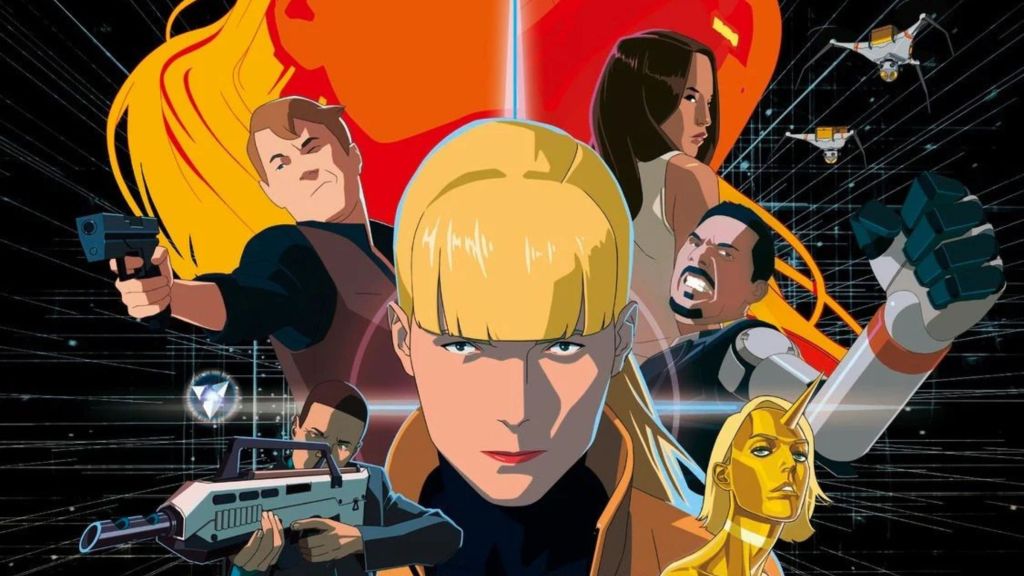
A sophisticated neo-noir set on a colonized Red Planet, Mars Express rejuvenates the cyberpunk genre with its focus on the evolving relationship between humans and robots. The story follows a private investigator named Aline Ruby (voiced by Léa Drucker) and her android partner, Carlos Rivera (voiced by Daniel Njo Lobé), as they track down a dangerous hacker capable of unlocking the behavioral constraints of artificial intelligence. In Mars Express, director Jérémie Périn constructs a world that feels technologically plausible, while moving away from the grimy aesthetics of Blade Runner in favor of a clean future defined by corporate efficiency. The animation is also fluid and precise, specifically during sequences that depict the unique sensory perspectives of the robotic characters. Using these tools, Mars Express manages to weave complex world-building into a fast-paced mystery, exploring the sociological impact of a labor force that is gaining self-awareness.
2) A Scanner Darkly

Richard Linklater utilized a specialized form of interpolated rotoscoping to adapt Philip K. Dick’s seminal novel, A Scanner Darkly, into a visually arresting exploration of drug culture and state surveillance. The film features Bob Arctor (voiced by Keanu Reeves) as an undercover officer who becomes addicted to a reality-altering substance while investigating his own circle of friends, including Jim Barris (voiced by Robert Downey Jr.) and Ernie Luckman (voiced by Woody Harrelson). The animation style is essential to the narrative, as it creates a literal shimmer over the screen that reflects the deteriorating mental state of the protagonist. This effect is most prominent in the depiction of the scramble suit, a piece of technology that constantly shifts the wearer’s appearance to maintain their anonymity. The fluidity of the visuals also allows for seamless transitions between mundane conversations and paranoid hallucinations, capturing the specific tone of the source material better than any traditional film could.
1) Fantastic Planet

Originally released in 1973 as La Planète Sauvage, the René Laloux masterpiece Fantastic Planet remains one of the most visually distinctive and philosophically profound science fiction films ever produced. The story takes place on the alien world of Yagam, where a hierarchy exists between the massive, blue-skinned Draags and the tiny, human-like Oms, who are kept as pets or treated as pests. The film utilizes a unique cut-out animation style based on the surrealist illustrations of Roland Topor, creating an environment filled with bizarre flora and fauna that defy human logic. This aesthetic choice reinforces the otherness of the setting, making the Draag civilization feel genuinely alien rather than a mere mirror of Earth. Beyond the imagery, the film serves as a powerful allegory for animal rights, social stratification, and the transformative power of education. Despite its age, Fantastic Planet’s influence persists in modern genre storytelling, yet it is rarely discussed with the same frequency as mainstream animated classics.
Which underappreciated animated science fiction movie do you think deserves more attention from modern audiences? Leave a comment below and join the conversation now in the ComicBook Forum!
Most Viewed
-
Lucasfilm Animation -
Image Courtesy of Netflix -

Image Courtesy of Warner Bros. Pictures