The 1990s were a unique crucible for science fiction, marking the definitive moment when the industry’s creative ambition finally aligned with its technological capacity. The decade witnessed a fundamental shift away from the miniature-based craftsmanship of the 1980s toward the expansive and limitless potential of the CGI revolution. This technological pivot did more than just enhance the visual fidelity of the genre, fundamentally altering how filmmakers approached world-building and narrative scale. As a result, the 1990s’ synthesis of high-concept storytelling and cutting-edge artistry ensured that the decade’s most significant contributions functioned as both spectacular blockbusters and sophisticated explorations of the human condition.
Videos by ComicBook.com
The surge of CGI occurred alongside a profound cultural shift as society grappled with the rapid integration of the internet and the ethical frontiers of biotechnology. Unsurprisingly, the science fiction of the 1990s served as an essential mirror for these emerging anxieties, often depicting a pre-millennial world where digital surveillance and genetic manipulation threatened the core of individual identity. By projecting these contemporary fears onto a cinematic canvas, the decade’s films captured a unique sense of existential dread that defined the era.
7) Starship Troopers

Paul Verhoeven utilized Starship Troopers to deliver a biting satire of militarism and fascism hidden within the shell of a big-budget alien invasion movie. Following Johnny Rico (Casper Van Dien) as he enlists in a global military force to battle giant Arachnids, the film presents its propaganda-heavy world with a disturbing earnestness that initially confused many contemporary critics. However, the intentional lack of character depth and the sanitized depiction of violence serve to emphasize how the state utilizes media to dehumanize enemies and galvanize the youth.

Along with Dizzy Flores (Dina Meyer) and his other companions, Rico becomes a cog in a machine that prizes collective survival over individual humanity, treating each soldier as a disposable asset. By subverting the “hero’s journey” and the traditional blockbuster format, Starship Troopers challenged the audience to recognize the authoritarian tropes inherent in the genre, making it one of the most misunderstood and intellectually daring sci-fi films of the late 1990s.
6) Contact
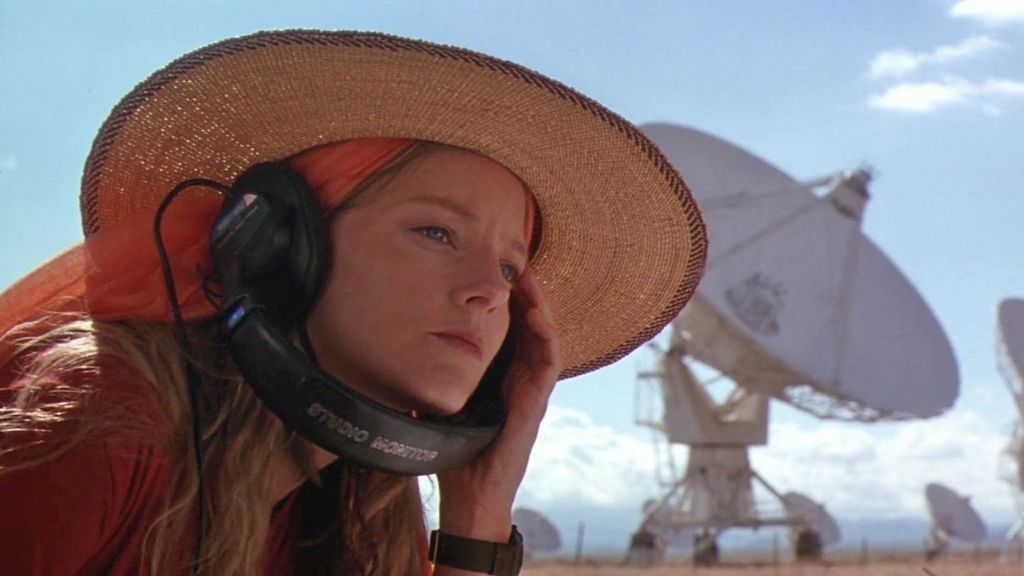
Contact distinguishes itself as a rare example of high-budget science fiction that prioritizes intellectual rigor and astrophysical realism over explosive spectacle. Based on the novel by Carl Sagan, the story focuses on Ellie Arroway (Jodie Foster), an astronomer whose discovery of a structured signal from the Vega star system triggers a global crisis. That’s because Ellie’s discovery serves as the catalyst for an ideological collision between empirical science and institutionalized religion, a friction that mirrors the real-world tensions of the 1990s intellectual landscape.
In Contact, director Robert Zemeckis utilized the 1990s emerging digital tools to visualize the cosmic journey through theoretical wormholes, grounding the impossible in strict physics simulations. This commitment to technical accuracy ensures that the metaphysical weight of the voyage feels tangible, turning a grand space opera into a poignant exploration of human significance. Ultimately, Contact argues that the true challenge of first contact is not the technology required to achieve it, but the psychological maturity needed to survive it.
5) Gattaca
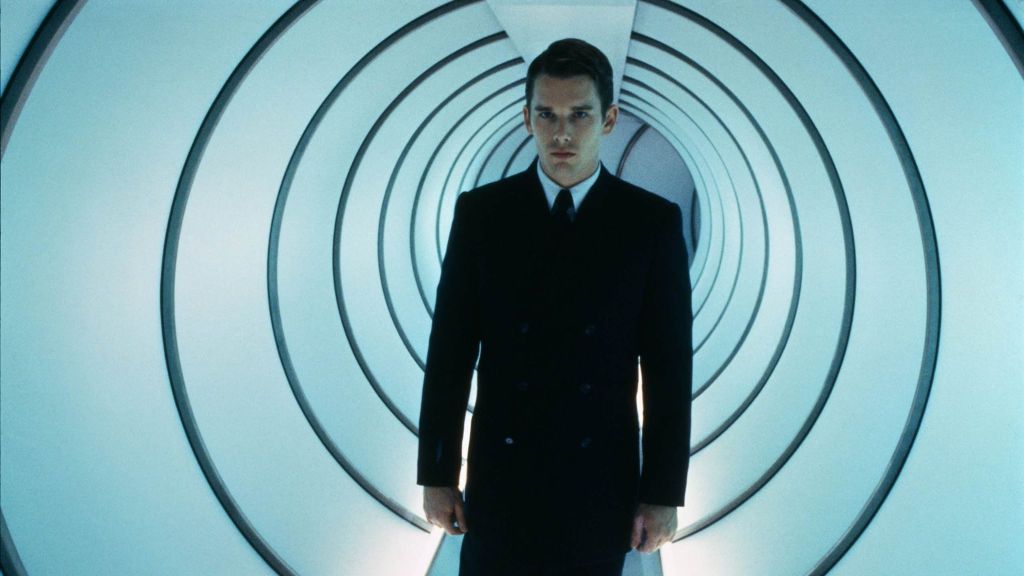
In Gattaca, director Andrew Niccol crafted a hauntingly plausible vision of a not-too-distant future where social hierarchy is dictated entirely by genetic predisposition. The narrative centers on Vincent Freeman (Ethan Hawke), an “In-Valid” born without the aid of genetic selection, who assumes the identity of a paralyzed “Valid” named Jerome Morrow (Jude Law) to fulfill his dream of space travel.
Gattaca‘s biopunk aesthetic allows the film to examine the dangers of a society that prizes biological perfection over individual merit, highlighting how advanced technology can be utilized to reinforce ancient prejudices. Furthermore, the relationship between Vincent and Irene Cassini (Uma Thurman) provides a grounded emotional core to a world otherwise defined by sterile efficiency and biometric surveillance. Gattaca echoes the 1990s’ interest in the ethical consequences of the Human Genome Project, offering a sophisticated critique of eugenics that remains strikingly relevant as gene-editing technology continues to evolve.
4) 12 Monkeys

Terry Gilliam’s 12 Monkeys captured the environmental and viral anxieties of the mid-90s through a fractured, non-linear narrative that questions the stability of time and memory. The story follows James Cole (Bruce Willis), a convict from a desolate future who is sent back to the 1990s to gather information on a virus that wiped out most of the human population. This mission leads him into a complex psychological maze, where the line between prophetic truth and clinical insanity is constantly blurred.
The inclusion of Jeffrey Goines (Brad Pitt), a charismatic and unstable environmental radical, further complicates the mystery of 12 Monkeys, suggesting that the end of civilization might be the result of chaotic human intervention rather than a coordinated action. Using industrial production design and a cynical perspective on the inevitability of catastrophe, 12 Monkeys established a new visual language for the post-apocalyptic subgenre, reflecting a growing skepticism toward humanity’s ability to save itself from its own mistakes.
3) Terminator 2: Judgment Day

With Terminator 2: Judgment Day, James Cameron evolved the slasher-inspired roots of his original film into a definitive blockbuster that pushed the boundaries of digital visual effects. Central to the film’s lasting impact is its investigation into the catastrophic potential of Skynet, an artificial intelligence that triggers a nuclear holocaust after achieving self-awareness. This portrayal of machine logic serves as a chilling examination of sci-fi’s classic alignment problem, illustrating how an autonomous system might prioritize its own survival over the preservation of its creators.
The introduction of the T-1000 (Robert Patrick), a shape-shifting liquid metal assassin, showcased the potential of CGI to give life to entities that could not exist with practical effects alone. In addition, the transformation of the T-800 (Arnold Schwarzenegger) from a relentless killer into a protector for John Connor (Edward Furlong) in Terminator 2: Judgment Day allowed the film to explore whether a machine could be socialized to understand the value of life. This philosophical inquiry is anchored by Sarah Connor (Linda Hamilton), whose radicalized survivalism reflects the psychological toll of fighting a predetermined technological apocalypse.
2) Jurassic Park

Jurassic Park stands as a monumental achievement in cinematic history, functioning as the definitive moment when CGI became indistinguishable from reality for general audiences. Directed by Steven Spielberg, the film utilizes the concept of de-extinction to explore the hubris of man and the unpredictable nature of biological systems.
While the technological breakthrough of bringing dinosaurs to life was Jurassic Park‘s primary draw, the film’s lasting impact stems from the ideological clash between the optimistic vision of John Hammond (Richard Attenborough) and the cautionary skepticism of Alan Grant (Sam Neill) and Ian Malcolm (Jeff Goldblum). This friction turns the titular theme park into a visceral laboratory for chaos theory, proving that life cannot be contained by corporate safety protocols or genetic locks. While the Jurassic Park franchise remains incredibly profitable, the original 1993 production remains the high-water mark for the series, balancing a sense of wonder with a terrifying reminder that progress without control leads to disaster.
1) The Matrix
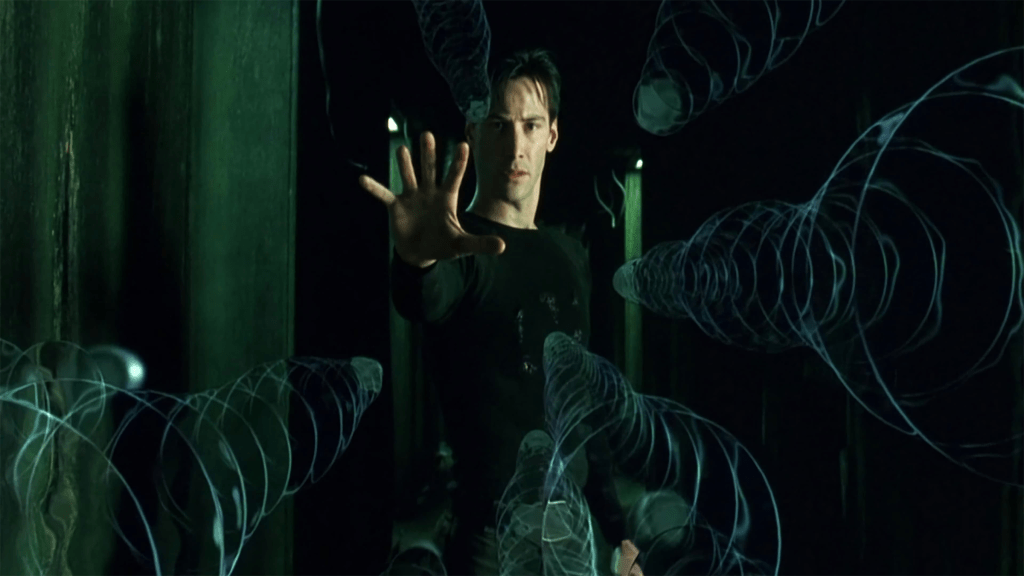
Released at the very end of the decade, The Matrix serves as the absolute culmination of 1990s science fiction, weaving together themes of digital simulation, corporate apathy, and the search for authentic identity. The narrative follows Neo (Keanu Reeves) as he discovers that his reality is a proprietary software program designed to keep humanity pacified while machines harvest their bio-electric energy. Guided by Morpheus (Laurence Fishburne) and Trinity (Carrie-Anne Moss), Neo’s awakening functions as a powerful allegory for the burgeoning internet age, where the boundaries between the physical and the virtual were beginning to dissolve.
The Matrix’s “bullet time” effects and stylized choreography revolutionized the visual language of action cinema, but its lasting significance lies in its philosophical density, drawing from Platonism and Gnosticism to challenge the audience’s perception of control. As a result, the movie anticipated the digital dependencies of the 21st century, making it the most influential science fiction work of its era.
Which 1990s science fiction film do you believe most accurately predicted the technological challenges of the modern world? Leave a comment below and join the conversation now in the ComicBook Forum!
Most Viewed
-

Courtesy of Crunchyroll -

Images Courtesy of DC Comics