Star Trek: The Next Generation was all the proof fans needed that the franchise could transcend the beloved Original Series. It laid out its own set of rules and created a slew of new references that Trekkies have now been talking, joking, and arguing about for decades. In the days of yore, before the ubiquitous presence of the World Wide Web, TNG unknowingly captured an image that would someday become one of the most widely used memes on the internet, in a top-tier episode that also brought back a fan-favorite character in the most unexpected way.
Videos by ComicBook.com
It was February 5, 1990, when The Next Generation aired “Deja Q.” The episode marked the unexpected return of John de Lancie’s omnipotent, immortal trickster, albeit without the omnipotence or immortality. And in addition to the iconic comeback, “Deja Q” also gifted the world a reaction shot of Sir Patrick Stewart’s Captain Jean-Luc Picard that has transcended the entire Trek franchise and is known today as the Picard Facepalm.
Q Returns Without His Powers in The Next Generation’s “Deja Q”
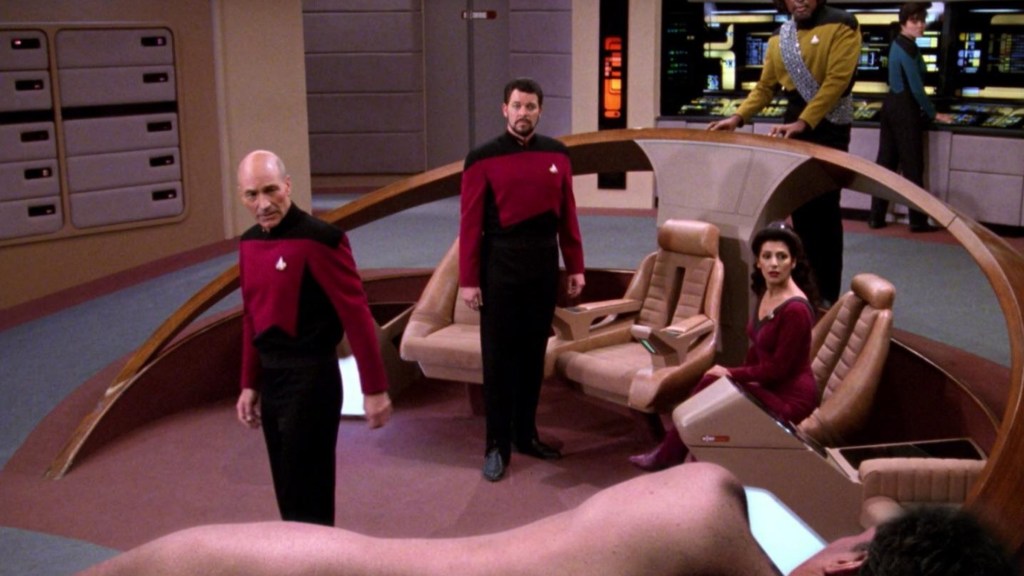
“Deja Q” aired midway through Season 3, and leading up to it, Q had already earned his reputation as TNG’s wildcard. Introduced in the series premiere “Encounter at Farpoint,” de Lancie’s Q wasn’t a conventional villain so much as an irritating, all-powerful troublemaker who loved to expose humanity’s flaws by mocking them. Each of Q’s early appearances revolved around his godlike abilities, contempt for mortals, and Picard’s refusal to indulge him.
Yet when Q reappears aboard the Enterprise in “Deja Q”, he’s not his usual arrogant, untouchable self, but rather a vulnerable, stripped-down exile, whom the Continuum punished by removing his powers and forcing him to live as a human.
Taking a mostly comedic approach, the episode depicts Q’s harrowing ordeal as he discovers hunger, injury, fear, and so on. Given that Q’s identity has always been inseparable from his omnipotence, his reappearance in “Deja Q” is both shocking and highly satisfying. Watching Picard and the crew react to a suddenly powerless god becomes about giving patience they didn’t get and finding a sort of reluctant empathy for Q. Among others, it’s one of the best episodes to illustrate Q as more than an antagonist or nuisance, but a three-dimensional character capable of evolving, no matter how much he resists. In fact, it was in direct reaction to Q’s behavior in the episode that we got the iconic meme.

The Picard Facepalm Meme in the Context of “Deja Q” and Beyond
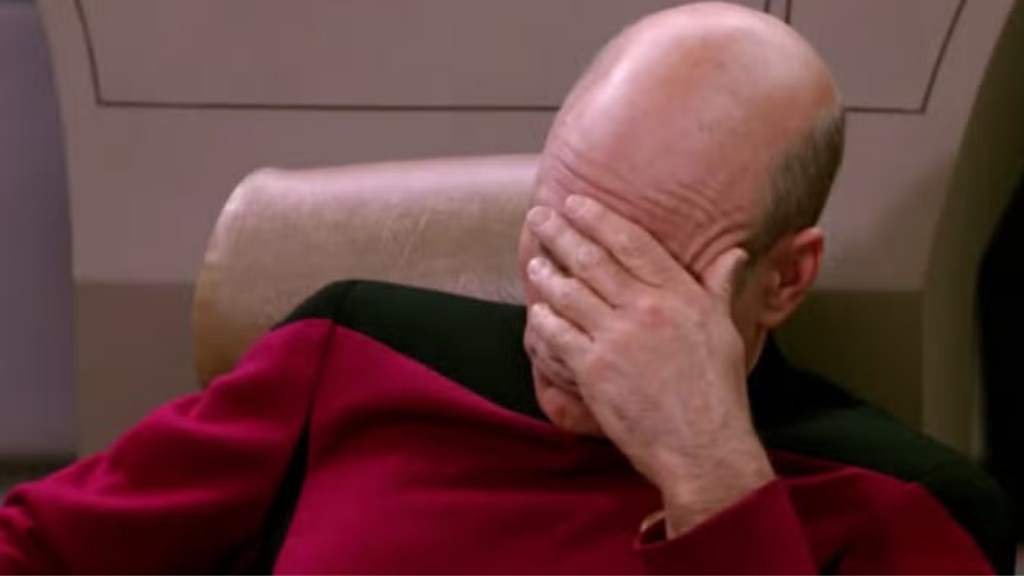
What we now know as the Picard Facepalm takes place in the first few minutes of the episode, shortly after Q arrives on the bridge. Q, now human, has already begun annoying the crew aboard the Enterprise, oscillating between self-pity and his usual arrogance. He insists on being indulged, protected, and comforted, all the while refusing to take responsibility for his situation. Picard, who is already dealing with a looming threat in the form of a moon on a collision course with Bre’el IV, finally hits his limit.
Thus, the Picard Facepalm is born from the Captain’s exhaustion with Q’s childlike behavior. We owe it to both the show’s writers and actors, de Lancie and Stewart, for the perfect storm that led to the meme. Today, over three decades later and stripped of its narrative context, the image has taken on its own life and meaning entirely. As the early internet embraced reaction images, Picard’s legendary facepalm emerged as a sort of definitive response to human folly and irritation in general. It spread through forums, blogs, and eventually social media, becoming shorthand for expressing one’s own frustration or secondhand embarrassment. Even as the internet and memes themselves have evolved, you can’t be online for too long before you see a Picard Facepalm.
Was your first viewing of “Deja Q” pre- or post-facepalm meme? Leave a comment below and join the conversation now in the ComicBook Forum!
More TV Shows
-

image courtesy of marvel studios -
IMAGE COURTESY OF PARAMOUNT -
Courtesy of Cartoon Network