Sitcoms are the kind of format that seems almost impossible to mess up: short episodes, built-in laughs, recurring characters, and conflicts that wrap up without needing heavy drama. But when they don’t work, you feel it immediately. When a sitcom is bad, the comedic timing just isn’t there, the silence turns awkward, and sometimes a single episode feels way too long to sit through — your interest slowly starts to fade. And over the years, TV has produced, alongside undeniable classics, a considerable number of shows that make you wonder how they made it past the pilot or even a first season.
Videos by ComicBook.com
Some aged poorly, some were outdated from day one, and others just never figured out what their own joke was supposed to be. Here are 7 terrible sitcoms that are incredibly hard to keep watching, because they miss the most basic fundamentals of what this format is supposed to deliver.
7) 2 Broke Girls

2 Broke Girls actually lasted a surprisingly long time, which, honestly, remains one of the more baffling TV success stories of the 2010s. Over six seasons, the series follows Max (Kat Dennings) and Caroline (Beth Behrs), two waitresses in Brooklyn, trying to save enough money to launch a cupcake business. Like most sitcoms, it’s built on a simple premise, but one that had real potential if handled well. There was room to explore class differences, ambition, female empowerment, and what it really means to survive in New York City. Instead, the show sidelines all of that in favor of relentless raunchy jokes, broad stereotypes, and humor that feels stuck in another era.
And the issue isn’t that the show relies on crude humor, because plenty of sitcoms thrive on sharp, edgy comedy. The real problem is how predictable and repetitive it becomes. Almost every Max joke is just another spin on the same brand of sarcasm, and the supporting characters come off more like exaggerated sketches than fully formed people. By the third episode, you can already tell exactly how every scene is going to play out. So 2 Broke Girls doesn’t lose viewers because it’s outrage-inducing — it loses them because it’s exhausting. And that burnout sets in fast.
6) Call Me Kat

Call Me Kat had all the ingredients to work, especially with Mayim Bialik in the lead, considering how great she was on The Big Bang Theory. But once you actually start watching, it’s surprisingly easy to forget that you are. The show follows Kat (Bialik), a single woman who uses the money her parents saved for her wedding to open a cat café and try to take control of her life. It’s a charming premise, almost tailor-made for viewers looking for something light and easy to watch, right? The thing is that lighthearted doesn’t have to mean low-stakes.
A sitcom is supposed to make you laugh, but it still needs a story driving it forward (it’s a series, after all). In Call Me Kat, episodes rarely build any real tension, the jokes almost never surprise, and the fourth-wall breaks don’t land because they feel more like a stylistic gimmick than something organic. And the cast has charm, but charm without strong situations doesn’t carry a show. In the end, the series struggles because it’s lukewarm. And that’s arguably worse than being outright bad, because a lukewarm sitcom is the kind you drop in no time.

5) Blockbuster

This show sounded like the perfect idea, especially for Millennials. Blockbuster follows the employees of the last remaining video rental store in the world, trying to survive in the age of streaming, while manager Timmy (Randall Park) fights to keep the business relevant. On paper, it felt like a built-in win. However, the production loses its footing because it doesn’t understand a simple difference: using nostalgia as a tool versus relying on nostalgia as a crutch — and it very clearly chooses the latter. And that’s frustrating, because the premise felt perfect for some smart commentary on obsolescence, pop culture, and how the market keeps shifting.
Unfortunately, almost none of that plays out in a meaningful way. Instead of exploring the symbolic weight of being the last Blockbuster standing, the show mostly sidelines that angle in favor of generic workplace situations we’ve already seen done much better in other sitcoms. Basically, the show chooses to blend in with every other average comedy. The pacing feels flat, the identity never actually forms, and most importantly, the series rarely makes you feel like the store is actually on the brink of collapse.
4) That ’80s Show

Remember the classic That ’70s Show? It was a hit, and in the early 2000s, it probably looked like the kind of success you could replicate. And that was clearly the thinking behind its spin-off, That ’80s Show. The series follows Corey (Glenn Howerton) and his group of friends living in San Diego during the 1980s, and just like its predecessor, it leans into romances, jobs, and light existential crises — all wrapped in heavy pop culture references from the decade. The intention couldn’t have been more obvious: repeat what worked before, just swap out the era. Did it work? Not really. And the main reason is simple: everything feels forced.
Sometimes networks assume you can just take the formula and “update” it, but that’s not enough. In That ’80s Show, every element feels deliberately engineered to mimic the original sitcom, which makes the decade references feel like shortcuts to punchlines rather than good storytelling. Plus, the characters never have the same natural dynamic or effortless charm that made That ’70s Show click. Instead of capturing the spirit of the ’80s, the series comes off like a calculated attempt to cash in on nostalgia. It has no soul.
3) AfterMASH

Another spin-off, but this one had a much tougher mission from the start. Living up to the weight of M*A*S*H is no small task. Titled AfterMASH, the show brings back a few characters from the original production, now working at a veterans’ hospital after the Korean War. On paper, the idea made sense: no need to reinvent the wheel, just continue following characters the audience already loved, only in a new setting. But it feels like the producers were so focused on capitalizing on the legacy of an iconic sitcom that they never stopped to consider whether it was better left alone.
The main issue with AfterMASH is that it misunderstands what made the original work in the first place: context mattered. Without the war as a backdrop, the humor loses its sharp contrast, and the drama loses its urgency. What was once layered and emotionally balanced turns into something procedural and flat. So in the end, the show never finds a compelling reason to exist beyond “people liked these characters,” and that’s just not enough to carry a series. It was a gamble that relied more on brand recognition than careful creative planning (so much so that it also went through some weird writing changes).
2) Work It
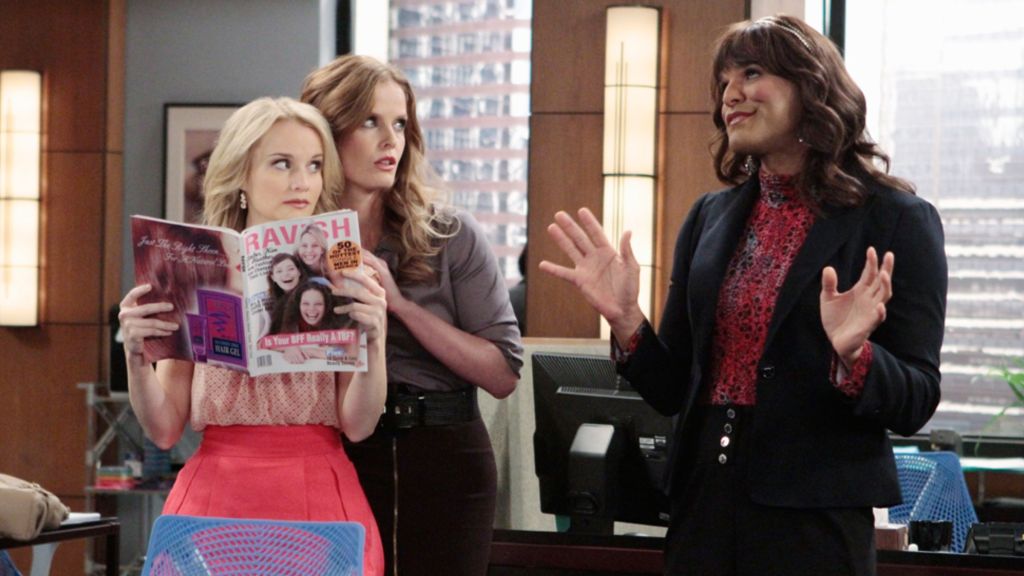
Hardly anyone remembers Work It, and plenty of people have never heard of it at all. And there’s a reason for that: it was so poorly received that it got canceled after just two episodes. The show starts with a deeply problematic premise: two unemployed men dress up as women to land and keep jobs at a pharmaceutical company. From there, it tries to squeeze humor out of the awkward situations created by the deception, relying heavily on disguises and misunderstandings as its main comedic engine. The problem is that the central joke never evolves.
With overwhelmingly negative feedback, Work It earned a reputation as one of the worst sitcoms ever made. Instead of attempting to build any smart commentary about the job market or identity, it doubles down on shallow stereotypes. Much like 2 Broke Girls, which also debuted in the early 2010s, it already felt outdated the moment it aired. The discomfort consistently outweighs the humor, leaving you watching and wondering what the actual point of the show is. And when a comedy makes you question its purpose more than it makes you laugh, that’s a structural failure.
1) Heil Honey I’m Home!

Just look at the name of the sitcom — yes, it was real. And it’s honestly hard to explain how Heil Honey I’m Home! got approved. The series portrays Adolf Hitler (Neil McCaul) and Eva Braun (Denica Fairman) as a married couple living next door to a Jewish family, all framed within a classic domestic sitcom format. The concept was supposedly meant to satirize Nazism by using the wholesome structure of old-fashioned family comedies. The problem? A project like that, if it’s going to be made at all, demands razor-sharp satire and absolute precision. In this case, there’s none of it.
Almost all of the humor relies on the shock value of the premise, with no intelligent buildup or consistent critical angle. You might think the show was trying to be bold and ended up misunderstood — but that’s not what happened. The execution itself fails to justify even the slightest reason for existing. Instead of provoking reflection or even uncomfortable laughter, Heil Honey I’m Home! just leaves viewers uneasy in the worst possible way. It was canceled after a single episode and remains one of the most insensitive and absurd project attempts ever put on TV.
What’s your opinion on these sitcoms? Leave a comment below and join the conversation now in the ComicBook Forum!
More TV Shows
-

Courtesy of Paramount+ -

Image Courtesy of Marvel

![MCU Fans Can’t Believe VisionQuest Just Killed [SPOILER] in the First Two Episodes](https://comicbook.com/wp-content/uploads/sites/4/2026/09/visionquest.jpg?w=300)