Alongside the Borg, the Cardassians, and the Q Continuum, the Klingons make up the top table of Star Trek villains. They are arguably the most iconic, the most recognizable, and the most accessible as an idea to even the most casual of Star Trek fans. Remarkably, that isn’t exactly because they’re one-dimensional, but more that their brand is immovable. That also accounts for the reaction that met Star Trek: Discovery‘s decision to redesign them so controversially. We all had our firm ideas of what Klingons are, and that just wasn’t it. But when you spend any time really thinking about Klingon culture or the idiosyncracies of their code of honor, you begin to realize that we’re all accepting some nonsensical things with little scrutiny.
Videos by ComicBook.com
In short, Klingons have become popular despite these issues, which just makes their longevity even more impressive. Also, let’s get a little disclaimer out of the way: Complaining about inconsistencies in how Klingons look is too low-hanging fruit. It all comes down to budgetary changes and then creative differences. As Worf said in DS9‘s TOS crossover episode, it’s a long story, and it’s not for outsiders (though Enterprise did eventually answer it). Now, let’s all move on.
5. They Should Never Have Been Dominant Warriors
You can understand how the Borg started an empire: they’re a relentless force that views almost all biological races as inferior and mere fuel for their growth. (A bit like tech billionaires, am I right?) They’re also equipped with significant augmentations, phenomenal technological power, and an armoury that genuinely does make resistance futile. Their irresistible march across entire galaxies was not only logical, it was sort of understandable: why would they tolerate such inferiority when they could conquer everything and improve it? On the other hand, the Klingons seem to largely just boast raging egos and near insatiable anger.
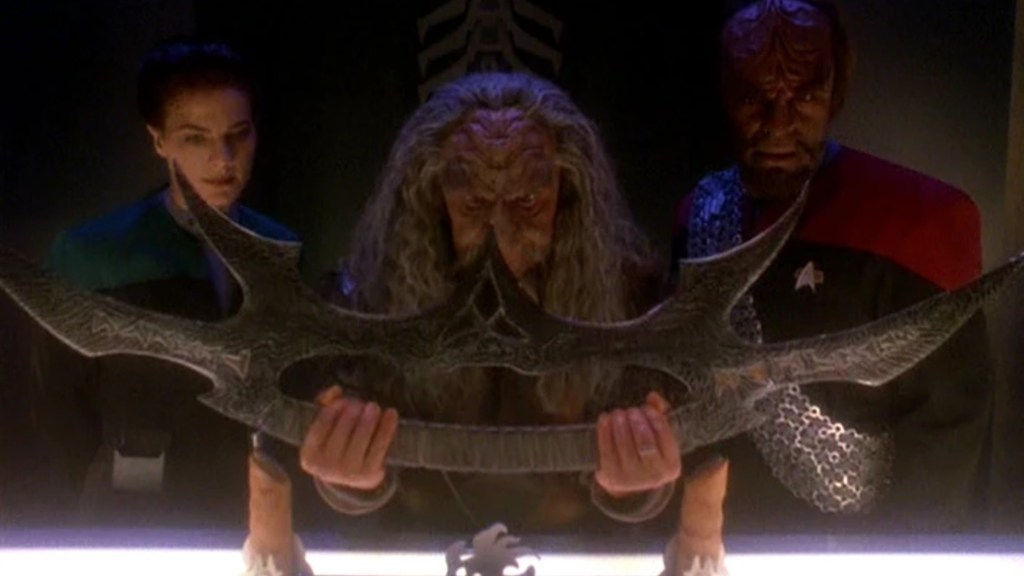
Traditionally, Star Trek presented the race as knuckle-dragging neanderthals, bred for war and married to a perverse code of honor that would ordinarily wipe entire civilizations out. The entire story of Star Trek, in fact, is mostly about the dangers of working in absolutes (see also Star Wars) as repeatedly proven by the constant breaking of the Prime Directive for the greater good. Klingons should have either gone extinct or been so limited by their reductive outlook that they quickly became irrelevant. Think about how confusing the very idea that they gained warp capabilities is for so many Trek fans… It’s because Star Trek paints a pretty problematic picture of Klingons as “bone-headed”. They use Bat’leths. Against laser guns. It’s a mark of glory to abide by those traditions, which should be completely undone by the fact that any of their enemies with ranged weapon capabilities could nullify them from a distance.
How did they conquer anything? They are presented as a colonial empire, unstable and beset by corruption and volatile internal politics: the very antithesis of the Federation. While the Federation would later be portrayed as somewhat fascistic, that was never Gene Roddenberry’s vision, and the Klingon Empire’s success seems weirdly at odds with the utopian vision of a progressive future society.
4. The Escape Pods Policy

Speaking of self-defeating commitment to glory, Klingons have a pretty admirable sense of loyalty to their comrades in arms. That means they do not abandon fallen warriors, or retreat. Even the most corrupt of their number seem deeply wedded to this commitment, and it’s something that is essential enshrined in Klingon lore… if not law. It all fits nicely with the Klingon proverb “May you die before you are captured.” That includes the idea of abandoning a stricken ship as being unthinkable, so you’d think escape pods would be a pointless extravagance on any Klingon vessel. In fact, as explicitly stated in Star Trek: Enterprise Season 1, Episode 14, “Sleeping Dogs”, “Klingons don’t use escape pods. It would be considered an act of cowardice to abandon ship.”
Problematically, though, just as individual members of the Federation completely ignore the Prime Directive (and usually face some sort of punishment), Klingons are shown to have escape pods several times in Star Trek history. Merely a season after Enterprise states the escape pod “rule”, Captain Archer himself fortuitously benefits from a Klingon vessel being fitted with escape pods as he uses one to escape (Enterprise Season 2, Episode 25, “Bounty”). It also happens in Deep Space Nine, in Season 7’s “Penumbra” when an actual Klingon (admittedly Worf) uses an escape pod to flee a K’Vort-class Bird-of-Prey. And yet, that all contradicts the idea that capture is the worst dishonor a Klingon can face? Surely, escaping is preferable to capture when there are examples of Klingons being completely ostracised for being captured, and the survivors of the Khitomer Massacre in The Next Generation actually choosing to remain captive long-term to avoid dishonor. It’s all a bit of a logical death loop.
3. Their Entire Societies Shouldn’t Actually Function
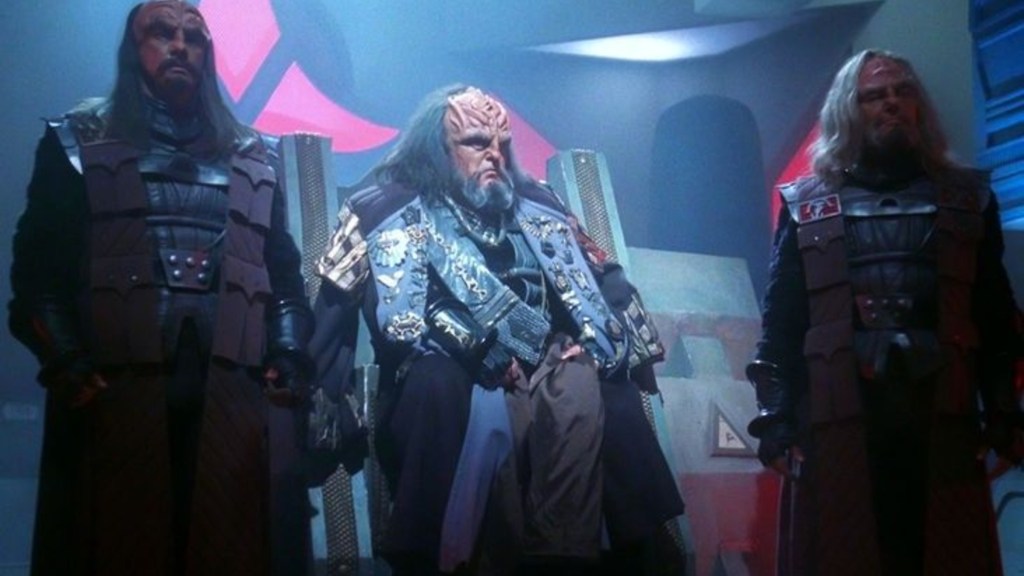
As already mentioned, Klingon culture is essentially perched perilously on a knife-edge of total volatility, thanks to their often blinkered commitment to self-defeating traditions and, frankly, pig-headedness. Their honor code is absolutely valuable in battle (despite the long-term sustainability of their military approach being suspect), but Klingons value warrior spirit to a fault, and anyone deemed to show any kind of weakness under challenge is deemed unworthy. They are not, as presented in most of their early iterations, political or democratically sound, and should, by normal logic, be a race split into many small tribal pockets constantly at war with one another.
Not to bore the life out of you with geopolitical nonsense, but it’s worth thinking about. The Federation was intelligent enough to separate the government from Starfleet (and later, of course, the War College), and the Klingon system arguably needed more separation for protection. Literally anyone could challenge the head of the Klingon Council, with no system of proxy in place (as in Game of Thrones‘ appointed champions in trial by combat). That’s not a good way to guarantee stability in leadership let alone any kind of continuity.
2. They Have Gender Equality, Until They Don’t

In The Next Generation double-header episode “Redemption” (Season 4), the Klingon Empire stands on the brink of Civil War as Gowron is installed as Chancellor, but the Duras sisters challenge the succession, hoping to install their own nephew. The wider details of the episode aren’t important to this discussion beyond the very specific moment when Gowron says “women may not serve on the council”. That does feel quite appropriate to Klingon culture in some ways, but it doesn’t hold true when Star Trek VI: The Undiscovered Country introduces Chancellor Azetbur, the daughter of former Chancellor Gorkon. The film predates TNG‘s “Redemption” by 80 years. And then there’s the tale of L’Rell, who became head of the Klingon Council in Discovery’s 23rd Century. And then, Gowron himself also offered K’Ehleyr a seat on the Council for her support of his succession, so the rule isn’t exactly consistent.
Are we really to believe that major civilizations could possibly regress, rolling back progressive laws in favor of self-sabotaging draconian measures that are clearly outdated? Wait, actually, maybe this isn’t that unbelievable given the shape of some of the current world’s major ruling powers. So perhaps Star Trek‘s “mistakes” were just prophetic reflections of our own world?
1. The Whole Twin Penis Thing

We know that Klingons evolved their unique physical attributes for better battle readiness. In other words, the thick skulls and forehead ridges were always more than an aesthetic choice, and they also evolved to have redundant organs to allow for survival of severe injuries in battle. Basically, spares for immediate transplants. The logic is pretty smart, and was introduced in The Next Generation when Worf was forced to undergo surgery. I have no issue with any of the major organs, particularly the major ones that could cause death when injured….
…But why the penises? In what world is a penile injury in battle cause to evolve to grow another one? How bad were the penile injuries? How frequent were they? Do Klingons have major arteries down there that meant a crotch shot would lead to instant death? This all feels like a quirk to generate conversation. And it’s genuinely canon, thanks to Star Trek: Discovery, that showed a Klingon urinating with twin streams. That also means neither of the penises was redundant, nor the associated plumbing. But at least someone got a laugh out of it, eh?
What do you think? Leave a comment below and join the conversation now in the ComicBook Forum!
More TV Shows
-

IMAGE COURTESY OF PARAMOUNT PICTURES