The Walking Dead has been to television what the Marvel Cinematic Universe has been to film: an entire sprawling universe of characters and content that first sprang from the comic book page. However, while the six spinoff shows each have their own merits, none of them have reached the same kind of heights as the original Walking Dead series. And we know this because, as time goes on, the standout episodes of The Walking Dead are still talked about and have become an indelible part of pop culture. But let’s be clear: certain moments of The Walking Dead will live on forever precisely because they scarred our collective psyche so deeply we’ll never fully heal.
Videos by ComicBook.com
12 years ago today, on March 16, 2014, The Walking Dead aired an episode that is still ranked by many as one of the top 5 of the series, while some call it the best single episode of the show ever. But no matter how you rank it, there’s one thing everyone can agree on: with this episode, The Walking Dead pushed the boundaries of television further than viewers were prepared for.
The Walking Dead Episode “The Grove” Is Still One of TV’s Darkest Stories

“The Grove” is the fourteenth episode of The Walking Dead Season 4, one of last episodes of the season. After settling in at an abandoned prison, Rick Grimes (Andrew Lincoln) and his band of survivors were once again attacked by the conniving and unstable would-be ruler “The Governor” (David Morrissey), and were forced to scatter their group to escape both the human attackers and a horde of zombies that breached the walls.
Peaceful big brother Tyreese Williams (Chad L. Coleman) manages to save Rick’s infant daughter, Judith, and escape the prison with the community’s two young sisters, Lizzie (Brighton Sharbino) and Mika Samuels (Kyla Kenedy). They soon hook up with Carol (Melissa McBride) and start heading for the mysterious location “Terminus,” which has been advertised through painted signs all throughout the countryside. “The Grove” focuses on this group as they find a nice little house in the middle of a pecan grove and take shelter. Tyreese and Carol turn out to be an effective co-parenting unit, while the location turns out to have all the amenities they need, including running water. Life seems ideal enough that Carol and Tyreese consider staying, playing house, and giving the three young girls a semi-normal chance to grow up. And it seems like that dream will be achievable, if only for a fleeting moment…
Walking Dead showrunner and producer Scott M. Gimple wrote “The Grove” as a masterful slow-burn descent into madness. Throughout the early parts of the episode, we’re shown that something is wrong with Lizzie: she cannot process the world they’re living in, calling the zombies her friends, attempting to feed them, play with them, and even considering what it would be like to become one. Tyreese and Carol (and the viewers) assume the young girl is traumatized from the violence, death, and loss she’s experienced, and it’s even more motivation for them to settle down and give the girls a chance at stability and peace. They try to give Lizzie much-needed compassion and guidance; Instead, they get only tragedy.
In the climax of the episode, Carol and Tyreese go hunting for food, and return to find that Lizzie has fatally stabbed Mika, and is eagerly awaiting her sister to change into a zombie, while preparing to kill baby Judith next. Carol and Tyreese can’t let their horror and grief show, as Lizzie, psychotically calm and nonchalant, holds them at gunpoint, and reveals that she has been crazy and corrupted all along, and that they all ignored clear signs that she was harming animals, and putting the entire prison community at risk. Carol eventually coaxes the gun from Lizzie, but in a final twisted turn, she and Tyreese decide that there’s nothing but violence and madness in the young girl, so Carol takes on the soul-breaking task of executing Lizzie.
It only gets darker: Carol is nearly driven mad by the grief of killing a child, and tries to goad Tyreese into killing her by revealing to him that she was the one who killed his lover, Karen, back at the prison, after Karen became infected with a deadly virus. Instead of vengeance, Tyreese shows Carol unbelievable grace, stating that her commitment to making unthinkable choices to protect their group is clearly its own penance, that she must pay. They leave the cabin with baby Judith in tow, their happy bond and the dream of a “normal” family life, completely shattered.
“The Grove” Was Gen Z’s Of Mice and Men Moment
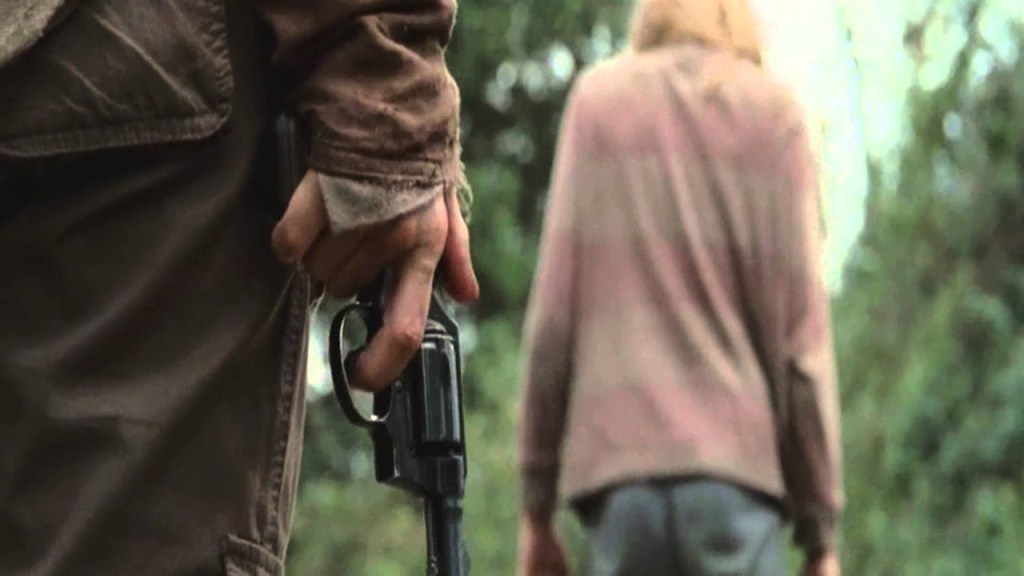
John Steinbeck’s classic American novel Of Mice and Men and its numerous movie adaptations live in infamy for their tragic ending: A quick-witted hustler named George has to make the tragic decision to execute his neurodivergent best friend, Lenny, after Lenny accidentally kills a farmer’s wife, and is about to be lynched by an oncoming mob. Steinbeck created a moral knot that many literary and film scholars still debate to this day; Scott M. Gimple certainly tapped into those same themes and ideas with “The Grove” and left an entire generation of TV viewers traumatized. Carol telling Lizzie to “Look at the flowers” that are blooming, as she shoots the young girl in the back of the head, was a clear homage to George and Lenny’s last moment, where the former has his simple-minded friend envision their happy future, as his last thought on Earth.
Critics and audiences were divisively split over “The Grove” when it first aired. Television had traditionally marked violence committed by, or against, children as taboo. It simply wasn’t done. “The Grove” shattered that glass ceiling by making a child both killer and victim within the span of ten minutes of screentime. The Walking Dead had also pulled a similar (dirty) trick on viewers with its infamous Season 2 mid-season finale: After a long, drawn-out mystery about Carol’s missing daughter, Sophia, the young girl is revealed to have been dead and zombified, trapped in a barn on the farm the survivor group has been staying at the whole time. The depiction of zombie-Sophia was thought to be as dark as The Walking Dead would go when it came to kids… and then we met Lizzie. For longtime viewers, this episode was an especially dark evolution of Carol’s character: once she had been the hysterical mother who would’ve done anything to save her child; now she had to be the “parent” who put a child down. It wouldn’t be the last time Carol carried some of The Walking Dead’s darkest storylines and moments, but it was one of the best performances Melissa McBride gave in the main series or her later spinoff show.

A lot of credit should go to Brighton Sharbino: child actors already have a tougher time delivering the same level of performance as trained and seasoned adults; Sharbino’s wide-eyed performance of Lizzie’s psychological break created powerful layers wherein re-watches of her arc reveal all the small hints that something was very wrong with this girl, from the start. That’s not to take away from Scott Gimple’s writing: “The Grove” is a standalone example of The Walking Dead at its core best, wherein the setting of a zombie apocalypse is simply a contextual canvas to explore deeper themes of humanity and civilization that should trouble our minds in real life.
The episode sparked debate about everything from youth mental health to questions about what kind of world the generation of youth and teens were being exposed to at the time. 12 years on, the notions of detachment, non-empathy, mental health crises, and youth-on-youth violence and/or self-harm are not only still relevant, but disturbingly commonplace. And the most disturbing part of it all is that “The Grove” still feels as relevant today as it did back then, and nobody should be okay with that fact.
The Walking Dead can be streamed on Netflix and Pluto TV.
Most Viewed
-

Courtesy of Warner Bros. Japan -

Image Courtesy of TOHO