
Few properties can claim the intergenerational appeal and lasting pop cultural impact of Charles Schulz’s Peanuts. Debuting seventy-six years ago as a four-panel comic strip in just a handful of newspapers, the Peanuts gang have become a global sensation and multimedia juggernaut, with its characters — Snoopy especially — more omnipresent than ever through television, streaming series, and endless merchandise. Though its uniquely endearing blend of heart and cynicism has been at the comic’s core since 1950, those earliest issues present a “world” much different than the Peanuts of today. Charlie Brown and his friends are thinner and rounder-headed; Chuck himself is a little more acerbic; Snoopy trots around on all fours — displaying none of his later talents as a writer, lawyer, or World War One flying ace. For collectors and fans, these early appearances are a fascinating window into Schulz’s creative process, enabling them to see in real time how the iconic, beloved characters evolve. The Schulz Museum’s own site traces the gradual development of iconic looks, lines, and character traits through the decades.
Videos by ComicBook.com
As the comic strips themselves are vanishingly rare (who would have thought to preserve newspapers for seventy-five years?) and difficult to store, many historically-geared Peanuts collectors have come to prize the early comic book appearances of the characters. The best-known are the all-Peanuts comics published by Dell and Gold Key in the early sixties. These are predated by single-page appearances in rare early 1950s humor comics published by United. However, United also published the first-ever comic book issue dedicated to the Peanuts characters, a single 1953 issue that also marks the first cover appearance of Charlie Brown and Snoopy. Although not as widely-discussed as other fifties grails like Showcase #4 or Action Comics #252, Peanuts #1 is one of the most quietly sought-after comics of the decade, worth up to $24k in high grade. Today, Heritage is auctioning off one of just a few dozen graded copies in the world, at an already record-breaking, value-redefining price.
How This Comic Captures the Essence ofPeanuts‘ Earliest Years

Besides the characters of fifties Peanuts comics not looking the same as they do today, many of them are outright absent from the earliest strips. If you were to flip through Peanuts #1, you’d find Snoopy and Charlie Brown, but few of the other characters that come to mind when you think of Peanuts. Two of the most prominent (and most easily recognized) are Violet and Patty, best remembered as the pair who draw the jack-o-lantern on the back of Charlie Brown’s head in It’s the Great Pumpkin, Charlie Brown. Patty even makes the cover of Peanuts #1, though the character would be eclipsed by “Peppermint Patty,” debuting in 1966 — a decades-long source of confusion for fans. Shermy (the shepherd in A Charlie Brown Christmas) appears in a few strips; as does a toddler named “Schroeder,” soon to be aged-up into the one-sided object of Lucy Van Pelt’s affection. Interestingly, Schroeder’s trademark obsession with classical piano came significantly earlier, introduced in a September 1951 strip. Beethoven would become the specific object of his obsession later.
Although both Linus and Lucy Van Pelt has been introduced by the time United published Peanuts #1, neither appear in the compiled stories chosen for the issue. Throughout 1953 and 1954, Lucy and Linus experienced character-redefining tweaks from Schulz. Initially conceived as younger than Charlie Brown, both Van Pelt siblings were gradually aged up: Lucy was introduced as an older toddler, Linus as her two-year-old sibling. By the end of the decade, Linus was loosely canonized as being the same age as Charlie Brown, while Lucy was older than either of them. Charlie Brown’s own younger sibling, Sally, was a full six years away from her comics debut, first introduced as a baby in 1959. By the time Sally was introduced, the comic and its characters were codified, with characters and designs virtually the same as today: Snoopy is bipedal and sleeps atop his doghouse, Linus can’t go anywhere without his blanket, and everyone’s heads have shrunk significantly.
Why Collectors & Fans Are Fascinated by Peanuts in the 1950s
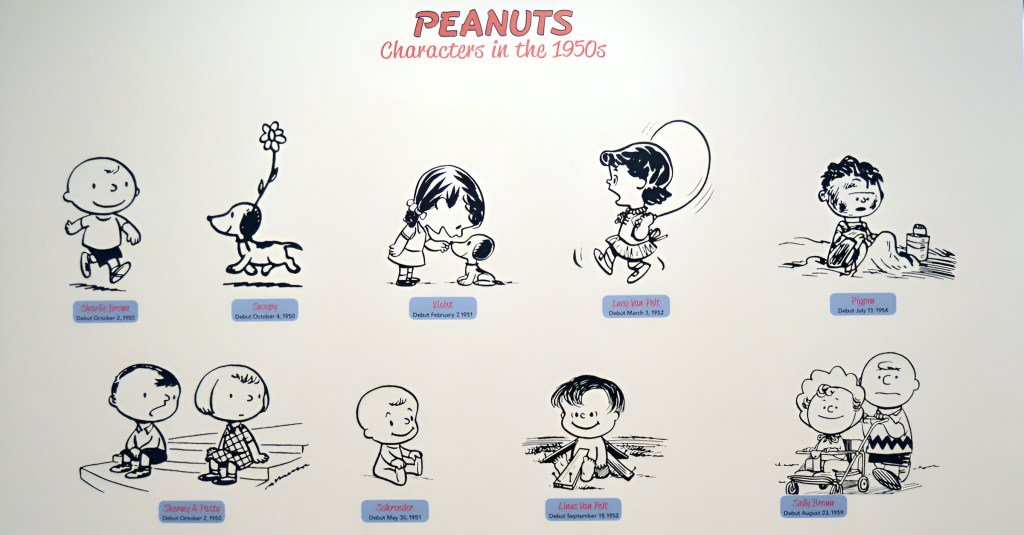
The fifties comics are like a published first draft, where you can see Schulz figuring out in real time what did or didn’t work about the strip. Characters like Shermy and Violet, who are less broad and have less comedic potential, give way to the easy-to-write antics of Lucy or Snoopy. Some of the designs are so distinct from their modern counterpart as to be unrecognizable — in the Peanuts #1 pages where Schroeder appears, it’s only when Charlie Brown refers to him by name that you can figure out it’s him. Even for lesser-known characters like Shermy, it sometimes comes down to an educated guess whether it’s supposed to be them or not in a given cartoon. In this way, the early Peanuts comics resemble what Marvel and DC fans refer to as “prototype” first appearances: issues featuring a character with a design or personality that anticipates a later, more significant character (as with a Steve Ditko-penciled older couple named “Uncle Ben and Aunt May” in Strange Tales #97). Just as fascinating are finding the things that emerged fully formed — like seeing that Snoopy has always marched to the beat of his own drummer, or that poor Charlie Brown has been picked on by his friends for as long as we’ve known him.
The 1953 Peanuts #1 is one of the best tangible representations of the comic strip’s evolution in action. Like Godzilla’s earliest appearances in Japanese manga, the real selling point is that it is the first cover appearance of the Peanuts gang. With a single image, the cover of encapsulates why Peanuts #1 is so important and interesting to collectors. It showcases those first appearance, first draft looks for Charlie Brown and Snoopy. Snoopy looks so distinct from his modern self that it wasn’t for his trademark black-and-white fur, he’d be hard to recognize. Charlie Brown and Snoopy are joined not by Woodstock, Sally, or Linus, but by Patty, a character everyone has seen, but only a dedicated Peanuts fan can even name. While action figures and other merchandise can help connect fans to this unique era, it’s only through these early reprint comics that most fans can truly own that history. With Peanuts more popular than ever, there’s more fans than ever looking to bring that history into their collection. Already an incredible rarity, it seems like Peanuts #1 may at last have found wide recognition as a golden age grail.
More Collectibles
-

Pokemon Happy Meal -

Courtesy of The Walt Disney Company




Forum Conversation: Which Superman Costume Is Your Favorite?
Go to ForumAs of now the Kingdom Come suit
My main answer to this is that when Dan Mora draws Superman, it’s instantly my favorite. I think I prefer the modern suit best, which is just an updated take on the classic costume.
Now, two honorable mentions here if we are going a little more out there with the designs. First, Michael Turner’s Godfall suit is wild but actually rules. Second, I will always have a soft spot for the Electric Blue Superman suit. It just looks so flipping cool.
I actually like the New 52 costume a lot but Kingdom Come might be my absolute favorite. Alex Ross is just amazing.