The Halloween booth at PAX East 2026 had arguably one of the most consistently longest lines of the weekend. Horror fans eagerly waited in line for an hour plus, but it was well worth the wait.
Videos by ComicBook.com
Because once you reached the front of the line, you and four other players got to play the first demo of Halloween—the upcoming multiplayer horror release from IllFonic (the same studio that brought us titles such as Friday the 13th, Predator: Hunting Grounds, and Killer Klowns from Outer Space).
The Halloween booth itself was a sight to see. There it was; a standing replica of Michael Myers’ home, circa-1978. It was a fun installation specifically for the event, of course, but even with the hordes of people around (and the line that snaked around the house), it still gave off a slightly unsettling energy.
Before my gameplay session, I got to go inside the house, which was a single room furnished with a standing lamp, coffee table, couch, and TV playing looped footage of the new game. There was, however, something else lurking inside that room…
Thankfully, instead of finding something that “was purely and simply… evil,” I was greeted by the delightful Jared Gerritzen, IllFonic’s Chief Creative Officer, who spent some time detailing how the game came to be, and what sets it apart from other asymmetrical multiplayer titles.
Building Halloween From the Ground Up

Gerritzen has a long history with horror IP at IllFonic, having been involved with Friday the 13th and Predator: Hunting Grounds, among others. But he was quick to point out that Halloween didn’t come about through some corporate pipeline. It started with deep fandom and a whiteboard session that sounded more like a late-night horror movie debate than a business meeting.
“My first day at IllFonic, we sat at an Airbnb, and we’re like, ‘What if we did this?’” Gerritzen recalled. “And so we literally were like, Jaws, and Predator, and Ghostbusters.”
From there, the team methodically worked through each IP, pitching ideas and feeling out which ones had the most potential. Halloween eventually rose to the top, and after connecting with the rights holders at Trancas International Films, the pieces fell into place.
The most important piece, as it turns out, was figuring out how to translate Michael Myers himself into a playable character. Specifically, that iconic, inexplicable ability to seemingly vanish and reappear without warning. The team coined it “Shape Jump,” and its origins came from obsessively rewatching the original 1978 film.
“There’s that scene in Halloween where the camera’s just sitting there, and all the lights turn off, and you don’t know why,” Gerritzen explained. “What if he doesn’t like the light? What if he needs the darkness?”
From there, it became a design principle. If Michael is in the light, or if someone is looking at him, he can only move at a walk. But turn your back, kill the lights, and he can vanish entirely… reappearing wherever he pleases.
Gerritzen even admitted the mechanic startled him during an internal playtest. Playing as a survivor, he ran out of a house instinctively after the power cut out (even knowing full well what the game was doing) and when he turned back around, Michael was standing in the doorway. “I threw my controller,” he laughed. “I was like, oh my God, what the shit?”
And that reaction is very much by design.
More Than Just a Killer and Survivors
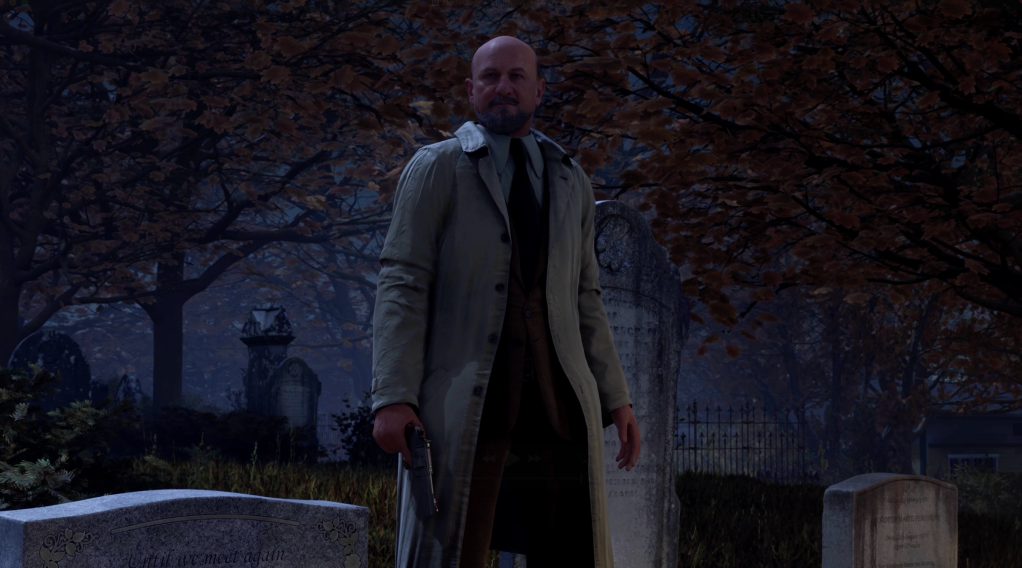
One of the things Gerritzen was most eager to talk about was how Halloween differentiates itself from the fun, yet crowded asymmetrical horror space, and a lot of that comes down to the game’s NPC civilians. Rather than a map with just four survivors and one killer, the world of Haddonfield is populated with townsfolk going about their lives, blissfully unaware of what’s lurking in the dark.
As a survivor (or “hero,” as the game calls them), your job isn’t just to escape, it’s to look out for those civilians too. You can tell them to hide, instruct them to call the police, or rally them to follow you toward an escape route. The more people you save, the more you’re rewarded.
For Michael, those same civilians are an opportunity. Hunting them down makes him progressively more powerful and bloodthirsty, and the more death and carnage he leaves in his wake, the more the fear system kicks in. Survivors who witness enough horror start to psychologically deteriorate. It’s a clever ecosystem that makes the map feel alive in a way that goes beyond a typical cat-and-mouse chase.
“We give you all the pieces,” Gerritzen said, “and then you get to decide how you want to do it.”
Getting Stalked in Haddonfield Heights
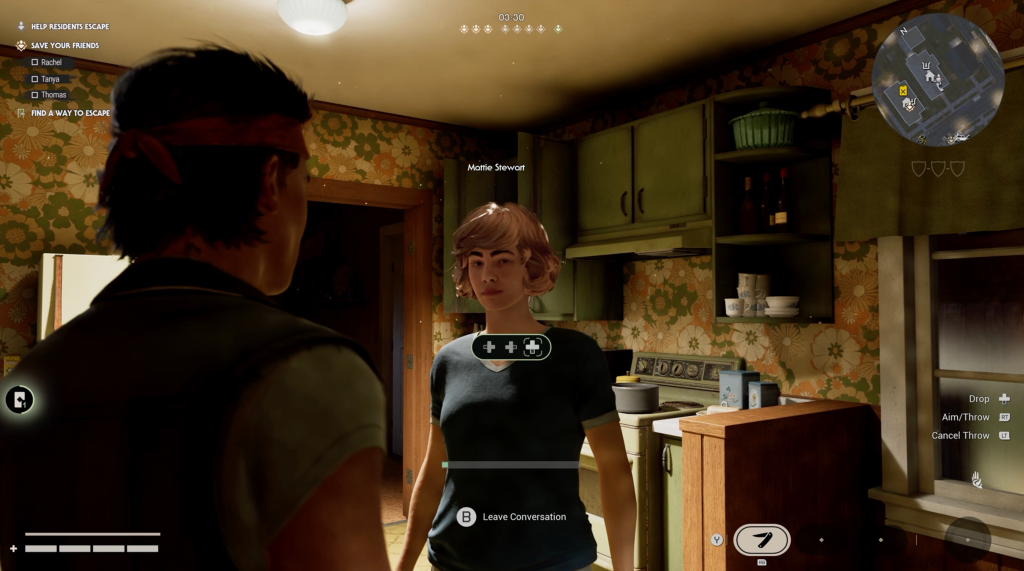
The PAX East demo dropped players into Haddonfield Heights, a deceptively quiet Midwestern neighborhood featuring modest single-story homes, dimly lit streets, fenced yards, and the looming presence of the abandoned Myers house. It looked and felt unmistakably like the world of the 1978 film, muted color palette and all.
My first instinct as a survivor was to round up some of the NPC civilians and stash them inside a nearby house, then cut the lights. A clever little plan to make the place look abandoned, right? What I failed to fully internalize from my conversation with Gerritzen just minutes earlier was that Michael thrives in the dark. Killing those lights was basically an invitation. Like shooting fish in a barrel.
He appeared, as Gerritzen had warned me he would, seemingly out of nowhere. One moment the room was empty. The next, Michael Myers was just… there. I did what any self-respecting 40-year-old who fancies himself the protector of his household would do in that moment: I shrieked out loud, in real life, at PAX East, in front of strangers, and dove headfirst out the nearest window. The fall wounded me with shards of broken glass. Michael finished the job.
The best part, though, was that I wasn’t down and out. After laughing out some of my nerves and getting my wits about me, I realized that you respawn. And in my case, I came back as none other than Dr. Loomis, which gave the experience a second-wind energy that felt true to the films.
Stalking in Haddonfield Heights
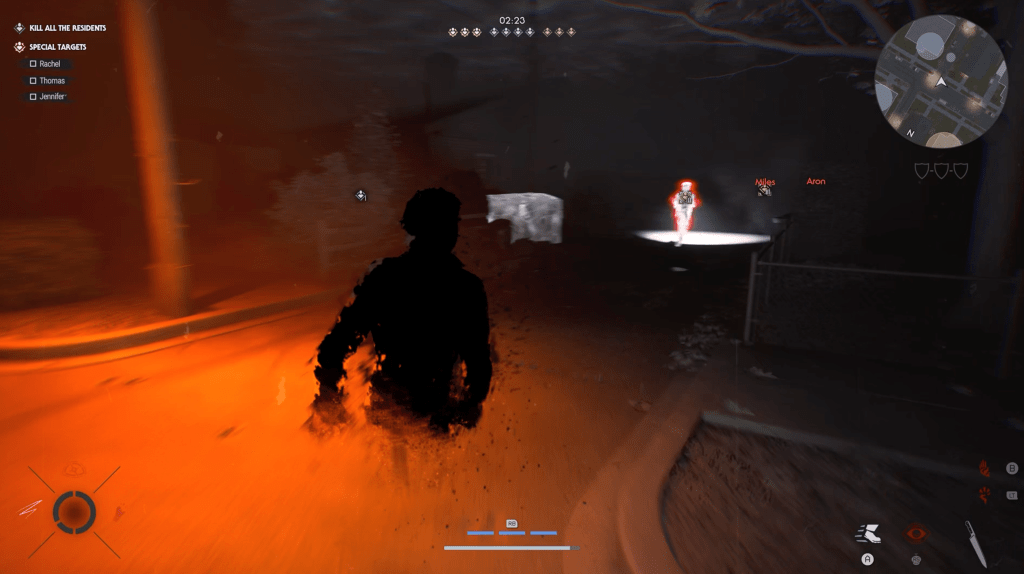
After my survivor session, I swapped over to Michael’s side, and it was an entirely different experience. There’s always a weighty pressure that comes with playing the killer role in asymmetrical horror. You’re the one person everyone is running from, and if the survivors are good, you can quickly feel pretty powerless. Certainly NOT like a bruising 80’s horror villain. Michael, however, carries a quiet confidence that comes directly from his Shape Jump ability.
I started by letting the survivors know I was able to be pretty much anywhere they were at a moment’s notice. I would appear at the end of a street, or come walking out from behind a nearby car before disappearing into the dark once the other players turned their backs to run.
Then, it was on to picking them off one by one. This was tricky, though, because the strategic layer as Michael is surprisingly deep. He moves slowly, which means brute-force chasing is largely a losing strategy (until maybe the survivor stops to interact with something, giving you the chance to come up to them from behind).
Success mostly comes from anticipation, reading where survivors are heading, and positioning yourself to meet them there. In a short demo session, it was a lot to figure out, which was kind of exciting. There’s obviously a ceiling of mastery that will likely keep players coming back to be the best Michael Myers they can be. And for what it’s worth, I did manage to claim one victim before the session ended, which felt disproportionately satisfying.
The Boogeyman is Back (and He Has a Release Date)
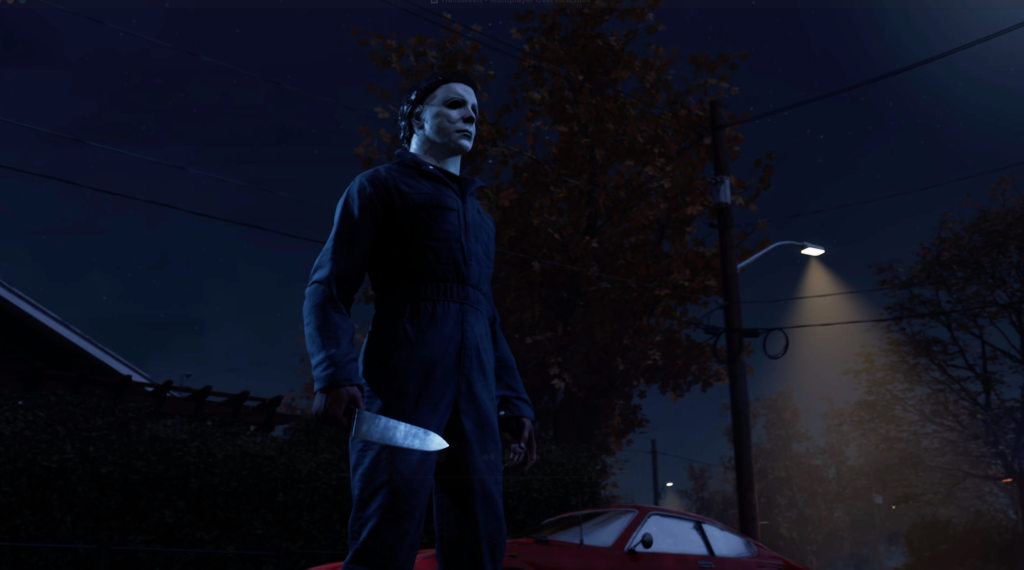
IllFonic has a strong track record with licensed horror IP, and Halloween feels like the studio’s most ambitious swing yet. Far from feeling even remotely gimmicky, the Shape Jump mechanic is a super fun design philosophy that runs directly through the DNA of the source material. It makes Michael Myers feel different from any killer I’ve played as in this genre before. When it works, it feels like a scene straight out of those early Halloween movies.
Halloween launches September 8, 2026, on PlayStation 5, Xbox Series X|S, and PC via Steam and Epic Games Store. Based on what I experienced at PAX East, horror fans should absolutely be watching this one, bringing The Boogeyman back just in time for spooky season.
Most Viewed
-

Courtesy of Crunchyroll -

Image Courtesy of WIT Studio -

Image Courtesy of TOHO