While today’s gamers typically play on PC or consoles, the industry thrived in arcades. And in the 1980s, arcades were built on competition, noise, and frustration. The reason for this was that many games were notoriously difficult. Success was measured in high scores or survival time, and every quarter mattered. Challenging games kept players coming back, both because of pride and how they were designed to be just beatable enough to make players want to keep trying.
Videos by ComicBook.com
Not every game was incredibly difficult, but the best arcade games of the 1980s created tension unlike anything else. There were no save files, online guides, or practice modes waiting at home. Players learned through failure, repetition, and the humiliation of losing in front of strangers. The hardest arcade games earned reputations that spread through word of mouth, and players spent small fortunes trying to beat them. But few games captured that ruthless spirit like the three games below.
3) Gravitar – 1982

Atari released Gravitar in 1982, and it quickly developed a reputation as one of the most difficult arcade games ever made. It expanded the vector graphics popularized by Asteroids, but demanded far more precision and patience. Controlling the small triangular ship through planetary systems while completing missions inside gravity fields sounded far simpler than the game actually was. Destroying enemy bunkers, escaping the planet, and surviving to the next stage would prove to be a nightmare.
The controls were the first challenge, as they relied on thrust-based movement rather than direct steering of the ship. Managing momentum was made especially difficult thanks to the gravity constantly pulling your ship toward the planet’s surface. Later sections implemented reversed gravity, disrupting the hard-fought instincts players had built throughout the game. Invisible landscapes added further complications and really tested players’ skills.
The creators themselves even admitted they could not consistently beat the hardest stages, and this level of uncompromising difficulty is what made the game memorable. The game would ultimately receive mixed reactions, with players who thrived on challenge giving it a passionate following, while casual players bounced off it. To this day, Gravitar remains one of the most punishing games of the golden arcade era.
2) Ghost & Goblins – 1985
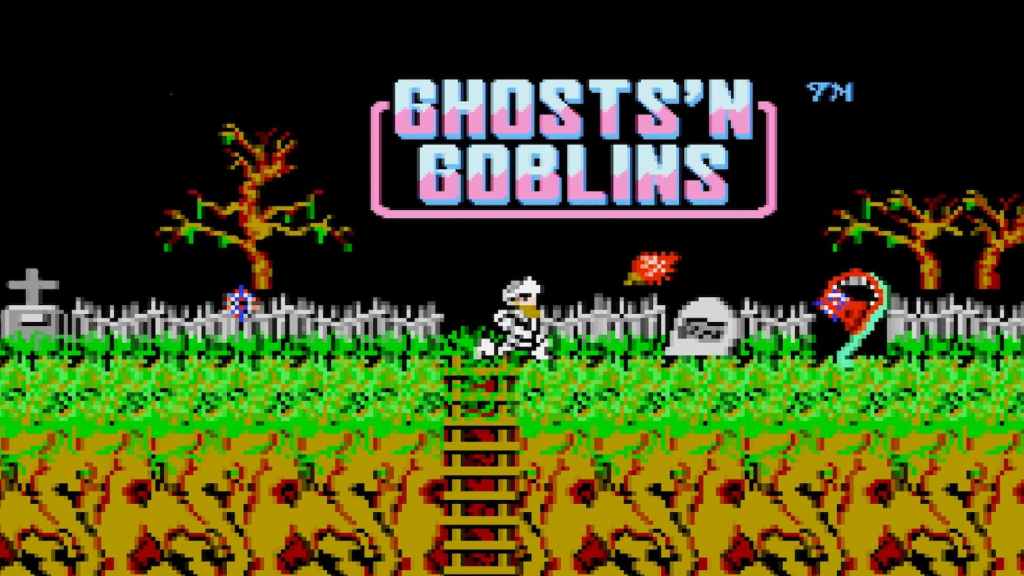
It should be no surprise to Ghosts ‘N Goblins here, as it is one of the most notorious arcade games of all time. Capcom’s challenging game tasked players to lead the knight, Arthur, on a desperate mission to rescue Princess Prin-Prin from the demon king. It was the typical fantasy plot, but it would prove to be anything but. Once the game started, though, players realized they had stepped into one of the harshest arcade experiences ever created.
Players only had two chances, as the first hit knocked Arthur’s armor off and the second ended the run immediately. Enemies attacked from every direction, often spawning unexpectedly and disrupting jumps at the worst possible moment. Zombies burst from the ground, flying demons filled the skies with projectiles, and platforming sections demanded exact timing. There were no shortcuts, no cheat codes, and no room for sloppy play; players had to rely purely on their skills.
The game was designed around relentless pressure, something that remained even after the NES port made the game easier. Even experienced players struggled to memorize enemy patterns because random elements kept each attempt chaotic. Even completing the game wasn’t enough, as the true ending was hidden behind a required second completion. The difficulty became a part of the game’s identity, and that legacy remains today. Players looking to cut their teeth on challenging games will find Ghosts ‘N Goblins the perfect test.
1) Sinistar – 1983

Not only was Sinistar one of the most difficult arcade games, but it was also terrifying. It wasn’t enough for the game to challenge you, but it had to break your spirit as well, combining innovative gameplay with pure panic. The gameplay was multi-layered, requiring players to rely on speed, preparation, and skill to succeed. From the very beginning, pressure was on the players to dodge enemies, mine floating planetoids to build Sinibombs, and then defeat the aforementioned boss, Sinistar. Players could not simply focus on attacking enemies because time was always running out.
The words “Beware, I live” and “Run coward” easily traumatized players of this age as the dangerous boss chased players down while they desperately tried to break through Sinistar’s armor. If Sinistar awakened before enough Sinibombs were collected, the odds of survival dropped dramatically. Once active, the creature hunted players aggressively across the map, and one collision instantly destroyed the player’s ship. At the same time, enemy ships attacked relentlessly, protected Sinistar, and repaired damage to Sinistar whenever possible. The game forced players to multitask constantly under extreme stress.
What separated Sinistar from other difficult arcade games was its atmosphere. The voice synthesis technology made the cabinet feel alive. Reactions to Sinistar were intense from the start. Critics praised its originality and audio design, but many players viewed it as terrifyingly difficult. Unlike slower arcade shooters that eased players into danger, Sinistar created chaos almost immediately. Decades later, the game remains famous not only for its challenge but also for its atmosphere. It is still hailed as one of the hardest arcade games of all time because it blended innovative mechanics with overwhelming pressure better than almost any competitor of the era.
Where do you stand on this? Jump into the comments and join the conversation now in the ComicBook Forum!
More Gaming
-
Courtesy of Wizards of the Coast