To say that Metroid Prime 4: Beyond has been a long time coming would be an understatement. The fourth entry in Nintendo’s acclaimed Metroid Prime series was initially announced for Nintendo Switch all the way back at E3 in 2017. The game was eventually scrapped and restarted entirely in 2019, with series developer Retro Studios once again taking control of it. In the nearly seven years since this move, news on Metroid Prime 4 has been few and far between until its reemergence just a few months back. As of this week, MP4 is finally out and brings an end to one of Nintendo’s longest-running projects in the company’s history.
Videos by ComicBook.com
While it took a very long time to get here, the resulting version of Metroid Prime 4 that we’ve been given is still better than I anticipated. Retro Studios has encapsulated all of the best parts of past Metroid Prime titles here in Beyond while still trying to push the franchise forward with more modernized game design concepts that have become more prominent over the past decade. This leads to Metroid Prime 4 feeling disjointed and at odds with itself at times, but these drawbacks don’t end up hampering the entire experience.
Rating: 4/5
| Pros | Cons |
|---|---|
| Exploration and puzzle-solving are as satisfying as ever | Larger emphasis on story and side characters doesn’t end up landing |
| Great boss battles with memorable designs | Open-world areas feel too empty |
| One of Switch 2’s best-looking games yet |
Metroid Prime 4 Puts a Greater Focus on Story, For Better and Worse
One of the biggest changes that Metroid Prime 4 looks to make is telling a more cohesive story. Whereas past games were content to relay much of the storytelling through more subtle means, Beyond features plenty of cutscenes and new side characters that protagonist Samus Aran interacts with throughout. Although this shift isn’t a bad one on paper and is something I would have appreciated a bit more from in previous installments, it’s the overall writing of MP4 that ends up dragging the game down.
Many of the aforementioned side characters, in particular, aren’t well-written and come across as annoying more than anything else. Some of the stronger personalities amongst this cast of characters also greatly clash with Samus’s nature as a silent protagonist. This leads to some cutscenes feeling particularly off-putting at times as a character’s loud, overeager monologues will be met with nothing more than a stare in response from Samus. These sequences did nothing but make me miss the quieter, more atmospheric approach to worldbuilding and storytelling that Retro established with its earlier Metroid Prime games.
Metroid Prime 4 also happens to thrust the ongoing rivalry and clash between Samus and Sylux, the mysterious bounty hunter who first appeared in the DS-exclusive Metroid Prime: Hunters, back into the spotlight. This battle between the two is something that has been quite literally decades in the making, as Nintendo had been laying the groundwork for Sylux to serve as a main antagonist in Metroid Prime 4 since the much-maligned Metroid Prime: Federation Force.
Unfortunately, Sylux ends up being greatly underused in Metroid Prime 4. While his hand can be felt on many of the biggest moments within the game, Sylux himself is hardly present. When he is on screen, he absolutely steals the show, which makes me wonder why he wasn’t more involved than he is. As someone who was greatly looking forward to MP4 in large part because of this promised bout between Samus and Sylux, I’ve been let down to see what this conflict actually resulted in.
Gameplay Is Great, But Too Similar to Its Predecessors

For the most part, Metroid Prime 4 plays about like you’d expect. Samus comes equipped with her Arm Cannon and Morph Ball out of the gate and slowly acquires new abilities over the course of the game. Metroid mainstays like the Super Missile, Grapple Beam, and Spider Ball all make their return, but have a “psychic” flair this time around to go hand-in-hand with the new powers that Samus has been endowed with. These throwback power-ups are then merged with new ones, like the Control Beam, which lets Samus slow time and guide her shots to more specific targets.
The process of unlocking these new gadgets and abilities that can then be used to earn upgrades that were previously inaccessible is the core loop of Metroid Prime 4, and it’s one that still works to a great degree. The simple satisfaction of solving an environmental puzzle or going off the beaten path to get an optional improvement for a certain weapon is where MP4 is most enjoyable. If nothing else, Retro more or less nailed the classic Metroid formula here in Metroid Prime 4.
The advent of the Vi-O-La, a motorcycle-style vehicle that Samus can ride, represents the most notable new addition to Metroid Prime 4. The Vi-O-La is introduced early in Beyond and is used primarily as a means of getting around the game’s open-world areas. While it also comes equipped with a weapon and can get some new upgrades of its own, the moments of riding on the Vi-O-La were my least favorite in MP4, largely due a lack of gameplay variety.
Not only is the Vi-O-La itself rather underwhelming, but Metroid Prime 4’s general aim to be partially an open-world game is something that just doesn’t work. Rather than feeling like a single cohesive world, MP4 feels incredibly disconnected. Each of the main hubs that Samus will venture through in Beyond are on complete opposite sides of the game’s setting, the planet Viewros. The only way to venture between these environments is by taking some long rides on the Vi-O-La from one to the other. Even though backtracking has always been prominent in Metroid games, this is, without a doubt, the most mundane manner in which the series has done backtracking yet.
Metroid Prime 4 Is an Excellent Showpiece for Switch 2
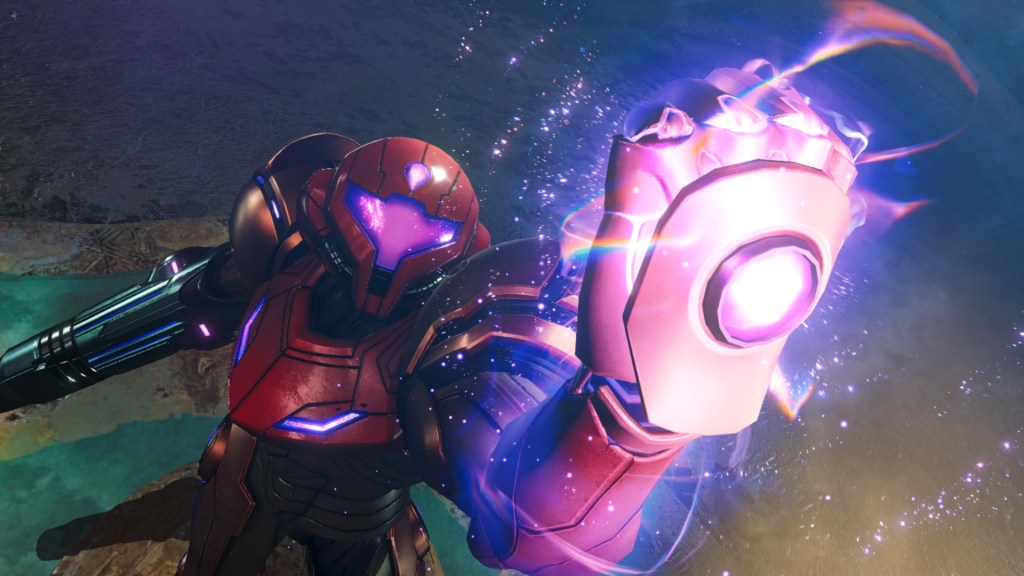
For those playing on Nintendo Switch 2, Metroid Prime 4 is likely one of the best technical showpieces for the console so far. Not only does Samus herself look better than ever with the game’s excellent HD visuals, but the consistent performance of MP4 on Switch 2 is truly impressive. Beyond has the ability to perform at either 60fps or 120fps, and both never wavered in my own experience. This consistent level of performance made some of the more hectic moments of Metroid Prime 4, namely boss fights, that much more enjoyable. Although I can’t speak to how the game might run on the original Switch, those who have upgraded to Switch 2 are in for a treat.
Even with its faults, Metroid Prime 4 still has a lot to like. Many of the game’s newer elements fall flat and don’t help push this series forward in the way that I’d prefer, but the most vital aspects that have allowed this franchise to become one of the most acclaimed in video game history are still very much present here in this long-awaited sequel. Metroid Prime 4 may not have warranted all of the hype and attention that has been placed on it for the better part of the past decade, but at the end of the day, it’s still good to have Samus back in another new adventure.
Metroid Prime 4: Beyond is set to release this week on December 4th. An advance copy of the game on Nintendo Switch 2 was provided by the publisher for the purpose of this review.
Most Viewed
-

Image Courtesy of Crunchyroll -

Image Courtesy of TOHO