Capcom was a mess during the PS3 and Xbox 360 generation. Even with some gems like Dead Rising, Asura’s Wrath, and Dragon’s Dogma, the flailing publisher was primarily defined by its inability to adapt and maintain its best franchises, a failing symbolized by the misguided Resident Evils of the time, as well as Lost Planet, which found its soul and lost it within a single console cycle. Those dark times make it all the stranger for Pragmata because of how it, in many ways, feels like it was ripped straight from that era. But this label isn’t meant to disparage Pragmata and imply it repeats the sins of Capcom’s worst period. It’s the opposite: Pragmata has all the clever game design of Capcom at its best with the type of bolder swings reminiscent of AAA games from that first HD generation.
Videos by ComicBook.com
Pragmata’s combat encapsulates this fresh take on a familiar concept. It wears the skin of a generic third-person shooter but augments that base with a hacking mechanic. Instead of merely blasting bots until they blow, players have to simultaneously crack into their matrices by moving a cursor through a grid with the face buttons. Hacked bots take significantly more damage and can recover from hacks after a bit of time, making this a crucial and consistent component of combat.
Rating: 4/5
| Pros | Cons |
|---|---|
| Excellent and unique combat that rewards multitasking, quick thinking, and smart build experimentation | Its story falters because of its weak main antagonist and two generic protagonists |
| Beautifully layers in new enemy types, upgrades, weapons, and skills to ensure players continually get stronger as the game gets more complex | Going back to the base after dying and to buy upgrades can be tedious |
| Meaty campaign offers just enough to do before and after hitting credits |
Pragmata‘s Hacking Is Surprisingly Deep
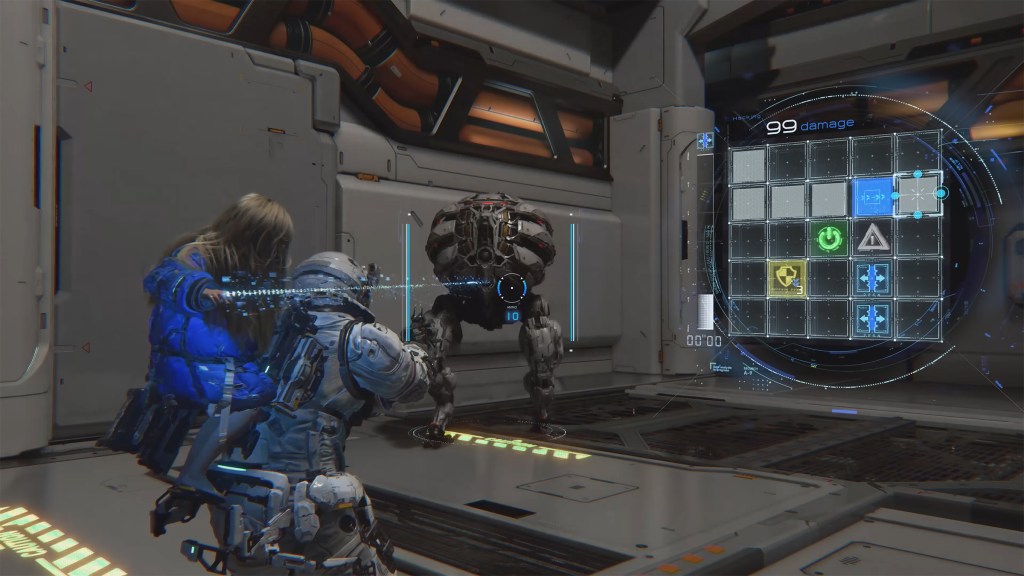
It initially comes off as a novelty meant to obscure potentially standard gunplay, but it quickly blossoms into something much greater and becomes the focal point of Pragmata’s overall design prowess. Navigating the cursor around the grid has its own tactical layer built in since how players navigate this rectangular digital maze changes the battlefield. Some nodes are infected and slow or damage players, while some activate passives or burn pivotal consumables that trigger various buffs. Blocks also can’t be moved through twice, so players have to quickly discern the optimal route without retracing their steps or carefully weigh if speed is more important than damage. Sometimes it is worth it to pass through every blue damage node, but other times it can be a death sentence.
The hacking has plenty going on and yields a surprising amount of strategy, but the system is elevated to the next level because of how it all takes place in real time. All the stress of picking which node to go through and when is magnified when having to also keep tabs on the battlefield and dodge errant missile barrages or metallic haymakers. Focusing on just one aspect for too long is punished appropriately and keeps players from falling into boring or predictable habits.
Having to rapidly and repeatedly switch between hacking and shooting is a unique and riveting quality but only a portion of the battle, too. Players still need to actually nail tricky shots on obscured weak points and know when to hack, when to let the trigger sing, and when to use its unexpectedly acrobatic and fluid dodge to narrowly evade certain death. It’s a whole confluence of planning, skill, and reflexes that makes Pragmata consistently engaging and unlike any other shooter out there.
Pragmata‘s Power Ramp Is Excellently Paced and Balanced
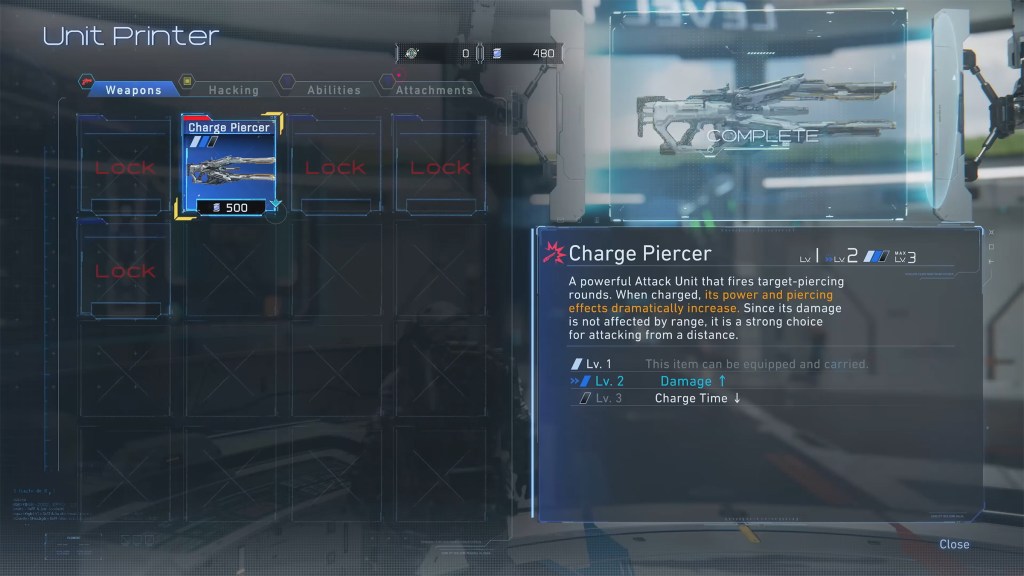
Insultingly simplistic battles and stingy ammo reserves in the introductory segments paint an inaccurate picture of the latter 80% of the experience where the systems coalesce and start building off each other. New weapons, perks, and consumable hack chips are gradually introduced and offer various strategies and variables that let players have an impressive amount of control over their build. It’s possible to focus on abilities and guns that make hacking more devastating or quadruple down on maxing out enemy heat meters to more regularly land satisfying executions. Frequently introducing new enemy variations and whole new mechanics only further shakes things up and doesn’t give Pragmata one second to stagnate.
It’s a stunning balancing act that is further tested in its challenge rooms that push these mechanics in closed arenas that also offer rewards upon completion. These rewards feed into Pragmata’s deep upgrade economy that, once again, is cleverly implemented in a way so that it enriches the entire experience. All sorts of upgrade materials are scattered around and allow players to grow in power and keep pace with the challenging campaign, in addition to encouraging exploration and making levels less linear. Players get stronger as the game gets more complex, leading to a gratifying power ramp that continues past the end credits. This wonderfully taut escalation is not too unlike the power ramp seen in Resident Evil 4, a favorable comparison that succinctly demonstrates Pragmata’s killer pacing.
Having to warp back to the base to buy upgrades is one of the only downsides to this whole loop. Dying also kicks players to said headquarters, so while checkpoints are graciously scattered around, having to manually lug it back to the battlefield after each defeat adds a few minutes of extra fluff in a game that otherwise doesn’t have much of it. Ideally, Pragmata would have more traditional checkpoints and the ability to upgrade directly from the warp stations and not just from the base itself, but these are relatively small issues that don’t tarnish the overall quality of its mechanics.
Pragmata‘s Story Is Easily its Weakest Part

And while so much of Pragmata feels like a PS3 game captured in amber and remastered in 4K, it also has some of the unfortunate staples from that time. Hugh, its protagonist, is the most generic of generic white guys with a forgettable yet affable personality with not a rough edge or amusing flaw in sight. The existence of Diana, the younger character players have to look after and work with, seems like she was also hurriedly pitched moments after The Last of Us’ success.
Having a child to chaperone isn’t an inherently bad or dated quality; she’s just one of the main avatars of Pragmata‘s shallow writing. Their interactions, while sometimes sweet, often boil down to Hugh softly explaining the concept of something simple like theme parks while Diana misunderstands and/or shrieks. Their relationship is never tested. They are never at odds. It’s just this benign and overly saccharine bond that’s too bland to explore any themes or introduce much-needed friction.
Even though Pragmata takes inspiration from games centered around duos like BioShock Infinite, the 2018 God of War, and The Last of Us, it doesn’t understand how conflict between those respective leads was vital to the narrative strengths of each game. The intro hints at Hugh possibly going through an Alan Grant-esque arc as seen in Jurassic Park since he seems to have an aversion to kids, yet, much to his downfall, no such evolution occurs.
Pragmata’s narrative doesn’t even come close to making up for this core weakness, either. It touches on how focusing only on the bottom line and an overreliance on AI can lead to outright doom, but not much of that makes its way out of the level design and optional notes scattered about. AI makes for a poignant and painfully relevant boogeyman, but, as shown by the last two Mission: Impossible films, it’s hard to build a narrative around something so inhuman. And by the time the game ties those ills to someone, it’s too late and their weak motivations only make this tale even more forgettable. The boss fight against this entity’s futuristic Final Fantasy-like form is at least quite the spectacle, though.

In the midst of its crisis during the HD console era, Capcom published the oft-forgotten Dark Void, which had all the hallmarks of a title desperate to follow trends. It revolved around cover-based shooting, had a color palette that was mostly brown, and starred a template protagonist voiced by the omnipresent Nolan North.
Pragmata feels like the game a more adept Capcom would have published at the time in Dark Void’s stead. It’s still a single-player third-person shooter, but one that gains new life through its suite of in-depth real-time hacking mechanics. It doesn’t attempt to be yet another Gears of War clone with one semi-original feature and instead forges ahead and exquisitely layers in mechanics, upgrades, and new enemies to create a unique and thoughtfully designed experience. That sort of approach is what separates modern Capcom from the Capcom that struggled during the aforementioned dark times. So while Pragmata borrows some hackneyed narrative elements that dragged that generation down, it also has the type of innovative spirit that was more prominent in that console cycle that modern AAA games could use more of.
A PS5 copy of Pragmata was provided by the publisher for the purpose of this review.
What do you think? Leave a comment below and join the conversation now in the ComicBook Forum!
Most Viewed
-

Image courtesy of Marvel Studios -

Image Courtesy of Netflix -

Courtesy of SuperGiant Games -

Courtesy of Kadokawa / Shosetsuka ni Naro