The Napoleonic Wars spanned a cruel 12 years that killed millions. The earth was razed, blazed, and covered in blood all in the name of empire. It’s the type of complicated conflict that could be translated rather easily into a work of fiction penned by writers with a penchant for lore. The Soulslike genre seems like a prime candidate for this multi-national struggle, something developer One More Level realized with Valor Mortis and its alternate history take on France’s lust for power. And even though Soulslike games have a tendency to follow formulas to a fault, Valor Mortis is a fresh spin on the subgenre that offers a unique perspective.
Videos by ComicBook.com
The perspective shift is literal because Valor Mortis is exclusively played in first-person; don’t expect to see the camera glued to protagonist William’s backside at any point. It’s an odd shift that doesn’t seem like it would work with the type of spacing needed in a genre like this where spatial awareness is king. And while there are the odd incoming lunging attacks that seem to land a little ahead of players, Valor Mortis is able to use this new camera angle to its advantage to craft a more immersive game with its own style.
Rating: 4 out of 5
| Pros | Cons |
|---|---|
| Combat wonderfully incorporates swords, guns, and magical powers | The handful of bugs and constant hitches are hard to ignore |
| The levels balance linearity and exploration well | Its story doesn’t fully grapple with the intriguing ideas it brings up |
| The alternate take on 19th-century Eastern Europe gives the game a unique look |
Valor Mortis‘ Combat Is Wonderfully Varied
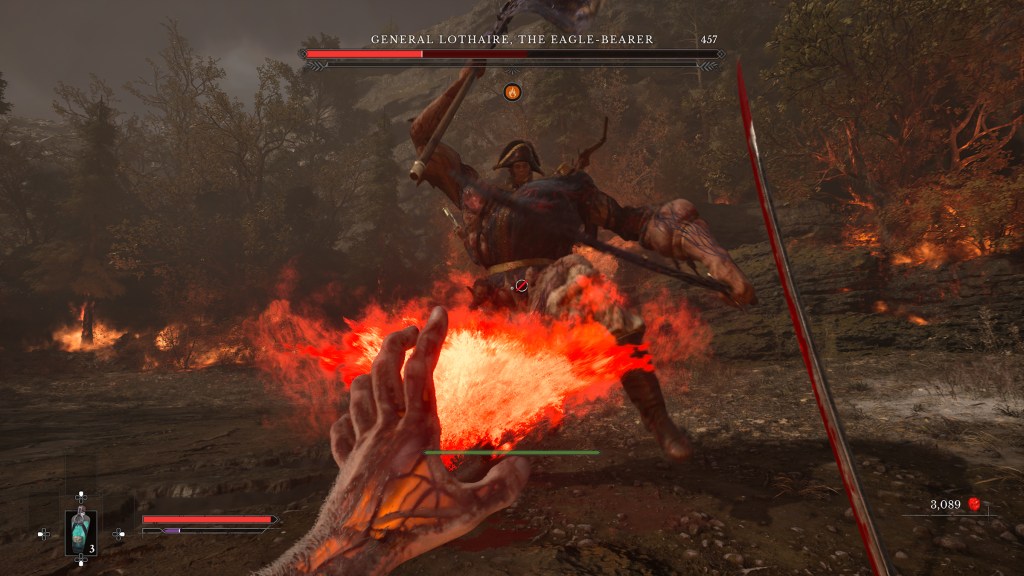
Combat does not feel limited by the first-person camera but is instead empowered by its wide array of tools that give players a front-row seat to their destructive capabilities. Melee swordplay takes center stage and is built around parrying blows. Two of the three blade types allow for a gun or spell in the other hand, meaning players are dual wielding most of the time. This ability to multitask is crucial because it gives the game an amount of depth it wouldn’t have it had been more restrictive.
Swordplay is carried by the deafening clang of a successful parry and sharp sound effects that play after a gut-wrenching riposte. The three swords all have varying strengths — the rapier specializes in parries, the lumbering claymore can’t parry at all, and the sabre lies somewhere in the middle — and picking the right one for the moment is key. The rapier’s parries and pokes are fantastic for duels and surgically popping bulbous weak spots, respectively, while the claymore’s devastating slams can slaughter a crowd if given the time.
Gunplay and spellcasting are similarly basic yet effective. The pistol is weak but can fire rapidly and hit weak spots. The handheld shotgun can obliterate anything up close if it stays reloaded. The musket is the most unique, as it takes both hands and has limited melee capabilities but can snipe targets at a much greater range. The flamethrower and shield spells are exactly what they sound like, while the time-slowing power is useful for making parries easier to nail.
Taken individually, none of these tools are particularly innovative or unexpected. But these elements sing because players are meant to mix and match them and jump between styles at a moment’s notice. Pulling out the rifle to eradicate the backline before parrying and executing a charging grunt and using the wide berth of the flame spell to incinerate the second rush of malformed goons is just one satisfying scenario players can pull off if they’re using everything at their disposal.
Valor Mortis is also, in many ways, cleverly structured to incentivize players to change it up. Every weapon is located on an easy-to-use weapon wheel; there’s no fiddling in the menus here. Melee attacks fill the magic meter and dead foes can drop ammo, so everything feeds into each other. Aggressive enemies and hectic battlefields will also murder stubborn players who refuse to exercise their entire arsenal. Many of its well-designed arenas are even expertly crafted to make players deal with ranged threats and take cover as the clawed or sword-wielding undead nip at their heels. Valor Mortis already has linear-ish levels with branching paths that don’t overstay their welcome, but this focus on variability makes this compact campaign even more resistant to stagnation.
(Editor’s note: While it is frustrating to have to make this kind of disclaimer again, it seems as though an update right before launch has addressed many of the stuttering issues mentioned in the next paragraph. The game seems to be significantly more stable now with only very minor stutters that pop up occasionally instead of every 10 seconds. As such, combat flows much more fluidly. It’s unclear if the other bugs have been addressed, though.)
Smooth controls lie at the foundation of its quality combat, however, some of this fluidity is undermined by the game’s technical flaws. Every 10 or so seconds, Valor Mortis hitches for a few frames. It’s not enough to make the game unplayable, but this type persistent stuttering can mess with the player’s timing and lead to missed parries or frustrating cheap shots. Enemies — bosses included — can also deactivate at times, leading to unearned victories that are far less sweet than ones won through skill and pattern recognition. Valor Mortis is significantly more polished than One More Level’s two buggy Ghostrunner games, but that doesn’t mean this action RPG isn’t in need of more than a few patches.
Valor Mortis‘ Story Doesn’t Live Up to Its Unique World
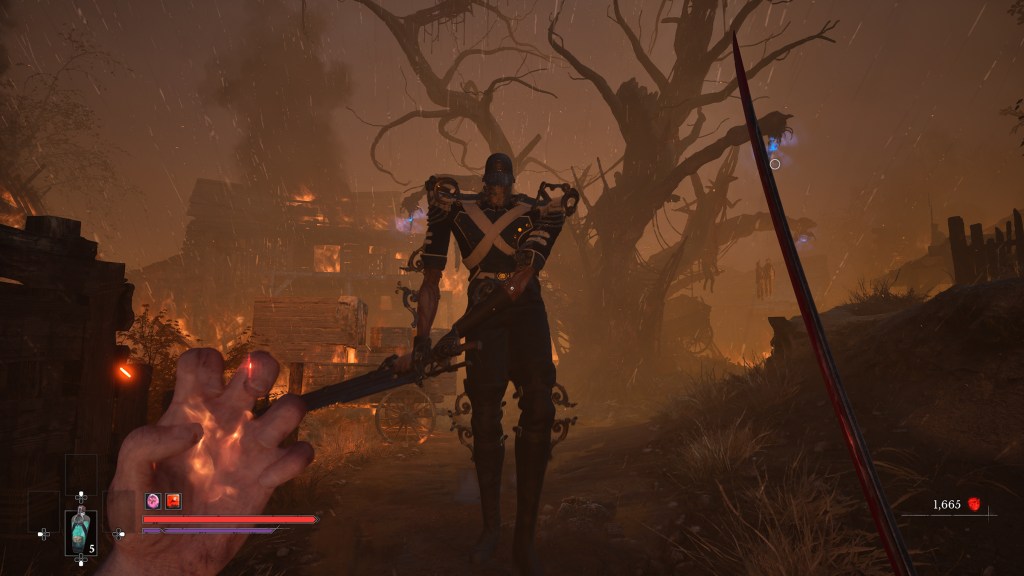
The game’s unideal technical state doesn’t impact the ingenuity of its world, though. While 19th-century Europe isn’t exactly a new setting for video games, Valor Mortis‘ mix of Cronenbergian body horror and imagery tied to the French Royal Army gives the game an inspired look. Watching the body of a typical French infantryman rip and contort itself to transform into a canine-like demon is stomach-churning, and the goopy towers and titanic spires that have spawned from this mysterious sickness are a sight to behold.
Seeing a bloodthirsty army become literally more monstrous makes for quite the metaphor, too, and Valor Mortis builds out from said metaphor to investigate the cruelty of Napoleon Bonaparte’s infamous crusades. His appetite for power and territory is examined in the various well-written notes scattered about, often through the eyes of his more skeptical followers or those who eventually became his victims. From the ghost towns to the glowing, otherworldly discharge that has poisoned the soil, the evidence of his barbarity is ever-present.
It’s a rich playground the game unfortunately doesn’t explore with the most grace. Even though some may point to a cherry-picked few of Napoleon’s efforts as righteous, he was an egotistical tyrant who left a trail of blood across Europe in a quest to replace one corrupt system with his own. Playing as a well-spoken soldier in Napoleon’s forces leaves ample ground for the game to explore how one can be propagandized into fighting for evil or how they can atone, but there’s not much dissecting to be had. William’s feelings for Napoleon aren’t initially clear, so the way in which he sticks up for the French despot in the later parts of the game is sudden and not earned, especially when that affection begins to sour. A turn like this should be handled slowly, not rushed through while barreling toward the final act.
Other parts are similarly fumbled. It merely touches on the interesting topic of Napoleon’s pillaging of Egypt (which echoes France’s longstanding plundering of Africa) but fails to analyze it much outside of one boss fight. Some crucial parts of the story and Napoleon’s omnipotent presence in William’s head are also glossed over or poorly explained, while William will often plainly summarize the poetic memories spoken by the dead as if he were given notes by Netflix. It tends to favor underexplaining events, though, since many of its threads are underexplored and sadly encapsulated by its strange final fight that comes out of nowhere and doesn’t tie up enough of the game’s loose ends. Striking imagery, various small tales here and there, and the quality of its dialogue and various notes mean the game’s narrative isn’t a total wash, but, even with those strengths, it still underachieves.
The Napoleonic Code was a landmark, if flawed, achievement that helped dismantle the old ways and make way for a new world, and while Valor Mortis obviously isn’t going to have that widespread of an impact, it is similarly breaking from an established way of doing things. Instead of merely following Dark Souls beat for beat, Valor Mortis has taken only some of those design elements and spliced in more than its share of unique ideas. The first-person perspective is chief among these changes and helps the game stick out, but this new viewpoint is also supported by a varied combat system that has players juggling multiple styles in levels that aren’t padded to the point of tedium. Uneven technical performance and a story that falls short of its potential are the notable, globular weak points here, yet Valor Mortis stands tall and is still deadly with the blade.
A PS5 copy of Valor Mortis was provided by the publisher for the purpose of this review.
Does a $40 price point and Game Pass launch make Valor Mortis more enticing? Or are there simply too many other games to get to right now? Tell us your answer in the comments.
More Gaming
-

Image courtesy of Nintendo -

Courtesy of Arc System Works