Nearly 40 years ago, Gary Goddard and Cannon Films brought He-Man, Skeletor, and the entire Masters of the Universe gang to live-action for the first time. Though a cult classic now, the movie’s reception is best judged by how long it’s taken to get a reboot into theaters. There have certainly been attempts – this is, after all, a fantasy world with incredibly deep lore, nostalgia, great characters, and, crucially, a committed audience who still buy MoTU toys in droves. Perhaps the key was just to get the right people at the right time. Talking to the creative heads behind 2026’s reboot – this time made by Mattel Films and Amazon Studios in collaboration – you really get the sense they’ve managed that.
Videos by ComicBook.com
This summer’s Masters of the Universe is helmed by Travis Knight, the genius mind partly behind stop-motion studio LAIKA, who previously made the excellent, equally nostalgic Bumblebee. Knight spoke to the press, including ComicBook’s Chris Killian, at a round table on the eve of this year’s CinemaCon, and he revealed his fan credentials:
“I was a fan long before I was a filmmaker and so, for those things I’ve been lucky enough to be a part of that that I had that kind of emotional connection with when I was younger, it was crucial for me to try to tap into what those, what made those things special, why I fell in love with those things in the first place, and to make sure that that stuff is honored and how we’re. You know, I think we’ve all seen a number of of these properties that that are made by people who we think maybe don’t necessarily understand them, appreciate them, love them, and to me I think the most important thing for any filmmaker that that is, you know, making the movie is that they have to love it. They really sincerely have to believe in it and love it and put everything they have into it. And I’ve said this many, many times, but I sincerely love He-Man.” That’s what you want to hear from a director in charge of a beloved IP.
Flashing back months to when Masters of the Universe was filming in London in 2025, ComicBook was invited to the set to witness the ambitious new blockbuster firsthand, where we spoke to producer Jason Blumenthal, Production Designer Guy Hendrix Dyas, and Costume Designer Richard Sale. It was immediately clear in every interaction that they all felt the same way about He-Man. The message from the set, and from every bit of footage revealed so far, is that detail matters. This is a labor of love, and the creative team is very invested in not only making something that honors the original lore (while making a few tweaks), but which also feels real.
Masters of the Universe is Travis Knight’s Labor of Love
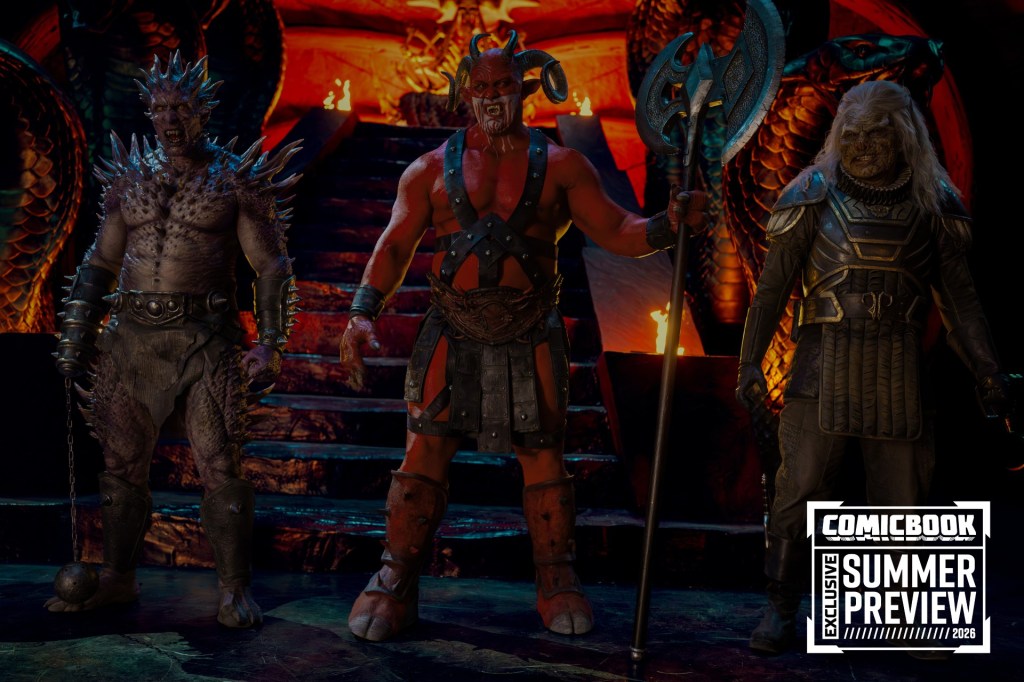
As Jason Blumenthal puts it, Masters of the Universe was shepherded into existence not just by a director, but by a fan who handily happened to possess the necessary film-making skills to make it work: “From the tip of the spear down, I’ll tell you the reason this movie is going to work, you know, and I believe it, is because Travis, our director, not only wanted to make this movie, needed to make this movie. This was a brand. These were toys. Not, they were more than toys. They were characters that became his friends. He literally came up in this universe, right? Never knowing that now he was in charge of it, in control of it. And thank God he is, because there is not a better steward to be running that brand and all of these things.”
For Knight, it was a “dream come true,” but that dream wasn’t just about making something so overstuffed with fan-service that it ended up feeling like an overenthusiastic kid in charge of a toy box. Some characters were considered but not used, because “this really was Adam’s story, it meant that all the other things had to be in service of his story, and you find nuance, you find depth, you find complexity in all those other characters, but the more it’s obvious, the more people, more characters you stack in there, the less you can do with them.” In short, the director wanted to avoid being “a ridiculously irresponsible fanboy as opposed to a filmmaker.” Knight confirms he wanted to put iconic character Merman in there, but couldn’t make it work, so he doesn’t appear. He did the right thing for the movie, rather than himself. Let’s hope he gets a chance to bring in Merman in a sequel.
And the commitment to the brand doesn’t end at Knight, as Blumethal confirms: “I never worked on a movie quite like this. Every single solitary crew member is wearing their old Masters of the Universe t-shirts. They all have the toys. They all grew up with the brand. Literally everyone on our crew, maybe 90% of them, even to the extent of a lot of the women on our crew, we have a very strong representation on it. Everybody grew up with this brand in some way, whether their brother played with it, whether they played with it, or they knew it. And we’re all of that same age group where, you know, if you’re lucky enough to work on a movie that means something because you remember what it was like to experience that.” The producer also reveals that the art team created an entire language – Eternian, which was postered up around the set in a grid, and if you learn it, you can translate text in the background of the movie as Easter eggs.
Masters of Universe’s Commitment to Detail Was Stunning

Perhaps because of the experience of the crew, everything we learned on set in London paints the picture of a ridiculously complex creative process. As Blumenthal reveals, “Every single solitary prop, costume, belt buckle, gun is bespoke to this movie. Everything. We were not able to and would not take it from somewhere else. We built it from scratch. We have a 40,000 square foot factory across the street that is literally manufacturing these things in-house. So we can design something on set and basically have it by the end of the day in some sort of 3D model form, and depending on then finished to production, all under one roof.”
Producers are numbers people, and Blumenthal has a lot of big ones to throw around. 40,000 square feet for a production factory; 24,000 for how many pounds Teela’s ship – which they built in such intricate detail that it “does everything but fly”; and 8, the number of hours it took to transform the world’s second strongest man and Game of Thrones star Hafþór Júlíus Björnsson into Goat Man. There are no corners cut here, and Blumenthal reveals every set was captured with GoPro cameras to show off the scale and scope of the production. “I’ve made a lot of movies. I’ve never been involved in a project of this size and scope, and the sheer volume of what has to be built from scratch, which is pretty much everything.”
When Blumenthal handed over to Production Designer Guy Hendrix Dyas, he did so with a glowing introduction that made it clear he was the man behind the Master of the Universe production bible: “this guy has kept a meticulous diary of every design – even the ones that never worked and weren’t gonna work but just gave us inspiration. It’s amazing to be able to have one document or that actually shows from what we started with, which was nothing to what we’re building here, which is to me something very special.” Dyas, who Knight affectionately calls “extraordinary” calls himself part of the “original generation… who watched [MoTU] fanatically” and is another whose love for the IP could be bottled and sold:
“When I got the opportunity to meet Travis for this, we immediately sort of bonded on a joint respect and love of the IP, and it’s really interesting because it, before we started what hopefully you like seeing here, one of the biggest things that we both felt was, how do we take a particular IP that perhaps gets a little bit of laughter, you know, He-Man – I mean, even just the name, the Green Tiger, everything about it is a bit sort of goofy and odd, so how do we take that and make it a very serious world, a very real world, a very visceral world that could compete on the same platforms as a Star Wars, as a Marvel Universe? And so we both agreed that perhaps the first place to start would be, first of all, to imagine everything was real. Let’s forget the ridiculous proportions of some of the characters, some of the over-vivid colors, you know. Forget the run cycles through the animation. Let’s take each of the characters and develop them into a real, real character, and that’s really where we started, and that was my very first job on the production.”
Dyas’ enthusiasm is intoxicating, and it was on the production too, to the degree that his designs actually helped give one character more screen time. Goat Man was only ever intended to appear once, but after he “showed them the design with this hulking great thing, this bizarre tribal makeup, they went, okay, we need to write some more scenes, so he gets a very big role in this film, which will be quite surprising to fans, because, of course, in the comic, he’s kind of a peripheral character.” Again, that’s the value of having such investment at the creative level.
Masters of the Universe Had To Get the Right Balance in Adaptation

Everyone we talk to is united on one message about adaptational purity: they didn’t want to disappoint the original fans, and they wanted to ensure fidelity, without too much rigidity. Costume Designer Richard Sale sums it up perfectly: “Our major goal was to try and be true to the original, and that’s what we’ve done whilst moving things on a little bit.” And Guy Hendrix Dyas says in even his earliest conversations with Travis Knight they knew what they needed to achieve, even with the challenges presented by the original toys and animation:
“The one thing that we both made a pact about as fans was that we didn’t want to disappoint the fan base, and we didn’t want to disappoint people who want to show up and see Skeletor and get Skeletor right, and get whoever it is, Mecha Neck, or whoever it is who’s your favorite. We wanted to make sure that that silhouette was correct, that the colors were correct, and I took that into all the vehicles as well, which was really hard, because holy sh*t, a helicopter that’s pink.”
This isn’t just an exercise in transforming the original characters into good live-action approximations and that being it. As Dyas says, the action backs up the labor that’s gone into the art: “Oh my God, some of the action sequences are literally out of control. I mean, I’m sometimes turning, because I’ll sometimes go hang out with Travis. Can we show this to kids? This is PG 13. There’s some serious violence, but then there’s the goofy stuff as well. So he’s sort of covering all his bases.” And balance seems to be the order of things for Masters of the Universe: they wanted to recapture the nostalgic spirit that made the crew so fond of the IP, but while making decisions to update where necessary. For the design of the city of Eternos, Dyas consciously rejected his own temptation to “get on the gravy train of my childhood”. Luckily, he says only about four cells of animation existed anyway, but that instinct and the freedom to express what wasn’t shown very much come through in the conversation.
And when changes had to be made, they were made in service of the story or the logic of the new take on the universe. There was, according to Richard Sale, serious thought given to whether we’d see Nicholas Galitzine’s He-Man nipples. And rather notoriously, this time out, he isn’t wearing furry microshorts – though Sale says they did prank the star into believing he would be:
“We went through lots of iterations of levels of stuff… We went through, like, 80 variations of, like, trousers. Is he wearing trousers? Is he wearing armour on top? You keep looking at it, and you’re going, like, well, it’s not quite He-Man… The fur on the whole was kind of, like, nixed quite early on. And, yeah, the furry pants would have been just too difficult. Although, to be absolutely fair, we did tease Nick at one point saying that he was going to be wearing that. And also the Adam look of, like, the really tight tights and just furry pants. We teased him for a long time to say that he was wearing. But, sadly, we didn’t get that. We got something else.”
Skeletor, too, was updated: unlike in the original, where he was wearing a sort of BDSM inversion of He-Man’s costume, Sale focused instead on more synergy between his Snake Mountain home and his aesthetic: “One of the choices I made early on when we designed Skeletor was to not have the cross strap… with the bones. Because it was like… they became too similar in a way. They just became a negative of each other. And… we were trying to move away slightly from the bone idea. Just for Skeletor… He lives in Snake Mountain. So, you know, he should be more snake-like. But then we used a lot of Snake Skeletons in the design, so we’re keeping the bone thing alive. But just having it a little bit more referential to his, you know, his detail.”
There’s a chance we might get to see more classic costumes in a sequel, if it happens, though, Sale teases: “Mattel-willing, if we come back and do something else – a similar one – there’s nothing to say they can’t have evolved into something closer… And that’s with all of these characters. We’re not saying this is the first time out of the box for any of this. They had history before our film, and they’ll probably have a history after our film. So they could always develop. As He-Man’s power gets bigger, maybe his costume changes for the next one.”
Knight revealed one of the key things he wanted to keep for Skeletor but without just copying and pasting the original: the spirit of his maniacal voice from the cartoon. It’s not the same, but the director revealed his thought process and the collaboration with Jared Leto that led to the final, still-very-odd version we’ll hear in the movie. Once more, the way he talks offers a fascinating insight into the labor of love that turned such a deep understanding of these characters into something more broadly accessible:
“Now the origin of the Alan Oppenheimer voice was that, you know, they made this cartoon for kids and he looked scary and so they needed to find a voice that was not scary. And so they purposely came up with this silly, comical, nasal voice that took the edge off of a skullface character. And so when I was speaking with Jared, you know, we recognize that we want to honor all those aspects, including a distinctive voice and an interesting laugh, but we did not want to engage in mimicry.
We did not want it to be him doing an impression of Alan Oppenheimer, and so he, and it was important for him to get the voice right. So there was a lot of exploration to figure out, OK, what does Skeletor sound like? And then ultimately we arrived at this, which I love because I think it has, it has menace, it has theatricality, which is always a part of Skeletor. He was always putting on a show and then being disappointed when he didn’t get the response that he wanted. Ultimately, he’s a very insecure man, and that becomes a part of his character. He’s a power-hungry man who’s deeply insecure, and that was a fun thing to kind of dive into and figure out, you know, how we could dramatize that character. He’s incredibly fun to watch… He’s horrible, but he’s really, really entertaining.”
If you needed reassurance that any changes Masters of the Universe made were thoroughly considered, you should now have it. And listening to Dyas talk about the changes he made, and the choices that had to be made when faced with some of the more “goofy” elements, you can almost hear a fan in conflict with his own love of the brand. Take Skeletor’s Roton, redesigned from the animation, because, frankly, it looked a bit silly. His notes, once again, speak to the delicate complexity of this whole project:
“If you look at the original roton, it is a barrel with two very angry red eyes and a buzz saw going around, and that is it, right? How do you make that cool? Well, you first of all start with the buzzsaw, and then you say, okay, what happens if we turn this into a gyroscopic situation, so you’re sitting in an independent vehicle, and the whole of the vehicle could actually turn around you anyway… What I’ve tried to do in every case is make sure that all the vehicles adhere to the original color schemes of the toys and the animation, which has been really, honestly, quite amazing for me as a designer who normally would always do spaceships in the classic sort of steel or gray, or come on, we all know spaceships are always gray, right? Well, not in this world.”
When Masters of the Universe lands on June 5, you’ll see the colossal effort for yourselves. You’ll see the fruits of Jason Blumenthal’s impressively large numbers; of Travis Knight’s conviction to make something that the fans will love, but which could reach a wider audience; of Guy Hendrix Dyas’ sprawling production bible; and of Richard Sale’s endless refinement to find the right balance. It sounds impossible not to be impressed already.
Are you excited for Masters of the Universe? Leave a comment below and join the conversation now in the ComicBook Forum!
More Movies
-
Image Courtesy of Marvel -
Image Courtesy of Warner Bros. -

Image courtesy of DC Studios