In the early 1990s, sci-fi TV was turning away from the planet-of-the-week format and towards longer serialized season arcs. Hit shows like Star Trek: The Next Generation were already expanding what syndicated sci-fi could accomplish, but the idea of a fully serialized and meticulously planned television narrative, like the ones we see today, hadn’t been attempted yet. That is, until one of the era’s most iconic series premiered with a particularly distinctive pilot.
Videos by ComicBook.com
On February 22, 1993, Babylon 5: The Gathering premiered as a two-hour “test pilot movie” introducing what would eventually become Babylon 5. Created by J. Michael Straczynski, the film was technically the first chapter, though the actual series wouldn’t debut until nearly a year later in early 1994. Intended to “pitch” the concept, demonstrate the show’s viability to the network, and introduce audiences to the show’s characters, Babylon 5: The Gathering was both the beginning of an epic five-year serialized series and the first of six films in the franchise.
Babylon 5: The Gathering, the 1993 “Test Pilot Movie” Experiment
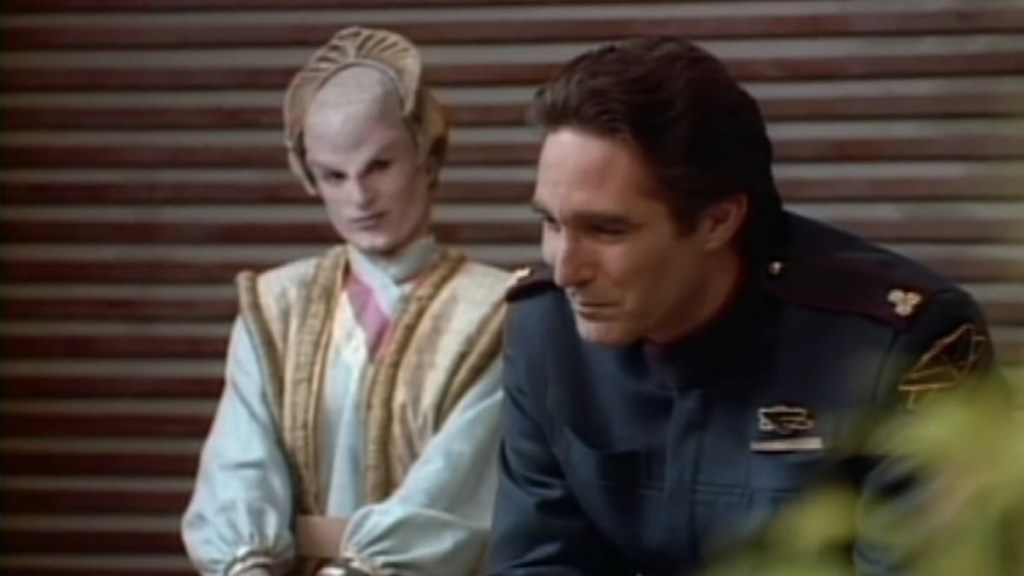
In addition to exploring the backstories and political agendas of the characters, Babylon 5: The Gathering was also effectively a standalone political space thriller. The film, directed by Richard Compton and written by Straczynski, also introduced viewers to the rotating space station known as Babylon 5, which was established as a diplomatic hub for multiple alien civilizations following an interstellar war.
Among those introduced was Commander Jeffrey Sinclair (played by Michael O’Hare), the station’s first commanding officer. When Kosh, the mysterious ambassador of the Vorlon Empire (voiced by Ardwight Chamberlain), is poisoned on arrival, Sinclair becomes the prime suspect. Other key characters introduced included security chief Michael Garibaldi (Jerry Doyle), ambassador Delenn of the Minbari (Mira Furlan), and Centauri diplomat Londo Mollari (Peter Jurasik). Notably absent was Captain John Sheridan, later played by Bruce Boxleitner, who would replace Sinclair beginning in Season 2 after some behind-the-scenes changes.
Though it’s common to find sci-fi movies preceding TV shows, what made The Gathering unique was the fact that it was designed specifically as a pitch for the series. Meanwhile, movies like Logan’s Run or Stargate were simply adapted into TV shows after the fact, rather than being designed as a “test pilot”. Straczynski, however, was playing 5D chess, envisioning Babylon 5 as a “novel for television,” with a predetermined five-season arc, which was also something virtually unheard of at the time. Instead of episodic plots popularized by franchises like Star Trek, the consequences of the characters’ actions would carry over and significantly impact the story over several years, resulting in a more ambitious, cumulative narrative with more dramatic character arcs.
While reception was mixed, audiences were certainly intrigued. The CGI was groundbreaking because it was created using affordable, consumer-grade Amiga computers rather than expensive motion-control models. Overall, ratings were strong enough for Warner Bros. Television to move forward with the series, though the long gap between pilot and premiere created uncertainty about its future. When you watch it today, The Gathering feels less like a true pilot and more like a prologue that lays the groundwork for the iconic series to come.
How Babylon 5 Pioneered Serialized Television

Babylon 5 series returned on January 26, 1994, in first-run syndication, and little did viewers know it would become one of the most influential and beloved sci-fi shows of all time. In addition to a creator credit, Straczynski served as showrunner and wrote an unprecedented number of episodes himself (92 out of 110), which allowed for a singular, cohesive tone and vision. Across its run, Babylon 5 followed escalating political conflicts among major alien powers, the rise of an authoritarian regime, and a cosmic war involving the Shadows and Vorlons. Rather than resetting every hour, however, the story was building upon itself all the while.
Babylon 5 was also the first TV series to rely extensively on CGI for space sequences, paving the way for later productions that embraced digital visual effects. Its serialized structure directly influenced later genre television, from Battlestar Galactica (2004) to Lost and to today’s prestige streaming dramas. By airing primarily in syndication rather than on a major network, and by treating its subject matter seriously, Babylon 5 was one of the first steps science fiction TV took outside of traditional broadcast models, opening up an entirely new landscape.
The show earned two Hugo Awards for Best Dramatic Presentation and received praise for taking on ambitious, difficult themes like propaganda, fascism, and religion. The Babylon 5 series ultimately ran for five seasons and ended on November 25, 1998, with the finale “Sleeping in Light.” The universe also expanded through several more TV movies, including In the Beginning (1998), Thirdspace (1998), The River of Souls (1998), A Call to Arms (1999), and The Legend of the Rangers (2002), which explored the pasts and futures outside the show’s central plot.
Despite budget challenges and network changes (including a move from PTEN syndication to TNT for its final season), the Babylon 5 series maintained a devoted fan base, and that fandom is still going strong today, 32 years after the premiere of The Gathering.
Is The Gathering essential viewing for new fans today? Leave a comment below and join the conversation now in the ComicBook Forum!
Most Viewed
-

Courtesy of Crunchyroll -

Courtesy of Bit Reactor