Created by Jeff Rake, Manifest has gone down in history as one of the most enjoyable sci-fi TV shows of the last decade. Originally launching on NBC in 2018, the series ran for three seasons before it was canceled – only for Netflix to take over after a popular fan campaign. Manifest flourished on Netflix, becoming one of the streamer’s top performers and with a popular (and critically acclaimed) fourth and final season.
Videos by ComicBook.com
Manifest struck a fascinating balance between science-fiction mystery and real-life drama. It starred the crew and passengers of a commercial airliner whose flight disappeared under mysterious circumstances, only to reappear five years later. The stories were fascinating and intense, exploring the personal implications of missing five years of life even as the mysteries surrounding the plane’s disappearance seemed to deepen. Now, Jeff Rake has returned to tell a story that blends science-fiction and human conflict in the best possible way.
Detour Follows in Manifest’s Footsteps in the Best Possible Way
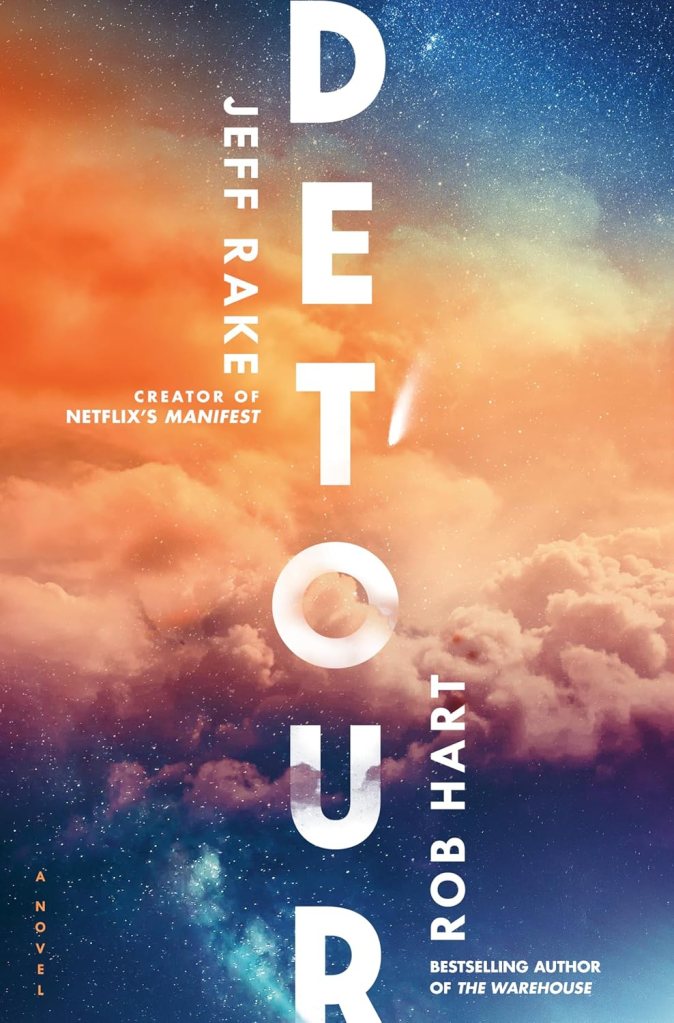
Rake has teamed up with Rob Hart (bestselling author of The Warehouse and the Ash McKenna series) to tell Detour, a story that initially feels like a riff on Manifest (available now from Amazon). The stakes are higher than ever before, though, when an experimental space flight to Titan goes badly wrong. The crew return to an Earth that is subtly different, and sci-fi conscious readers will immediately guess where this is going; multiverses are all the rage right now. But Detour is a multiverse story with a difference, because the temporal mechanics come second to the character work.
Detour is something of a surprising read. The blurb makes it clear where the story is going, but Rake and Hart spend half the book building up to it. There’s a good reason; it’s because they want readers to connect to the individual characters, to understand them and their world. By doing so, they ensure that the return to Earth will feel every bit as unsettling for anyone reading the book as it is for the characters themselves. Detour plays on some of the established multiverse tropes – several characters discover they experienced “turn left” moments – but it also cleverly subverts them, avoiding easy answers.
There are answers, though, and that’s part of the genius of Detour. Smart inserts establish the scale of events, ensuring readers know a little bit more than the protagonists. That’s what gives the book its true sense of scale, because it swiftly becomes clear that crossing universes has a consequence – on the fabric of the universe itself. The MCU’s interdimensional incursions are a similar idea, but Detour plays them much better, giving the cosmic a personal feel once again.
Detour’s Hook Shows How To Do A Multiverse Story Well
Let’s be clear; Detour is no Manifest. That story was as much mystery-driven as character-driven, and there aren’t really many (perhaps any) surprises on a cosmic scale for any readers who are remotely familiar with other multiversal stories. But Detour succeeds where more spectacular tales have often failed, because it’s less interested in the spectacle than it is in the individuals. Rake and Hart spend a lot of time in each character’s personal world, setting up a fascinating story where an unlikely space crew must support one another as they navigate a reality that’s subtly, strangely wrong.
It helps that there’s a strong antagonist (albeit not exactly a villain); the project is sponsored by billionaire presidential candidate Jeff Ward, a rather transparent riff on Elon Musk crossed with a little Donald Trump. The crew is a blend of three experienced astronauts and civilians taken along for the trip as a publicity stunt (or so it seems). One is a scientist who’s essential to figuring out the quantum mechanics, another is a raffle-winner who has a good eye for pattern recognition, and the third is a cop who was in the right place at the right time. Each has a compelling, conflicted world.
Like all the best multiversal stories, the six heroes must struggle to support one another in a world that’s simply not quite right. What makes Detour work, though, is the fact that some of the characters actually prefer the lives they’ve stumbled into, while others are shocked to discover things about themselves they never suspected (and don’t quite like). The cop, for example, learns that a lot of the problems he struggles with came from his sense of morality – and that, without that morality, his family’s lives would be better in a superficial way. Some of the tropes here are a little overdone, but they’re generally effective.
That said, readers do need to go into this aware that Detour is book one in a series. The mysteries are all wrapped up by the end of the book, especially if you read the inserts. The overall story, however, is far from resolved. It feels like the first season of a TV show that’s been literally designed for renewal, but the good news is that Random House has already commissioned the sequel – so this story is not going to go unfinished. If you’re willing to jump into a new ongoing series, Detour will definitely scratch your Manifest itch.
What do you think? Leave a comment below and join the conversation now in the ComicBook Forum!
Most Viewed
-

Image Courtesy of Studio Bones -
Image Courtesy of Image Comics -

Image Courtesy of Sunrise/Enishiya -

©Fujino Omori, Toshi Aoi, Kodansha/Wistoria: Wand and Sword Production Committee