Netflix has given viewers plenty to be thankful for in 2025. The streaming service once again asserted itself as king of the industry with a release of some big new original series and films, as well as a monthly library of some of the hottest licensed content from the entertainment industry. As Thanksgiving segues into the Christmas and New Year’s holidays, Netflix is red-hot with new and returning series, which are trending all over the world. And one of the top-ranked shows is one that is not a must-watch, but is inspiring viewers to go back and also check out a 25-year-old cult-movie masterpiece.
Videos by ComicBook.com
Streaming on Netflix since November 13th, Last Samurai Standing is the new action series that is adapted from the early 2020s Japanese novel and manga of the same name, by author Shogo Imamura. It’s a show that pits different samurai, ninja, and ronin of Japan’s late Feudal era against one another in a deadly tournament/quest to win a life-changing prize. However, the way the show imagines this tournament, its rules, and the fatal consequences, has fans immediately drawing parallels to the 2000 cult-hit film, Battle Royale.
Last Samurai Standing Story Explained
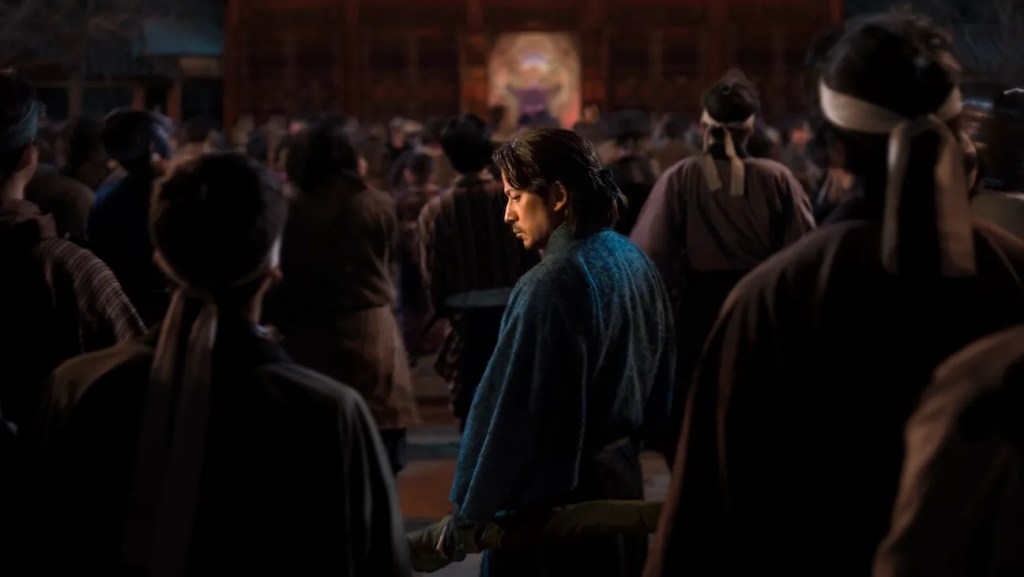
Last Samurai Standing follows former master samurai (and killer) Shujiro Saga (Junichi Okada), who put away his sword after firearm and cannon technology entered the battlefield, heralding the end of the samurai era. However, when cholera strikes Japan, Saga’s daughter is an early casualty. Knowing his wife is soon to follow, the fallen warrior accepts an ominous offer to come to the city of Kyoto and participate in a martial arts tournament that offers a massive prize chest of gold to the winner. However, when Shujiro arrives, he finds himself in a courtyard with many other elite warriors of battles past; a mysterious official, Enju (Kazunari Ninomiya), informs them that this “game” is a deathmatch called “Kodoku” with a very specific set of rules: Each “player” is given a wooden game piece to wear as a necklace; a path is set between Kyoto and Tokyo that players must traverse within a month. The path of the quest is marked by checkpoints, which can only be passed by a player wearing an increasing number of gamer tags required at each gate.
Ergo, a player must kill opponents and collect the tags along the way in order to win the race. Failure to complete the trek in time, or any deviation from the stated rules, and the player is eliminated from the game with prejudice. Meanwhile, wealthy elites observe and wager on the players, trying to predict the outcome, while the shifting sands of Japan’s political landscape hide an entirely different agenda for having all the greatest warriors of the previous era kill one another off.
Is It Fair to Compare Last Samurai Standing and Battle Royale?
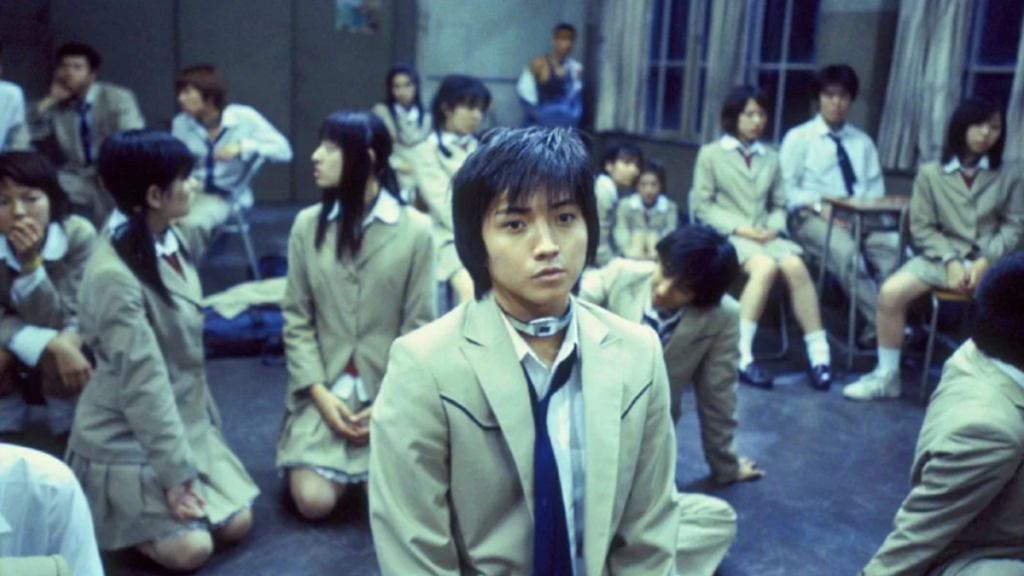
Kinji Fukasaku’s 2000 film Battle Royale was also inspired by a novel-turned-manga, written in 1999 by author Koushun Takami. It told the story of a group of Japanese students living in a dystopian future where Japan’s authoritarian government quells the upstart nature of youth culture by annually selecting a school class of kids to participate in a deathmatch. Named “Battle Royale,” the tournament is held on an island where the kids are fitted with hi-tech explosive collars, and forced through video game-style mechanics like collecting items and supplies, navigating traps and designated “danger zones” around the island, and anticipating the possible “strategies” of classmates who eagerly embrace (or not) the opportunity to settle teenaged grudges in the most violent, lawless ways possible. In the end, a group of protagonists survives long enough to turn the tables on the government and become symbols of youthful rebellion.
Obviously, from those synopses, there are several franchises that can be rightly cited as being newer adaptations of Battle Royale‘s concept. Author Suzanne Collins’ The Hunger Games book series (turned film franchise) may never beat allegations of being a Battle Royale ripoff; many saw Netflix‘s Squid Game as a Korean-language and adult-aged flip on the concept. Last Samurai Standing clearly looks like the next rung in that same ladder of building idea concepts upon older idea concepts – but does that make it a “rip-off” or lessen the quality of Last Samurai Standing as an enjoyable show?
Consider this, perhaps: Not every fan may know that Battle Royale writer Koushun Takami has been very open about getting his own inspiration for the story from a combination of pro-wrestling theatrics, a fever-dream about school, gaming, and the Stephen King short story The Long Walk. Just before The Last Samurai dropped on Netflix, King’s The Long Walk got a new movie adaptation, directed by Francis Lawrence, the filmmaker who has been overseeing The Hunger Games film franchise since the 2013 film Catching Fire (including his second prequel film, Sunrise on the Reaping, which will drop in theaters in 2026). So if Francis Lawrence isn’t out here complaining about the circular nature of ideas, or concept theft amongst authors, who really should be?
If anything, being able to tell potential fans that Last Samurai Standing is “Battle Royale (or The Hunger Games) with samurai and ninja,” is a perfect elevator pitch, in our opinion. How about you? Are you watching Last Samurai Standing? Have any issues with Battle Royale clones? Let us know your thoughts on the ComicBook Forum!
More TV Shows
-

Image Courtesy of Lucasfilm -
IMAGE COURTESY OF MARVEL TV -
Image Courtesy of Netflix -

Prime Video & United Artists