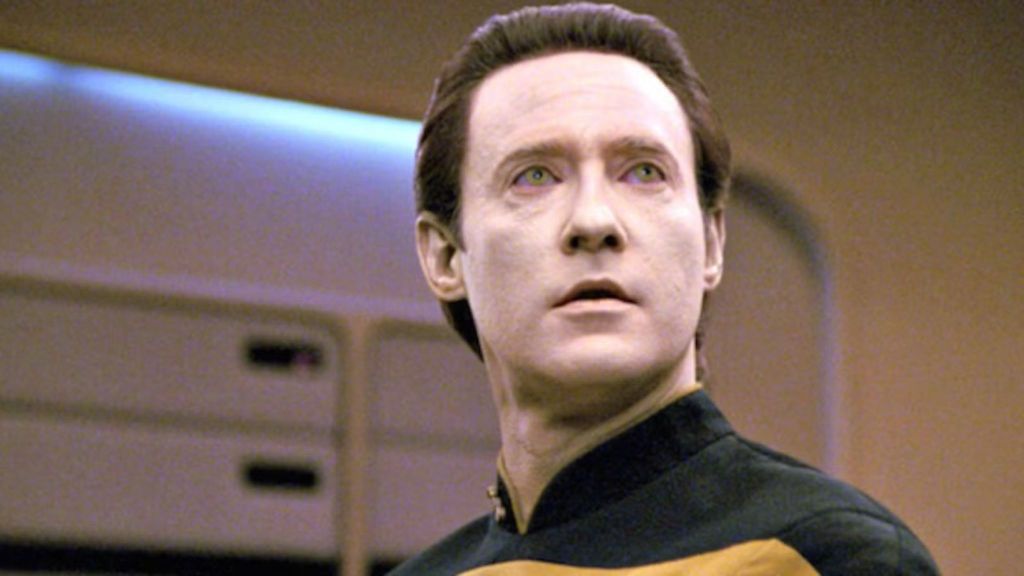
Star Trek always promised to boldly go where no series has gone before, and not only has it taken us to strange new worlds, but no two Trek series have ever been quite the same – each new generation brings us something fresh. Yet despite the constant reinvention, there’s one familiar character that crops up time and again, whatever the star date. No, we’re not talking a ship or computer or immortal Q. From Spock’s struggle with Vulcan logic vs human emotion, to Data’s quest to prove himself more than a machine, for years, Star Trek has relied on one familiar anchor character: the ‘outsider’ who just wants to better understand humanity, and in doing so, be accepted.
Videos by ComicBook.com
Ironically, these characters are often the most memorable, iconic, and beloved by fans precisely because they don’t fit the mold, and the latest addition to the duty roster is no exception. She’s loud, she’s loquacious, and above all, lovable. She is Series Acclimation Mil — better known as SAM — and judging by what Starfleet Academy has revealed so far, she’s far from just another cadet.

Star Trek’s Most Reliable Archetype
Like Data, Spock, and Seven of Nine, and even Odo before her, SAM is someone who doesn’t quite fit at first glance. She’s a little… much, to begin with – even the EMH himself seems to have met his match with this excitable young protégé, despite their similarities. That’s because SAM is a Kasqian photonic (holographic) lifeform, created specifically to integrate with organic life. She’s insatiably curious about everyone and everything and desperate to connect with her peers, but first, she’s got a lot to learn.
It’s no accident that some of Star Trek’s most enduring characters fit this mold of a relative ‘outsider’ looking in. Not only do these characters speak straight to the misfit in all of us, but they have a way of making us reflect on what it really means to be human. Spock wasn’t just a token alien crewmember thrown in the mix; he was a living embodiment of questions about logic, emotion, and identity. Data wasn’t just a classic robot; he was a mirror held up to humanity’s assumptions about life, personhood, and morality. The EMH, Seven of Nine, and others all explored variations on that same theme: what defines a person, and who gets to decide?
These characters were central to Star Trek’s philosophical outlook. By giving audiences a character who literally does not understand human behavior, the franchise created a built-in vehicle to explore everything from love and humor to ethics and free will. Data asked why humans laugh, and Spock questioned the logic of grief. Star Trek was inviting viewers to really examine themselves and question the truth of the world around them.

Why Starfleet Academy Is the Perfect Setting For SAM’s Journey

Rather than being designed primarily as a problem-solver like Data or a medical expert like her Forbearer, the EMH, SAM was created specifically to learn how to live among people.
You have to feel for the girl; whoever created her apparently decided that someone programmed to feel like a “typical” 17-year-old, but who in reality has only been around four months, would be the best placed to do that. What could possibly go wrong…? Unlike Data, who at least had pre-programmed operational skills, or Spock, who grew up navigating two cultures, SAM is pretty much new to everything. Played expertly by Kerrice Brooks, you can’t help but warm to her instantly. With her indomitable spirit and positive attitude, you immediately find yourself biting your lip at her failures and cheering on her small victories.
Starfleet Academy is a perfect setting to explore such a character. A school is where identities are forged. SAM is thrown headfirst into the awkward, emotionally volatile throws of adolescence, in a classroom with all its hidden rules and cliques. She isn’t just learning Starfleet protocols; she’s learning what it means to be young, dumb, and surrounded by peers who are just as anxious and occasionally judgmental. This setting also allows Star Trek to revisit old questions in a fresh context. How does Starfleet treat its new photonic members? Does SAM get the same leeway to fail, to rebel, or to change her mind as other cadets?
Those tensions echo classic Data episodes, but are shown through a fresh coming-of-age lens. Instead of a courtroom deciding SAM’s rights, the show can explore those issues through friendships, rivalries, and mistakes — the messy, human stuff that Star Trek has always thrived on. If Data emerged as a fully formed adult trying to understand humanity from the outside, SAM is something closer to a child trying to navigate the complexities of growing up and finding oneself, without necessarily having all the right tools and support to do it.

What SAM Being The “New Data” Means for Star Trek in 2026

What makes SAM feel like a worthy successor to those that came before her is how Starfleet Academy reframes the archetype. Data’s journey was often about changing or adapting; he wanted to become more human. SAM’s story seems to be about accepting herself and finding her place. She is already designed to be human, but that raises the question: if a being is programmed to feel human, are those feelings any less real?
This is a very 21st-centuryTrek problem. SAM isn’t striving to feel or not feel emotions; Her challenge isn’t acquiring humanity, but understanding her unique version of it. In that sense, SAM feels like an evolution of decades of Star Trek storytelling. The franchise has already argued that artificial life can be sentient and should be valued, but what happens once said artificial life goes out and takes its place in the world?
Of course, SAM is much more than just “Data’s replacement,” but every generation of the franchise introduces its own unique version of the character who asks the tough questions. In 2026, those questions are less about whether machines can be human and more about what humanity even means in a world of artificial intelligence, and blurred boundaries between organic and synthetic life. SAM embodies those anxieties and possibilities in a way that feels both classic and timely.
If Starfleet Academy succeeds, it will undoubtedly be in part due to Kerrice Brooks and her portrayal of SAM. Not only is she arguably the most likable character on the show, but she’s carrying the torch for Leonard Nimoy and others, and carrying on the tradition of using an outsider’s eyes to examine humanity — not from a distance this time, but from the inside out.
What do you think? Leave a comment below and join the conversation now in the ComicBook Forum!
Most Viewed
-

Image Courtesy of Amazon MGM Studios -

Image courtesy of PerBlue -

Image courtesy of San Diego Studios