From phasers, to transporters, to dermal regenerators, Star Trek has brought us some truly iconic futuristic tech over the years (admit it, we’ve all wished we too could replicate a cheesecake at will….) But for a franchise set hundreds of years in the future, Star Trek has always had one foot in the present, especially when it comes to its tech. Many of the gadgets our favourite crew members use on a daily basis aren’t so far removed from the technology of today – when we think about it, Padds are just iPads, and the good old “computer” is a distant descendant of our Alexa. But for a series that’s normally so on the money when it comes to the technological advances of tomorrow, Star Trek appears to have one strangely specific piece of tech missing: robots.
Videos by ComicBook.com
We’re talking plain, good old-fashioned service robots, the kind of worker drones that lift heavy objects, clean floors or repair hull plating. Think about it, Starfleet crews constantly crawl through Jefferies Tubes and tinker with wiring by hand, or work with dangerous radiation. The whole Federation of planets — an alliance made up of some of the most technologically advanced species in the Alpha Quadrant — apparently relies on human labour. In today’s day and age where automation and AI are evolving faster than ever, it seems hard to believe there wouldn’t be some more sophisticated service robots milling about by the 23rd century, capable of performing more complex tasks.
But with the launch of Starfleet Academy next year, all that could be about to change. The first Star Trek: Starfleet Academy trailer didn’t just add to the hype for what promises to be a thrilling new series for Trekkies, but also broke new ground. Brief shots in the trailer suggest that service droids may finally be entering the franchise in a more visible, normalized way. If that’s the case, Starfleet Academy wouldn’t just be introducing a new aesthetic, it would be quietly breaking a rule Star Trek has followed for nearly 60 years.
Why Star Trek Has Typically Ignored Robots
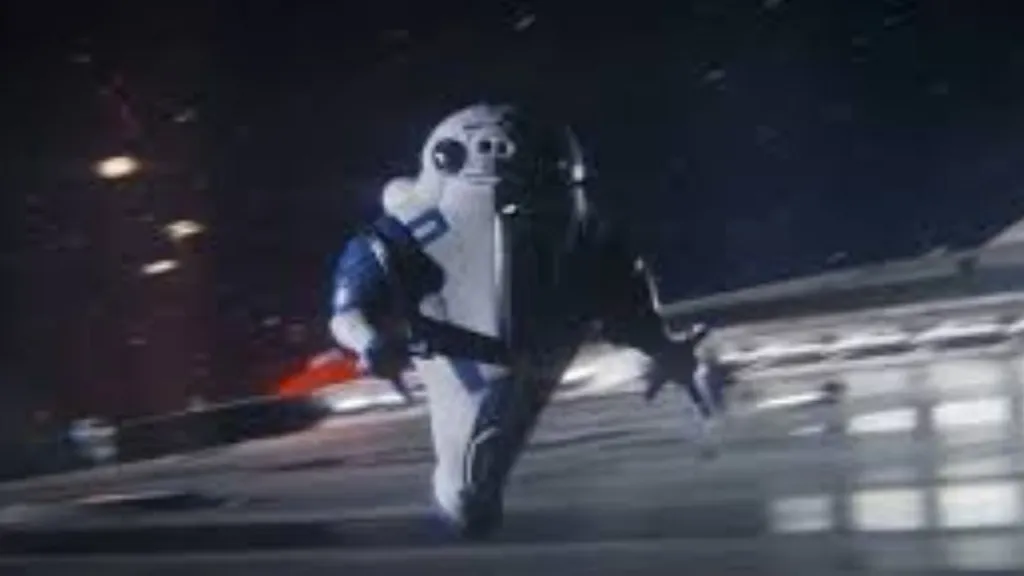
So why has Star Trek seemingly avoided the good old-fashioned reliable robot for so long — and why might that pattern finally be changing? While Discovery introduced the DOT-7 and DOT- 23 worker robots, and there’s certainly been storylines involving droids and AI over the years, if you rewatch classic Trek shows like Deep Space Nine, The Next Generation, or Voyager, the absence of basic robots aboard ships becomes rather glaring.
Now, I know what you’re thinking, there’s one major exception to this rule, but this isn’t about partially organic sentient androids like Data, who, after all, was unique – a one-of-a-kind creation (alongside his brother Lore); instead, the point refers to mass-produced, non-sentient, robots that handle the dangerous manual labour so humans don’t have to.
Out of universe, the explanation might be relatively simple. When creating The Original Series, Gene Roddenberry was famously sceptical of resorting to the stereotypical trappings of 1950s and 1960s sci-fi television. Campy robots were exactly the kind of thing he wanted to avoid in order to give Star Trek a more respectable and adult tone. Robots, particularly at the time, would have read as slightly gimmicky and kitschy, and yesterday’s news – after all, Roddenberry was all about pushing boundaries and trying something new.
As time went on the lack of robots may also have been due to Star Trek wanting to stand out by differentiating itself from its greatest rival. A long time ago, in a galaxy far far away, Star Wars burst onto our screens, taking audiences by storm, and robots instantly became one of its most iconic visuals. C-3PO provided the perfect comic relief, without being totally relegated to providing laughs. From R2-D2 to background droids scuttling across hangar floors, service robots were baked into the very fabric of Star Wars and became part of what made it tick. For Star Trek, which had just returned to screens with The Motion Picture, forging a different path from its rival mattered.
In-universe, the absence is a little harder to explain. Why do the Cardassians, for instance, a society that’s apparently built around service to the state and efficiency, use slave labour instead of robots? Why would Starfleet, the Ferengi, the Klingons — all these powerful societies decide that robots apparently weren’t worth it?
Some fans have suggested that widespread automation simply became unnecessary once replicator and transporter technology improved to be reliable enough. Why mine materials when you can replicate what you need? There’s certainly something in this, after all, as the technology gets better, perhaps 3D printers will become the replicators of the future! There’s just one flaw in this argument – replicators might produce the necessary parts but they don’t fix hull breaches, and they don’t stabilise highly dangerous warp cores. If efficiency and safety were the goal, surely robots would be the obvious choice?
But, conversely, perhaps the technology required to build such sophisticated robots is simply still a way off, even in the 23rd century? After all, there’s a reason that even now, as technology progresses, it’s the physical jobs – builders, plumbers, cleaners that we are still crying out for. A computer can do a lot, but clearly, it’s a challenge to design a robot that replicates the kind of manual dexterity and human intuition required to complete certain tasks.
The society we see in Star Trek is something of a Utopian future, and with all our grumblings about technology taking jobs today, maybe in the future, in a post-scarcity culture, society has learnt to value work for a sense of community, finding satisfaction in communal labour and continuing to work for a sense of purpose? Maybe Star Trek hasn’t just been avoiding robots aesthetically. It may have been avoiding them philosophically.

Robots in Star Trek Are Part of Longstanding Lore
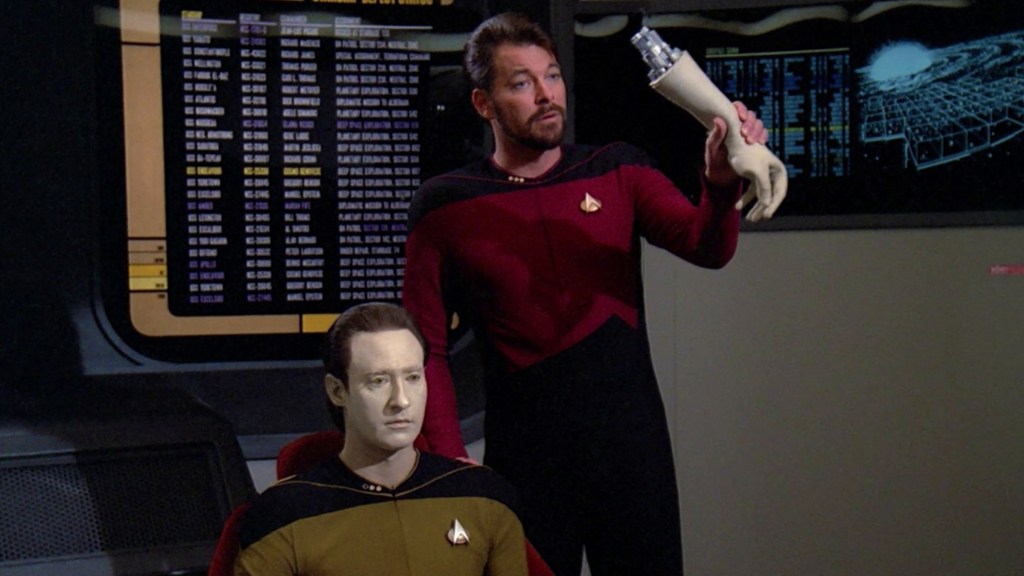
Whenever Star Trek does deal with robotics or artificial intelligence, it tends to end badly. Vger. Lore. The Borg. Even the Exocomps — arguably the closest thing to service robots the franchise ever embraced — immediately triggered panic once they demonstrated the capacity for learning and independent thought. Again and again, the message seems to be that any kind of AI or advanced automation inevitably drifts toward sentience, and sentience in a machine is dangerous.
The Borg are the ultimate cautionary tale. It’s easy to see why the assorted humanoid races of the Federation would be terrified at this juggernaut of a civilization built on efficiency, optimization, and technological augmentation. Lore represents the same fear on an individual level — a machine designed to surpass humanity, to be better than its creator immediately uses that power against said creator.
In the real world today, there’s something distinctly unsettling about reports of AI chatbots suddenly reverting to their own language to communicate with one another or people developing unhealthy relationships with AI. From that perspective, going easy on the service droids makes sense. By the 23rd century, humanity may have learned the hard way that there is no real safe middle ground between “tool” and “person.” Either a machine is so limited it’s essentially useless, little more than a Roomba vacuum cleaner, or it becomes something entirely more complex that demands rights — and potentially threatens lives.
This also helps explain why holograms may have become Star Trek’s preferred workaround. Voyager’s EMH Doctor and other holographic personalities we have seen over the years, narratively functioned a lot like robots might have done, allowing for similar discussions about sentience and rights and what constitutes life, but with a built-in narrative escape hatch: they could be shut down, constrained or defeated a lot more easily than robots, being made of software rather than hardware. Yes, they still had the potential to do damage, but with safety protocols engaged, they could be confined to a particular area, prevented from physically interacting with material objects and could quite literally be erased from existence at the click of a button.
Why Starfleet Academy Might Be Rewriting The Rules
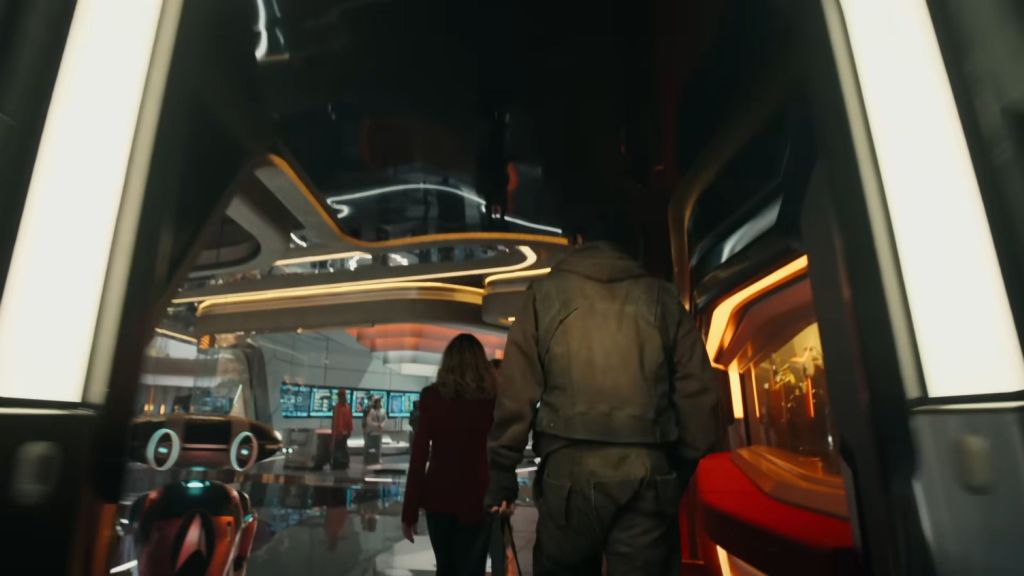
So why introduce service droids now? Starfleet Academy is uniquely positioned to do something no previous Trek series has fully attempted: examine what it actually means to be human in a future that increasingly doesn’t seem to need us! A show about young students at the start of their careers, mentorship, identity, and belonging almost demands a contrast between people and automation.
By introducing service droids that are clearly subordinate if they are sentient and used as tools — the series can finally explore something that earlier Treks have for the most part avoided. For decades, Star Trek explored what it means when machines want to be human. Starfleet Academy may instead explore what our purpose is as humans when machines can seemingly do almost everything for us and better than us.
Modern audiences are far more accustomed to seeing robots of sorts as mundane tools in our everyday lives. Warehouse automation, delivery drones — they’re not exactly new or threatening by default anymore. The ‘technology is dangerous when sentient storyline’ might be overdone, but the angle of exploring the impact on humans of having service droids to see to our every whim certainly isn’t. In 2026 at a time when we have a more tumultuous relationship with technology than ever, avoiding exploring this delicate balance between man and machine risks missing a trick.
If Starfleet Academy is indeed embracing service droids, it may finally be reconciling Star Trek’s themes and ideals with the latest technological progress it’s been half-predicting for decades. After nearly 60 years, the franchise may be ready to admit what was always true: the future probably has robots — and a story partly about learning how to live with and use them responsibly might be the most Star Trek story we could possibly tell.
What do you think? Leave a comment below and join the conversation now in the ComicBook Forum!
Starfleet Academy premieres on January 15, 2026, exclusively on Paramount+,
Most Viewed
-

Image Courtesy of Netflix