Bringing a sci-fi story from page to screen often comes with challenges, as the concepts and technology outlined in the original story aren’t always easy to convey. And with any genre, book adaptations tend to get a bad rap, the assumption being that they’ll prove inferior to their source material. There are a few sci-fi series that manage to improve upon the books, however, enhancing the experience by bringing it to a new medium.
Videos by ComicBook.com
In many cases, such adaptations take books that are on the shorter end — or masterful sci-fi standalones — and infuse them with greater depth. Depending on how long it runs, a TV show can expand on characters and storylines that standalone novels and shorter series won’t necessarily get a chance to. They can also give certain themes the layers of complexity they deserve. From The CW’s adaptation of a post-apocalyptic YA series to a show that’s only slightly better than its books, these sci-fi hits are proof the book isn’t always better.
5) The 100

The 100‘s last two seasons may have soured fans on the CW series, but it’s still leagues ahead of the books it’s based on. (Considering how different the two versions of the story are, it’s worth noting it’s loosely based on Kass Morgan’s YA series.) The premise of The 100 — a group juvenile delinquents being sent to Earth, years after a nuclear apocalypse, to see if its habitable — is pulled straight from Morgan’s pages. However, The 100 TV show offers a much lengthier, more in-depth take on this concept. It fleshes out the characters and storylines more, adds new ones, and digs far deeper into the fight for survival. Like many YA dystopian series of the 2010s, The 100 books stay more focused on the dynamics between the teen characters instead.

4) Station Eleven

Station Eleven is a sci-fi masterpiece in book and TV form, but HBO’s adaptation manages to surpass Emily St. John Mandel’s novel — and that underscores how impressive it is. Both explore the aftermath of a pandemic with a focus on holding onto what truly matters. Yet the emotional elements of the TV series land a bit better, as the adaptation is able to flesh out the characters more thoroughly. The conclusion of the TV series also proves a tad more satisfying, though the source material remains well worth a read. Station Eleven works well in both forms, but the show successfully improves upon the book.
3) The Handmaid’s Tale
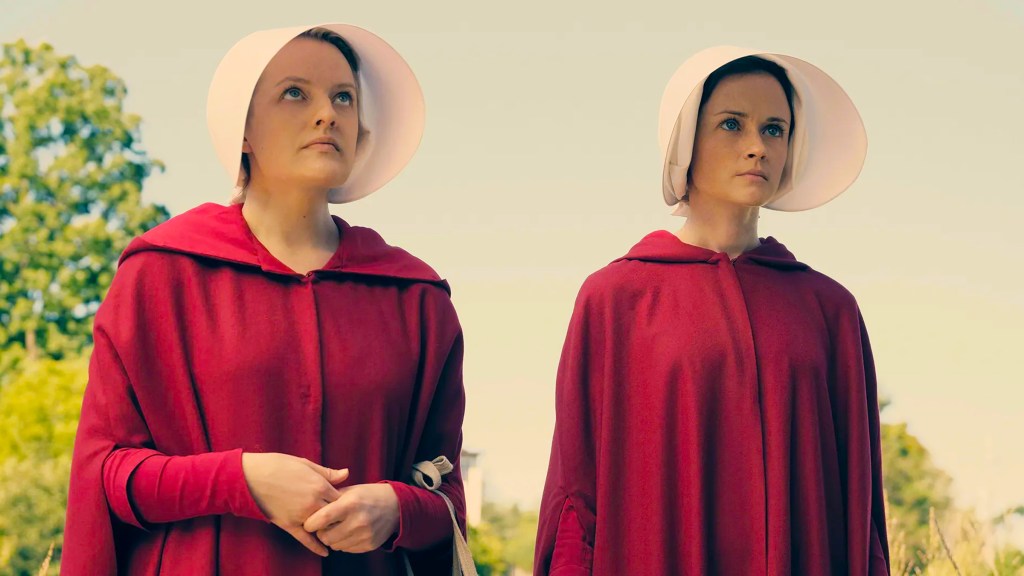
The Handmaid’s Tale is a modern classic, but Margaret Atwood’s novel checks in at a little over 300 pages. By contrast, its Hulu adaptation unravels over the course of six seasons. That gives The Handmaid’s Tale show a lot more time to expand on Atwood’s world and characters. It also enables it to dig into the pushback against Gilead and all the complexities that accompany it. The result is a dystopian series that’s able to spark more conversations and get viewers much more emotionally invested. Like with Station Eleven, the book is incredible in its own right. It just leaves a lot up in the air, something the TV series doesn’t do. Its heavier focus on rebellion also pays off the journey a bit better.
2) The Man in the High Castle

Similar to The Handmaid’s Tale, Prime Video’s The Man in the High Castle takes a relatively short book and turns it into a multi-season series. By doing this, the adaptation brings Philip K. Dick’s novel to new heights. It keeps the premise — reimagining the world if if the Axis powers won World War II — but takes a much more thorough approach to it. The show’s exploration of the aftermath digs more deeply into the politics, casting a wider net setting-wise and unfolding over a longer period of time. As a result, it also has more time for action and character work, and it one-ups the novel on both fronts.
1) The Expanse

This might be a controversial take, as The Expanse books and TV show are different experiences — both of which are fully worthwhile. (As the show doesn’t cover the series to the end, there’s an incentive to check out both.) The show maintains the most important bits of the books, but it alters how its story unfolds. On the bright side, it’s the type of adaptation that knows precisely what to keep and what to cut. The timeline changes improve the story in this new medium, and The Expanse‘s action is understandably better on-screen. There are details of the books that only they can excel at, so it’s an extremely close call. With the author duo that makes up James S.A. Corey being involved in the series, it’s no surprise it’s at least as great as the source material. In a lot of ways, it does top it by expanding on certain things, but it still shouldn’t be viewed as a replacement.
What’s a sci-fi show that you think is better than the book(s) it’s based on? Leave a comment below and join the conversation now in the ComicBook Forum!
More TV Shows
-

Courtesy of 20th Television Animation