For fans of sci-fi, we live in interesting times. Genre staples, like the rise of machines and artificial intelligence, is rapidly become reality with AI becoming integrated more and more into nearly every aspect of life by the day. It’s something that’s led to some wildly divergent opinions about how this sort of fiction becoming fact will impact humanity — and there are plenty who feel like it will spell our doom. The idea of a full AI takeover is something that is finding its way into entertainment as well and now, Image Comics’ upcoming If Destruction Be Our Lot is looking at what the world will look like should that become our reality, and it’s bleak.
Videos by ComicBook.com
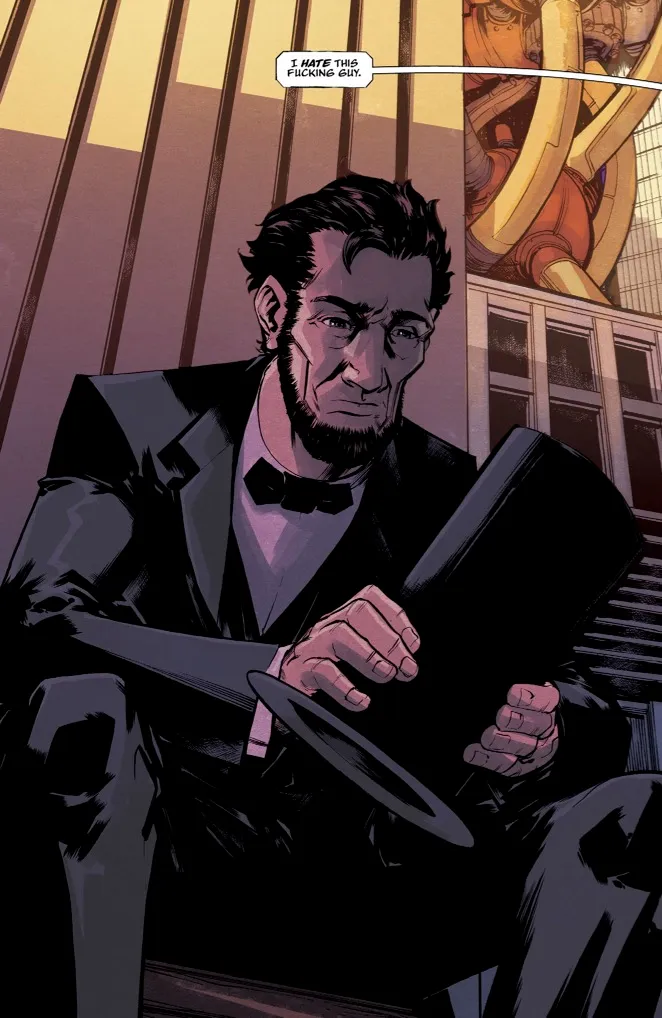
Written by Mark Elijah Rosenberg (Approaching the Unknown, Year Million) and Matthew Rosenberg (We’re Taking Everyone Down With Us) with art by Andy Macdonald (Doctor Strange, Wonder Woman), If Destruction Be Our Lot takes us into a future where humanity is extinct and all that is left are the robots who once helped them. But while the robots are happier now, there’s one, Abe, who is not. Feeling like there must be something more out there, after he’s nearly killed Abe is determined to wander the Earth until he finds what he’s looking for — or gets recycled trying. ComicBook as an exclusive Q&A with Matthew Rosenberg about the upcoming series, breaking down everything you want to know about this dark future and why an Abraham Lincoln quote made for a perfect title for the series.
If Destruction Be Our Lot May Be a Dark Future, But It’s Also a Story of Hope
If Destruction Be Our Lot is an extra length issue that covers a lot of ground. We’re introduced to a completely robot-run future where humanity is a relic of the past. Feels like this hits a little too close to home—especially now during the rise of AI and self-driving delivery trucks/cars already zipping around major cities. Are you predicting a dark future for us, Matt?
Matthew Rosenberg: Honestly we’re in a pretty dark present right now, so I’m not sure how much of a prediction that is. But in a lot of ways the book is about cutting through that darkness. We start in a place of loneliness, decay, and the extinction of humanity, and all that less than great stuff. But as the story progresses it deals with the importance of holding onto hope, and fighting for a better world, and trying to reach out into the unknown and find something in common with a stranger. The thing we keep going back to is that this is a story about trying to find a friend. It may sound small and trite in some ways, but our connections are at the core of who we are as people and we think it’s important to tell stories that celebrate that.
On the one hand you’ve got this incredibly technologically advanced society, but on the other hand your main character is a robotic replica of an icon from our past. Why such a striking past/future contrast between character and setting?
The best science fiction looks forward as much as it looks back but maybe we just were a little more literal with that here. Originally the animatronic Abraham Lincoln wandering the globe at the end of the world was just something that I got stuck in my head one day and couldn’t shake. Here you have this historical figure who has become this larger-than-life icon representing compassion, leadership, perseverance, and just generally personifies this idea of the American spirit in so many ways. He’s the face on Rushmore; he’s the man in the monument. But he’s also this folksy sort of hero, famous for his kindness and his quirks. And then you have this version of him, brought back to life through state-of-the-art technology (at the time), and you get this awkward contrast. The legend made real, but somehow not real at all. Through him you begin to see these cracks in the seams which often happens when we look too close at our history. We memorialize him and honor him, but do we carry on the ideas that he championed? Having this anachronistic robot in an apocalyptic future who represents a better past in a sort of cartoonish way, was something that really felt like it could bring us to really fun places. From there it all started to spin out in a lot of fun and unexpected ways. Thinking about what the real Lincoln represents, what this replica of him represents, and what it means to be a fake man from the past who is lost in the future, all of that just felt like fertile ground to tell stories that are both huge in scale and deeply intimate. Also, it’s an excuse to have Robot Lincoln arguing with a toaster.
What is the relevance of Abe’s speech/why did you decide to title the whole series after a quote from it?
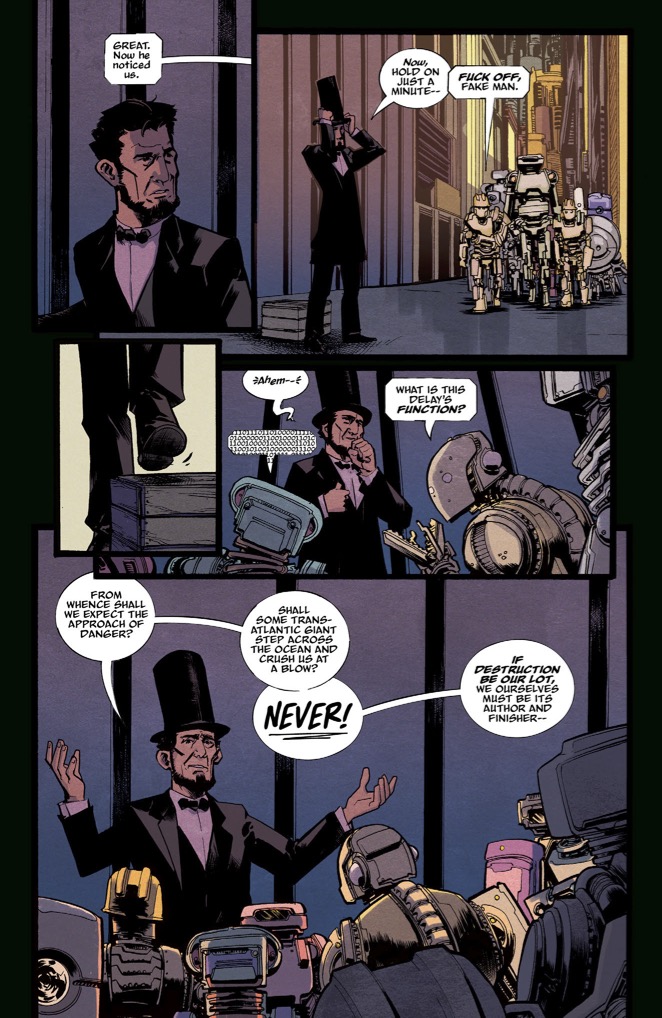
The Perpetuation of our Political Institutions, better known as Lincoln’s Lyceum Address, is one of his earliest known speeches. He was 28 years old when he delivered it and it set the stage for him to become not only a major political force but among the greatest orators in our nation’s history. So, for that reason alone it’s worth stealing from. But actually, the speech is incredibly powerful and prescient. Both an ode to the exceptional nature of America and a dire warning about its collapse. Lincoln warns about tyrants rising to power and the duty of all citizens to stay vigilant against them. It is the kind of speech you read now and it can give you chills. There is real beauty in the way he sees the United States and the individual’s role in it. “Shall we expect some transatlantic military giant, to step the Ocean, and crush us at a blow? Never! All the armies of Europe, Asia and Africa combined… could not by force, take a drink from the Ohio, “ he says. “If destruction be our lot, we must ourselves be its author and finisher. As a nation of freemen, we must live through all time or die by suicide.”
It is both one of the most chilling warnings about the fragile nature of democracy and among the most powerful pleas for its defense. But, and I can only assume that this is what he intended, it is also one of the most badass lines you could ever use for your post-apocalyptic comic book series.
This isn’t the first humanized robot you’ve introduced us to—you had a robot body guard in We’re Taking Everyone Down with Us—nor is the first time we’re traversing the ruins of America—you explored a dystopian future in What’s the Furthest Place from Here?. How did those two previous series lead us to If Destruction be Our Lot?
Yeah, I probably have to talk about that. When I write a series I spend a lot of time really letting the settings and themes take over my head in a questionably healthy way. I can’t speak for other writers on this, but I sort of live in these books for a long while. And what happens is I come out the other side realizing that I still have more to say about them than I originally thought. Sometimes it’s in a positive way, like I loved something that didn’t fit in the book and I want to play with it. Sometimes in a less positive way, like I no longer believe the points I was making. So, a lot of my work is in conversation with itself, for better or worse. Sometimes I’m exploring an idea further, sometimes I’m trying to understand it from a different point of view, sometimes I’m trying to contradict it. And so, Abe is the product of all that. If Da Vinci said “art is never finished, merely abandoned” I guess I have abandonment issues.
If Destruction Be Our Lot Has Creative Worldbuilding (And a Strong Creative Team Bringing It To Life)
Tell us about the creative team, we’re not familiar with Andy and Mark—how did you three sync up—and is Mark related to you?
This is one of those dream projects because I truly believe it is the kind of book that would not exist without all three of us. I’ve known Andy MacDonald for a long time. Years ago, I asked him to do a book with me because I loved his excellent NYC Mech series. He said no. But a few years later we teamed up to do a Multiple Man book at Marvel together anyway. It was really weird and I think a lot of people didn’t really get it. I’m not sure we fully got it. But Andy and I both loved making it together so we kept talking about working together on stuff in the future. Since then, Andy has only gotten better and better and I feel so lucky that he didn’t bigshot me… again.
And Mark Rosenberg I’ve known even longer because he lived with my parents when I was born. Technically we actually share the same mother and father. I actually learned to read by stealing his comic books from his room when we were kids. Don’t tell him. But when the time came for our parents to assign us careers, he, being the eldest, was given the role of filmmaker. And I, being the not eldest, was assigned the role of comic creator. And while I spent years in the comic mines telling stories about mutants and batmen and writing rap comics, my brother was running a film festival, making amazing short films, and eventually writing and directing film and TV series like Approaching The Unknown and Year Million. He is someone who I have always turned to for guidance and inspiration in my work. He has one of the best minds for story of anyone I’ve ever met, so getting to make a book together has been a dream of mine for years. I think he likes doing it too.
Also, our amazing colorist Francesco Segala, our letterer Hassan Otsmane-Elhaou, and our editors Steve Foxe and Eric Harburn from Tiny Onion are all crucial to making this book what it is. I say with my whole chest that I believe they are among the best in their fields. Francesco’s work in issue #1 is stunning, rich and moody in the best ways. But issue #2 has some of the best colors I’ve ever seen in a comic. Full stop. And I never get tired of saying Hassan is the most innovative and exciting letterer in comics. As for Steve and Eric, they truly are the reason the whole book exists. It simply wouldn’t be here without them.
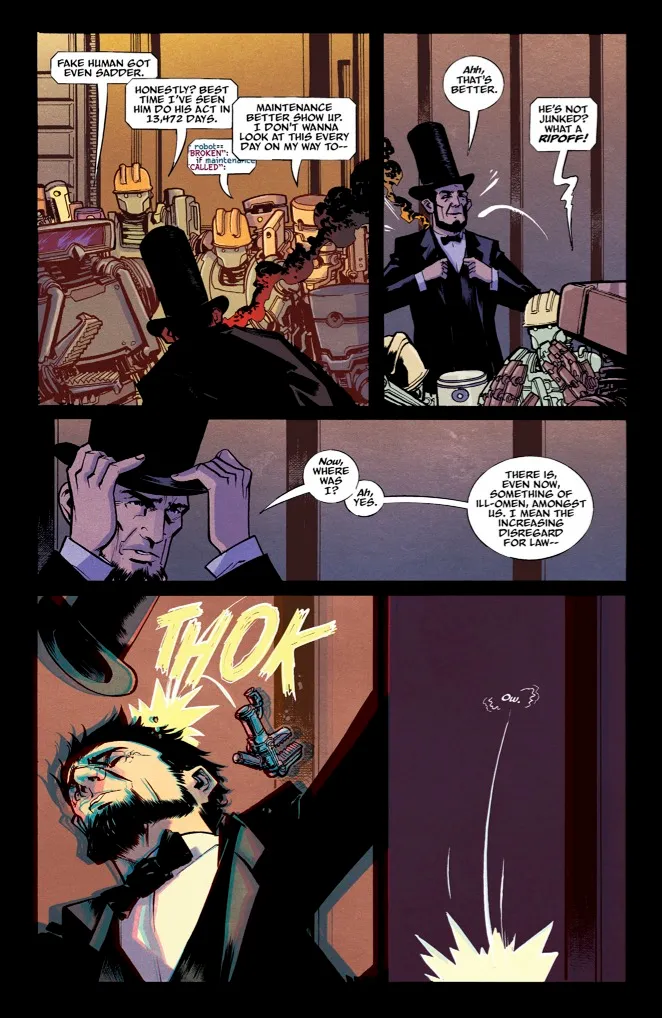
Something we loved about this first issue was how you could take these incredibly haunting ideas (like a robot reflecting on its last interaction with its humans) and imbue it with an element of whimsy just with some quirky dialog. How did the three of you hold that tension when you were creating this story? In less capable hands it could either be too bleak or come off as flippant!
I think a huge amount of credit really goes to Andy for that. I knew when Mark and I first started talking about this book that the acting of the characters was going to be so crucial. Finding a way to put humanity into the inhuman, to make us care about these robots, was going to determine if the book lived or died. And, to me, Andy was always the person who had to do it. He can do slapstick humor, he can do heartbreak, and he can do the always-difficult ennui. Just as importantly he can just make the odd feel normal and the normal feel odd. And all of that is at the heart of what we’re doing. From there Mark and I just spend a lot of time trying to really find that balance in our words. I’m a big believer in the idea that sad stories work best when they have some humor and vice versa. The climb in the rollercoaster makes the drop even better. We take the story that we’re telling very seriously, it is very important to us. But it’s weird and silly and we never lose sight of that too. It’s always a bit of a tightrope walk but all the stuff worth making is.
This first issue is cleverly packed with worldbuilding without getting bogged down with voiceover narration or exposition. In what creative ways did you use the comics medium to your advantage when trying to get the reader up-to-speed on everything they need to know in an installment like that?
The biggest thing we wanted to avoid were exposition dumps. I hate them. It immediately takes me out of the story. We use a bunch of techniques and little tricks to teach people about the world of If Destruction Be Our Lot and get them up to speed, but the biggest one by far is trust. We trust that if you tell a story that’s interesting and give a reader characters they’ll care about they will reward you with patience. So that’s what we’re doing. We are building things slowly, organically, and trust that readers will trust us to make everything clear when they need to know it.
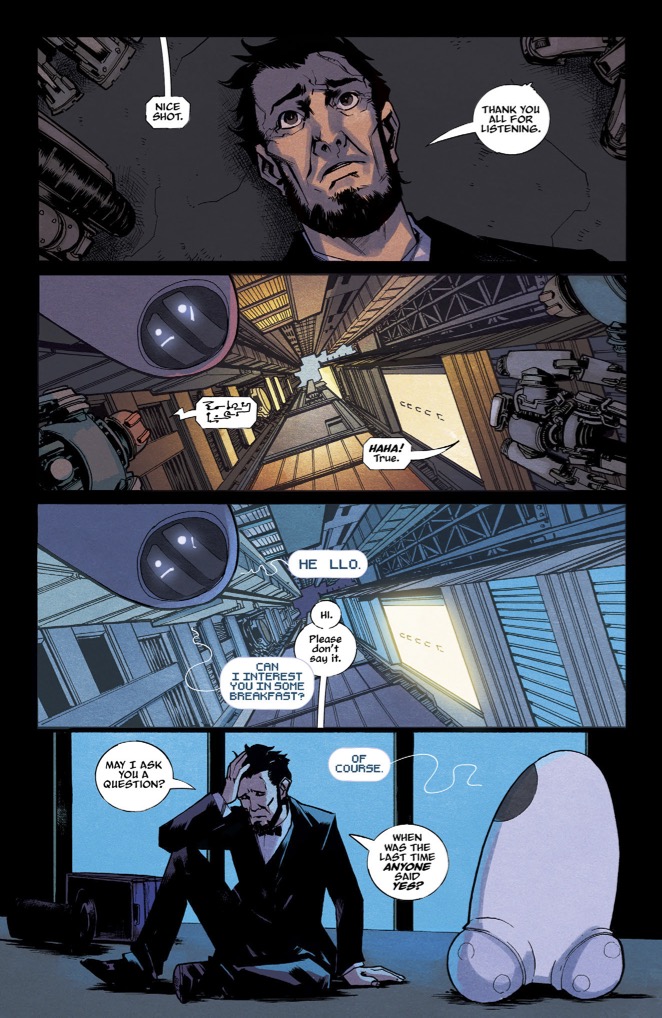
In a world where robots inherit the future and humans become myth, what human flaw do you think robots would accidentally preserve the longest—and did you choose to make that part of the story? Or fix it?
The correct answer is probably the reckless consumption of fossil fuels or the inability to adequately take preventative measures. But for our story its loneliness. And yeah, we got tons of lonely bots. So many.
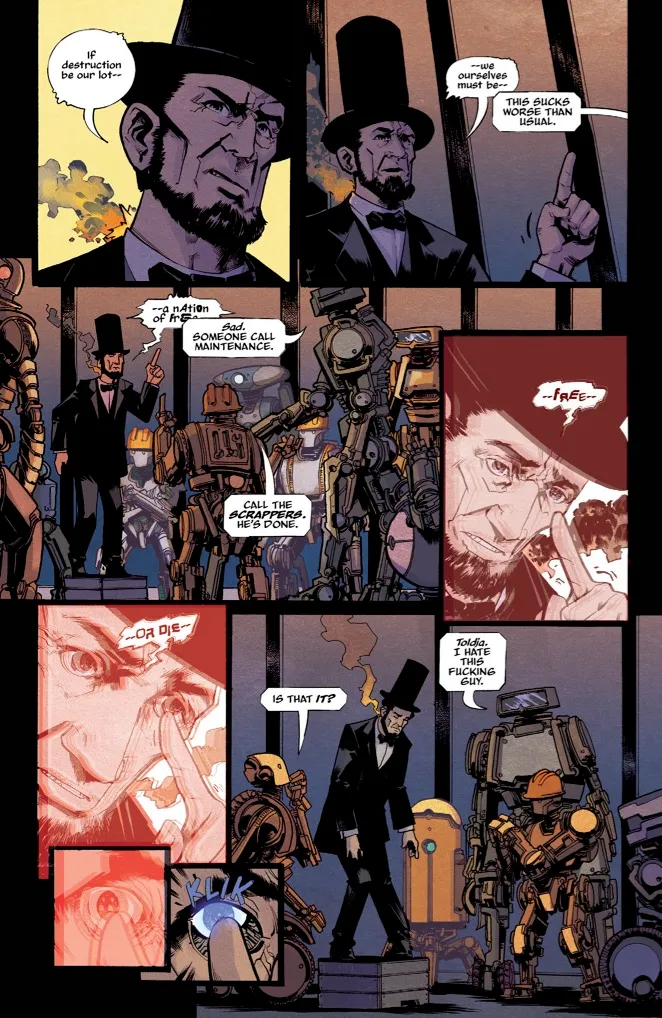
There are some great little details in this with the lettering that create personality for the robots (including cuss words displayed as an assortment of nuts and bolts)—how do you think details like this pay off in the long run?
Hassan Otsmane-Elhaou, who letters this book, and a sizable percentage of the best books going, is truly a master at knowing when to push the lettering to be a focal point and when to pull it back. Giving the robots their own “voices” is all I really hoped for, making some of them visually stand out from each other. But he did so much more, of course. A lot of it is creating not just a voice but a feeling and mood. The chaos of a noisy street, the disorientation of a car accident, the haunting feeling of hearing a voice when you think you’re alone. As the story progresses and we meet more characters those little details in the lettering will start to play an even bigger role in defining our world. I can’t say much more about it without spoiling things.
The big thing for all of us was to make a book that didn’t quite look like or feel like anything else out there and Hassan really took that note and ran with it. He really helped make it something very unique and I could not love it more.
If Destruction Be Our Lot #1 by Matthew Rosenberg, Mark Elijah Rosenberg, and Andy MacDonald with colors by Francesco Segala, and letters by Hassan Otsmane-Elhaou will be available from Image Comics on Wednesday, May 6, 2026.
What do you think? Leave a comment below and join the conversation now in the ComicBook Forum!
Most Viewed
-
Image Courtesy of Marvel Comics -
Image courtesy of Bandai Namco -

Image Courtesy of HIDIVE -

Image courtesy of Paramount Pictures