Star Trek: Deep Space Nine was a turning point for the entire franchise. Launching in 1993, this spinoff was very different to traditional Star Trek shows; it centered on a space station rather than a starship, meaning the various Deep Space Nine characters lived in a fixed context rather than facing new alien races every week. The result was much more serialized, and later seasons doubled down on this with the Dominion War.
Videos by ComicBook.com
This was also a time of technological change in the real world. Star Trek had always wrestled with budgetary constraints; Gene Roddenberry came up with transporters as a work-around so he didn’t have to use expensive shuttle models, and Voyager had to reuse models from The Next Generation. But advances in technology meant the Dominion War became a turning point for the entire franchise, when Deep Space Nine introduced the USS Defiant.
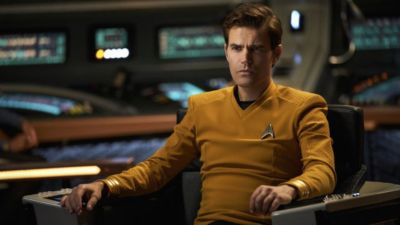
The USS Defiant Was a First For Star Trek – In Every Possible Way
In narrative terms, the USS Defiant – which finally made Sisko a captain – meant Deep Space Nine could depart the Bajor System. From an in-universe perspective, this was the first ever Federation warship; overgunned and overpowered, it had the teeth Sisko felt were needed to intimidate the Founders. Even more impressively, cooperation with Romulus meant the Defiant was the first Federation ship with a cloaking device. The Defiant had been created to wage war against the Borg, but design flaws meant the prototype was mothballed. Smaller and deadlier than any version of the Enterprise, the Defiant felt ground-breaking.
Behind the scenes, the ship’s compact, heavily armed design meant it was perfect for battle scenes. Although models were originally used, scripts often demanded maneuvers that were difficult to pull off with these, especially as the Dominion War plot escalated. The USS Defiant became the first full-fledged starship in the entire franchise to have a CGI model used in regular production, with the studio VisionArt also creating runabouts and Jem’Hadar vessels for these action scenes. The CGI Defiant was particularly noted for the episode “Starship Down,” where it battled a CGI Jem’Hadar ship.
Modern sci-fi – and, indeed, modern Star Trek – takes this kind of approach for granted. In 1995, though, it was ground-breaking. VisionArt worked closely with the studio over the next few years, with further Jem’Hadar battle cruisers and – on a smaller scale – CGI effects for when Odo changed shape. Ironically, the Deep Space Nine station itself largely remained a model, with CGI used on only a few occasions – including Deep Space Nine‘s final shot.
In terms of CGI, Deep Space Nine‘s greatest moment of technical wizardry really came in 1997, with the Season 6 episode “Sacrifice of Angels.” This featured a scene with the entire Starfleet fleet assembled, an almost impossible challenge for traditional modelwork – both in terms of the fine degree of motion control, and budgetary constraints. As supervisor Bruce Branit of Digital Muse explained (via Ex Astris Scientia), “They were talking about having fifty to a hundred Starfleet vessels on screen at one time, and there was no way to pull that off in traditional ways.” It was only possible with CGI, and Star Trek once again demonstrated that technology’s potential – boldly going where it had never gone before.
What do you think? Leave a comment below and join the conversation now in the ComicBook Forum!
More TV Shows
-

Courtesy of 20th Television Animation