For years now, Star Trek: Discovery‘s flagship has had a reputation: it’s the cheat code ship. With its spore drive, the USS Discovery could jump anywhere, anytime, effectively bypassing the traditional rules of space travel that had defined Star Trek for decades. That made it exciting, but it also made it a problem. When one ship can solve almost any crisis instantly, it risks draining tension from the story. Now, nearly a decade after Discovery debuted, Star Trek: Starfleet Academy may have finally found the perfect counterbalance: a galaxy-breaking superweapon that rewrites the rules entirely. And in doing so, Star Trek has quietly taken a page straight out of Star Wars.
Videos by ComicBook.com
In the first season of the now-canceled Starfleet Academy, the Federation faces a terrifying new threat: Omega 47. This volatile particle is obviously incredibly destructive, but its potential is on another level: it actively shreds space and subspace itself, making warp travel impossible across vast regions. The introduction of a super weapon is so familiar to sci-fi fans at this point that cynicism is inevitable (akin to Hollywood’s fascination with Earth-threatening sky beams), but like Star Wars’ use of them, they both reflect real-world fear and successfully level out even the most broken power hierarchies.
Omega 47 Is Star Trek’s Stormwall
George Lucas was always open about the political inspiration behind Star Wars – the Vietnam War and Nixon’s presidency – but the repeated use of super weapons (the Death Stars primarily, of course), reflected an even more ubiquitous fear: human scientific over-reach that comes at catastrophic cost. In the franchise, technology that renders people – even incredibly powerful people – vulnerable and powerless is a long-running trend. If Omega 47’s power sounds familiar, it’s because it closely mirrors the Stormwall from Star Wars: The High Republic: a massive defensive barrier used by the Nihil to seal off entire sectors of space. The Stormwall prevents ships from entering or exiting at hyperspace speeds, effectively carving out a region of the galaxy under total control.
Omega 47 does the same thing, just with a more destructive twist. Instead of a static barrier, it weaponizes the fabric of space itself. And the result is a Federation that suddenly finds itself boxed in, unable to move freely without risking catastrophic destruction. It’s one of the most radical shifts in Star Trek’s depiction of space travel in decades. Even though the Athena’s young crew neutralized the threat of the Omega 47 mines in the finale, for a brief moment there, it even nerfed Star Trek‘s cheat ship.
Star Trek’s Discovery Problem Finally Has an Answer
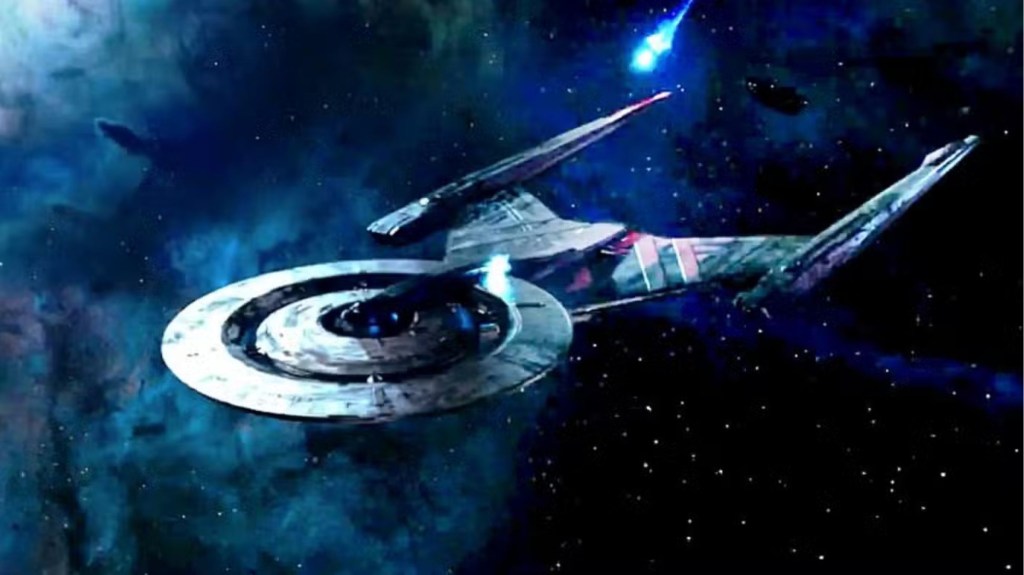
For years, the spore drive has sat awkwardly within Star Trek canon. Introduced in Discovery, it allows instantaneous travel via a mycelial network, bypassing warp entirely. It’s a brilliant concept, but, dramatically, it creates headaches. Why worry about distance when you can teleport across the galaxy? Omega 47 changes that equation, because the weapon doesn’t just interfere with warp – it destabilizes space itself. That means even unconventional travel methods like the spore drive may no longer be reliable. Suddenly, the USS Discovery isn’t the guaranteed solution it once was. For the first time, the franchise has introduced a threat that feels specifically designed to counter its most overpowered technology.
What makes Omega 47 so compelling is that it’s strategic. Like Star Wars‘ Stormwall, it allows a villain to control territory on a galactic scale. By surrounding Federation space with Omega-based mines, Nus Braka effectively creates a no-go zone, essentially perverting Star Trek‘s core storytelling message of exploration. You can’t boldly go or discover new worlds or expand horizons when Omega 47 flips that premise on its head by asking a different question: What happens when you can’t go anywhere at all? It’s a darker, more claustrophobic vision of the future and one that feels very in line with modern sci-fi trends.
Why Omega 47 (Briefly) Made Star Trek Better

There’s a reason the Stormwall worked so well in The High Republic: it forced the heroes to adapt. The Jedi couldn’t simply fly in and save the day. They had to rethink strategy, operate in isolation, and confront a galaxy that suddenly felt much larger and more dangerous. Omega 47 could have done the same for Star Trek. By limiting movement – even for ships like Discovery – it restores a sense of stakes that the franchise has occasionally struggled with in its more technologically advanced eras. And the Federation, for all its power, looked vulnerable again. And that’s particularly good because Star Trek has always been at its best when its ideals are tested. Not when victory is assured, but when it has to be earned. You might say superweapons are an overused trope in major sci-fi franchises, but when done well – even temporarily – they create a true sense of jeopardy that levels the playing field. George Lucas knew it, and now Star Trek has acknowledged it.
What do you think? Leave a comment below and join the conversation now in the ComicBook Forum!
Most Viewed
-

Image courtesy of Sony -

Image Courtesy of Netflix -
Lucasfilm Animation -

Image Courtesy of Shueisha